Showing posts with label Apologetics. Show all posts

Tuesday, July 21, 2009

Forthcoming: Christian Apologetics Past and Present: A Primary Source Reader

I often shy away from reading books on apologetics, but this one looks like the kind of book on the subject that I would enjoy reading. More than that, I can see this book (and the subsequent volumes) being useful reference tools for many years to come.

Christian Apologetics Past and Present: A Primary Source Reader (Volume 1, To 1500), edited by William Edgar and K. Scott Oliphint. Wheaton: Crossway Books, Forthcoming, 2009.

WILLIAM EDGAR (DTheol, University of Geneva) is professor of apologetics and coordinator of the apologetics department at Westminster Theological Seminary. His books include Reasons of the Heart, The Face of Truth, and Truth in All Its Glory.

K. SCOTT OLIPHINT (PhD, Westminster Theological Seminary) is professor of apologetics and systematic theology at Westminster Theological Seminary in Philadelphia. His books include Things That Cannot Be Shaken, Revelation and Reason, and Reasons for Faith.

Publisher's Description:

An unprecedented anthology of apologetics texts with selections from the first century AD through the Middle Ages. Includes introductory material, timelines, maps, footnotes, and discussion questions.

The apostle Peter tells us always to be ready to give a defense to anyone who asks us to account for our hope as Christians (1 Peter 3:15). While the gospel message remains the same, such arguments will look different from one age to another.

In the midst of a recent revival in the field of apologetics, few things could be more useful than an acquaintance with some of these arguments for the Christian belief through the ages. This first of two proposed volumes features primary source documents from the time of the early church (100-400) and the Middle Ages (400-1500). Featured apologists include Aristides, Justin Martyr, Irenaeus, Tertullian, Origen, Athanasius, Augustine, Anselm, and Thomas Aquinas.

The authors provide a preface to each major historical section, with a timeline and a map, then an introduction to each apologist. Each primary source text is followed by questions for reflection or discussion purposes.

$39.00 Hardcover
Available Sep 30, 2009

ISBN
: 1581349068 / 9781581349061
Size
: 6 x 9 inches
Pages: 512


Share/Bookmark

Wednesday, July 1, 2009

New from B&H Academic: Tough-Minded Christianity: Honoring the Legacy of John Warwick Montgomery

A couple of days ago I received the following very large book in the mail courtesy of Jim Baird at B&H Academic:

Tough-Minded Christianity: Honoring the Legacy of John Warwick Montgomery, edited by William Dembski and Thomas Schirrmacher (Foreword by Paige Patterson). Nashville, TN: B&H Academic, 2009. 800 pages.


I must admit that I am not at all familiar with John Warwick Montgomery (JWM personal website), but I'm convinced that this book should give me an excellent introduction to a man that appears to have been highly influential among conservative evangelicals. A quick survey of the Table of Contents noting the chapter titles and the names of the contributors, has lead me to believe that this just might be an important volume for those studying modern apologetics. This is no less than a massive anthology of essays from a particularly conservative, evangelical perspective collected in honor of Montgomery.

Yesterday evening I spent some time reading and browsing through this massive tome. Having been planned and produced by a Southern Baptist publisher, it is fitting that one of the SBC's highly conservative leaders, Paige Patterson, was asked to write the forward and explain some Montgomery's impact on the denomination. Montgomery was a Lutheran and many of the contributors to this volume are also non-SBC members which makes this volume even more fascinating to me. A couple contributors not mentioned below that caught my eye are Harold O. J. Brown, Roger Nicole, I. Howard Johnson, Edwin Yamauchi, Michael Horton, and Robert Culver.

From the Publisher:

Tough Minded Christianity is a collection of essays about the great work of John Warwick Montgomery (1931), a living legend in the field of Christian apologetics who has earned eleven degrees in philosophy, theology, law, and librarianship, debated historic atheists including Madalyn Murray O’Hair, and influenced the work of bestselling authors such as Josh McDowell.

Contributors to this volume include J. I. Packer, Ravi Zacharias, John Ankerberg, Erwin Lutzer, Vernon Grounds, Gary Habermas, and among others Paige
Patterson who writes in the foreword that John Warwick Montgomery did the “intellectual heavy lifting” that undergirded the conservative renewal of the Southern Baptist Convention.

Download a Sample Chapter | Download the Table of Contents


ISBN: 9780805447835

Trim Size: 9.00 x 6.00 x 1.65 in

Weight: 2.10lb
Binding: Trade Paper
Publication Date: March 2009


Share/Bookmark

Thursday, July 24, 2008

Book Review: New Dictionary of Christian Apologetics

The following book review was submitted by Dr. Paul Martin Henebury of Veritas School of Theology and is being simulposted here and at SharperIron.org.

__________

McGrath, Gavin, Walter Campbell Campbell-Jack and C. Stephen Evans, eds. New Dictionary of Christian Apologetics. Leicester, England: Inter-Varsity Press; Downers Grove, Ill.: InterVarsity Press, 2006. cloth, xx + 779 pages. $45.00

Purchase: IVP | WTS ($27.45) | CBD ($32.99) | Amazon ($32.85)

ISBNs: 0830824510 / 9780830824519 / 1844740935 / 9781844740932

Subject: Apologetics

When Norman Geisler published his Encyclopedia of Christian Apologetics in 1999 he provided the Christian community with a helpful, if slanted reference book on the defense of the faith. Like the Catholic Handbook by Kreeft and Tacelli, it reflected a heavily Thomistic approach. This offering from the UK, produced by IVP and including articles by many contributors, reflects a more diversified approach.

The choice of articles is on the whole excellent. It appears that a lot of thought has gone into the selection. We find good coverage of such pertinent topics as “Advertising,” “Authority,” “Critical Realism,” “Foundationalism,” “Globalization,” and “Islam.” Included also are many cameos of important thinkers (e.g. Augustine, Barth, Dooyeweerd, Henry, Lewis, Newbigin, Wittgenstein) that support the formal entries.

The dictionary is divided into two parts; the first fifty pages being given over to six essays on the history, role and relevance of the discipline. These essays range from the excellent (K. Vanhoozer on “Theology and Apologetics”), to the mediocre (A. M. Robbins on “Legitimacy of Apologetics”). The first essay, by W. Edgar, is a skillful historical survey of the subject with good observations about the future. Next is C. S. Evans limited treatment of “Approaches to Christian Apologetics.” It could be summed up as excellent on Plantinga, useful on Swinburne, not much use besides. As with Christian philosophers generally, one gets the impression that Evans and others are not overly familiar with the work of many important evangelical apologists. Then follows Robbins’ piece, which is worth reading for its insights on postmodernism, but quite generic otherwise. I confess that I found it difficult to follow his reasoning in places. It was also off-putting to read an essay on the legitimacy of the apologetic task that did not cite Scripture!

K. Birkett’s essay on the viability of apologetics in our non-Christian culture mentions some essential matters with which apologists must always be concerned (e.g. the interface between faith and reason; the importance of clear terms), even if she fails to provide much in the way of how these matters have been and may be dealt with by apologists. She also seems to regard apologia as purely defensive and inward looking (p. 33). But this would be incorrect in view of 1 Peter 3:15 (cf. Jude 3) which surely involves a challenge to non-Christian outlooks from the perspective of God’s right to be God.

Skipping Vanhoozer’s contribution for a moment, the sixth introductory piece entitled “Christian Apologetics in the non-Western World," is quite good, even if it is more accurately described as a survey of how “Christians” – very broadly conceived, have approached doing apologetics among Indian Hindus. This article, by A. Aghamkar, is purely descriptive, which sorely limits its value.

As already indicated, K. Vanhoozer on “Theology and Apologetics” is superb. Not only is it abreast of the latest thinking in the related areas of philosophy of religion and hermeneutics, but it is self-consciously aligned with the theological construct of Scripture. The author is skeptical of the agenda of classical apologetics to “prove” that theism in general is true (pp. 35, 39). Drawing on the insights of certain non-conservatives like Hans Frei, John Milbank, and Bruce Marshall, he asserts that “When Christian beliefs are taken as true on their own terms, all other truths in the world fall into their proper place” (p. 40). Unsurprisingly, Vanhoozer focuses attention on “the epistemic primacy of Jesus Christ” (pp. 39-40) and the Christological interpretation of reality (p. 42). He even supplies a brief programmatic framework within which this form of rational defense can take place (pp. 41-42). Perhaps the piece is a little shallow when discussing the place of evidences, but one can’t ask for everything. Whether intentionally or not the ghost of Cornelius Van Til (correctly understood!) looms over Vanhoozer’s essay. Indeed, it would be difficult to find a more VanTilian thesis that failed to mention the Westminster polymath.

We have felt it necessary to interact somewhat with the articles in Part One of the dictionary. As for the articles in the second (and main) part of the volume, they are, of course, of differing quality; but, on the whole, the standard is high. Among the best I came across are “Accommodation Theory” by A. Billington; “Certainty,” “Infinite Series,” “Self-refuting Statements,” and “Unregenerate Knowledge of God” by J. Frame; “Evil,” and “Satan” by H. Blocher; “Deity of Christ” by T. R. Thompson; “Historical Apologetics” by J. Beilby; “Miracles in Scripture”by P. G. Bolt; “Noetic Effects of Sin” by W. Edgar; “Gnosticism,” and “Pascal” by D. Groothuis; “Monism” by A. F. Holmes; “Thomism” by A. Vos; “Nature of Truth” by P. Hicks; and “Worldview” by A. Wolters.

Groothuis, a verificationalist, covers both “Theistic Proofs” and “Point of Contact.” Both essays are very informative. As a thorough-going presuppositionalist I am far from agreeing that a good theistic argument only provides “sufficient reason to believe that monotheism is objectively true” (italics mine). 1 Peter 3:15 does not endorse reasoning to a god. And I cannot understand why opponents of Van Til do not represent his views on point of contact correctly. Anybody can read Van Til’s treatment of this in, (e.g., his Christian Apologetics) and see that the epistemological point of contact does exist by virtue of the fact that every man knows his Creator in some sense. Furthermore, the Christian is not all he should be (or will be), and the non-Christian cannot live upon all he professes to believe and live rationally in this world. The antithesis between saved and lost is not absolute, nor, in this age, can it be. The writer of the piece on “Common Ground” is even further off-beam in this regard. While we are on the subject of Van Til, it was surprising to read P. Hicks’ opinion (“Evidentialism”) that Reformed Epistemologists were partly influenced by him. A survey of even the best thinkers among this school reveals that they suffer from similar false impressions in this regard to those just mentioned.

As might be expected from a reference work arising out of Great Britain, the articles on “Origins” (R. J. Berry) and “Scientific Dating” (R. S. White) are none too sympathetic towards young-earth creationism. The former is by a theistic evolutionist and leaves a decidedly unpleasant after-taste in the mouth. There are other qualified men in the U. K. – one thinks of Stuart Burgess and Andy McIntosh – who might have been called upon to provide a more satisfactory effort.

The pieces on “Natural Theology” by R. C. Koons, and “First Principles” by S. Theron I found to be a little confusing. The contribution on “Fideism” (J. W. Ward) was so inclusive as to bring all faith commitments, even biblical ones, under its purview.

If I were to choose just one article to have someone read it would be either the aforementioned essay by Vanhoozer in Part One or the one on “Certainty” by J. Frame. This article is such an outstanding display of the antithesis between Christian and unbelieving views of the subject that it acts as a sober reminder that we are to be fully committed to the revelation of God in the Bible.

Overall, the New Dictionary of Apologetics is a success. I might have singled out many other entries for commendation or criticism, but this review is already long enough. One might have one or two gripes about some matters (such as the decision not to indicate who wrote what in the list of contributors). But for all that, this addition to the apologetics literature of evangelicalism is most welcome.
Click here to learn more about SharperIron book reviews.

Share/Bookmark

Thursday, April 24, 2008

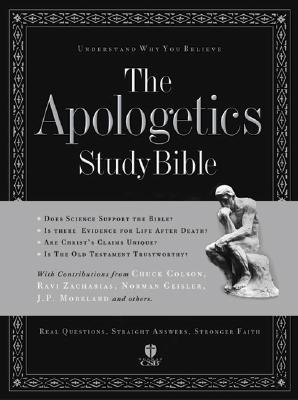
The Apologetics Study Bible

This morning I posted a review of the following Study Bible at SharperIron.org. The review was written by Dr. Paul Henebury (founder/president of Veritas School of Theology). I hope that you'll take a moment to read it there.

The Apologetics Study Bible, Ted Cabal, General Editor. Nashville, TN: Holman Bible Publishing, 2007. Jacketed Hardback. 2,048 pages. $39.99

(Review copy courtesy of B&H Publishing.)

Purchase: B&H | CBD | Amazon

Website: The Apologetics Study Bible (a very resourceful page!)

Sample pages

Features: Holman CSB® translation; Introduction to the Holman CSB®; Two-column Bible text setting; Translation footnotes; 100+ articles; Profiles of Christian apologists; 72-page Bible concordance .

ISBNs: 158640024X / 978-1586400248

Dr. Ted Cabal, General Editor, is professor of Christian Philosophy & Applied Apologetics at The Southern Baptist Theological Seminary. Along with Dr. Cabal, about one hundred other scholars contributed to this study Bible.

(Read his review here...)

My Comments:

I was able to preview this Study Bible prior to sending it on to Paul and was very impressed with the amount of information contained within it. I was concerned to find out if the articles and notes were written from either a Presuppositional or Evidentialist perspective. There is quite a difference in both of these approaches, but I did not have time to read any of the articles. According to Paul Henebury, "ASB is definitely slanted toward an evidentialist perspective, but presuppositionalists will not encounter as many objectionable entries as they might suspect."

I think that this is very important to keep in mind as you use this tool. In general it seems to be a very helpful tool. I can imagine any Christian benefiting from reading these articles and notes, although I don't expect to see a whole lot of these Bibles showing up at church. I've enjoyed reading the HCSB translation, but it isn't my favorite. I've seen a few Southern Baptist churches using this translation, but I don't expect it to supersede any of the other standard translations already available.

One critique I have with this edition has to do with the graphics. This is something that seems to be consistent with other HCSB editions. The cover is awesome. I love the strong black background with silver text and decorations.

However, the inside is overwhelmed with graphics. For instance, consider the title pages and the "Twisted Scripture" blurbs:

The design certainly is creative, but so many graphic elements make for a very busy, and possibly distracting, page layout.

Finally, there is a lot of good information made available, but it brings me back to my original concern with study Bibles. Do these elements encourage reading, meditation and memorization of the text? Do articles, notes, blurbs, graphics, charts, indices, concordances, and so on, work together to exalt the text or crowed it out? I fear that the latter may be more true, as fine as these articles are.

I see this Study Bible being left on a shelf and used as a reference work, not as a regular, everyday, or every Sunday, Bible. However, if this system was added to a software package like Libronix, so that these articles could be found while searching the Bible electronically, that would be very nice. Maybe something like this is in the works. We'll see.


Share/Bookmark

Wednesday, February 27, 2008

What Has Athens To Do With Jerusalem?

April DeConick, professor of Biblical Studies at Rice University, has called for a Blog Post Co-Op on Tertullian’s famous rhetorical question, “What has Athens to do with Jerusalem?” Athens represents Greek philosophy; Jerusalem represents the revelation from God—the Holy Scriptures. Tertullian seems to be warning against corrupting Christian doctrine and practice with philosophy (Colossians 2:8). Opinions are divided as to Tertullian’s estimation of the value of Greek philosophy in its place. He himself was trained in the classics and was very familiar with that culture.

I’d like to offer an opinion as a possible answer to his question. Athens has quite a lot to do with Jerusalem, but in a subservient way. It’s well known that Greek culture was widespread before, during, and after the New Testament era. Not only was our New Testament originally written in Greek, but the Old Testament had been translated into Greek (the Septuagint, or LXX) and was in wide use in the time of Christ and the apostles.

What may not be as well known is that certain concepts and exhortations in the NT find their counterpart in Greek philosophy. That doesn’t mean that Christian doctrine came from pagan philosophy or was somehow influenced by it. Rather, Christian doctrine came from God, and the better elements of Greek philosophy came from minds groping for truth. Those minds, like ours, are darkened through the fall into sin and are prone to much error and resistance to light. But shafts of God’s light occasionally pierce the darkness.

For example, the Apostle Paul seems to demonstrate this in the sermon he preached at Athens in Acts 17. (This chapter records Jerusalem having to do with Athens!) Paul proclaimed to the Athenians that God “made from one man every nation of mankind to live on all the face of the earth, having determined their appointed times and the boundaries of their habitation, that they would seek God, if perhaps they might grope for Him and find Him, though He is not far from each one of us; for in Him we live and move and exist, as even some of your own poets have said, 'For we also are His children’” (Acts 17:26-28). Paul, of course, is not preaching Universalism here. But he finds common ground in this point of Greek philosophy, which he can use to communicate Scriptural truth to a heathen audience, because all truth is God’s truth.

In its proper subservient place Athens has plenty to do with Jerusalem; not for formulating or even understanding God’s truth, but as a vehicle for spreading God’s truth.


Share/Bookmark

Monday, December 31, 2007

Apologetics in an Age of “Niche TV”

Darrell L. Bock, research professor of New Testament studies at Dallas Theological Seminary, has an interesting brief article on the necessity of knowing early Christian history. He says that “we are now in a period when it is not enough to know only about the Bible. The apologetics of the past is no longer adequate. Today's questions involve not only how the Bible came to be, but even if there was originally such a thing as orthodoxy.” Bock makes a good case for familiarizing ourselves with the roots of our faith because of the revival of the ancient heresy of Gnosticism. Though brief, his article is a good stimulus to further study.


Share/Bookmark

Monday, November 5, 2007

New Book for $5 at Desiring God Ministries


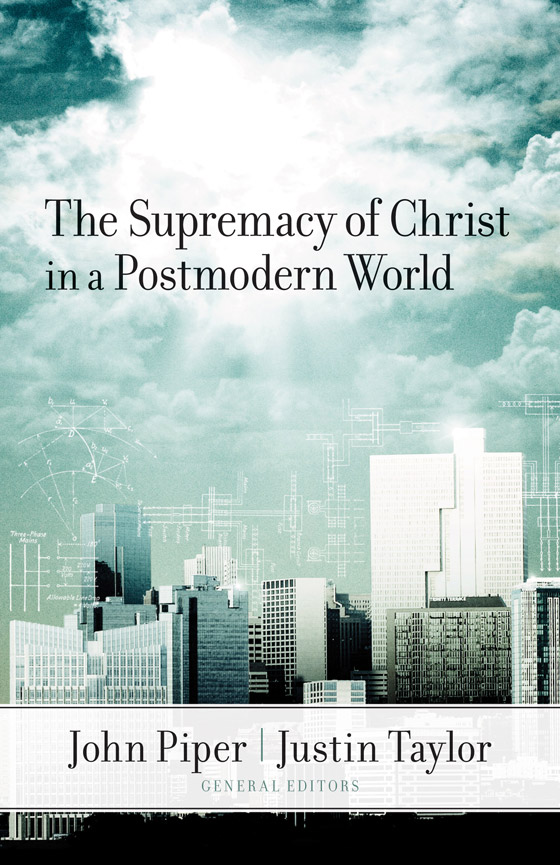
Crossway Books has just recently published The Supremacy of Christ in a Postmodern World edited by John Piper and Justin Taylor.

Abraham has just announced that, "We just received the new book The Supremacy of Christ in a Postmodern World. It will be on sale for $5 from now through Friday."

November 5, 2007 thru November 9, 2007 ONLY.

You may be interested in browsing this book and can do so online here.

Here is a list of the contents:

Part 1: Culture and Truth
1 The Supremacy of Christ in a Postmodern World by David Wells
2 Truth and the Supremacy of Christ in a Postmodern World by Voddie Baucham Jr.

Part 2: Joy and Love
3 Joy and the Supremacy of Christ in a Postmodern World by John Piper
4 Love and the Supremacy of Christ in a Postmodern World by D. A. Carson

Part 3: Gospel Theologizing and Contextualizing
5 The Gospel and the Supremacy of Christ in a Postmodern World by Tim Keller
6 The Church and the Supremacy of Christ in a Postmodern World by Mark Driscoll

After this sale you can purchase this book from Westminster Bookstore for $9.89 or from CBD for $11.99.
Share/Bookmark

Thursday, May 10, 2007

Public Inter-Faith Dialogue in Dubai with Thabiti Anyabwile

Inter-Faith Dialogue, Who is Jesus in the light of the holy Bible and the holy Quran, between the Muslim Student Association (MSA) and the Christian Fellowship Club (CFC) at the University of Wollongong in Dubai.

I came across the video listed above and have now finished watching it. Thabiti Anyabwile was invited to present for the Christian side and did a fine job. From what I have read, which has been brief, Bro Anyabwile is a converted Muslim. He showed great familiarity with the Qu'ran as he presented his arguments and special care when answering questions about the Bible.

The Muslim representative, I did not get the name, did an impressive job as well. I've never had the opportunity to hear a Muslim speak about his faith, but this was amazing. I was shamed by his having memorized, not only passages from the Qu'ran and Bible in Hebrew, Arabic, Greek and English, but he also gave precise chapter and verse references. This is a young man and one who has given himself completely to his religion.

The Muslim student panel seemed to have done their homework in preparing questions, and the Christian student panel didn't seem to know what to say. This was a bit embarrassing. However, the Lord gave Bro Anyabwile numerous opportunities to give solid, clear answers to some hard questions. He also took advantage of many opportunities to share the glorious Gospel. Praise the Lord!

I hope to watch this again. It's about 2.5 hours long, but very worthwhile.
Share/Bookmark