Showing posts with label Preaching. Show all posts

Monday, August 22, 2011

Themelios | A Preacher's Decalogue by Sinclair B. Ferguson

Sinclair Ferguson shares a suggested preacher's decalogue.  I found this to be stirring and very helpful.

Ferguson seeks to answer the question, "What Ten Commandments, what rule of preaching-life, do I wish someone had written for me to provide direction, shape, ground rules, that might have helped me keep going in the right direction and gaining momentum in ministry along the way?" He answers with the following suggestions:

  1. Know Your Bible Better
  2. Be a Man of Prayer
  3. Don't Lose Sight of Christ
  4. Be Deeply Trinitarian
  5. Use Your Imagination
  6. Speak Much of Sin and Grace
  7. Use "the Plain Style"
  8. Find Your Own Voice
  9. Learn How to Transition
  10. Love Your People
Read the entire article here.

Share/Bookmark

Thursday, January 14, 2010

Pastoral Counseling Begins in the Pulpit


The January edition of New Horizons (published by the Orthodox Presbyterian Church) includes an excellent article titled "The Therapy of the Word" by Carl Trueman.  Years ago, I was taught that pastoral counseling begins in the pulpit.  I've recognized this to be true and do my best to keep this in mind whenever I preach.  Trueman asks a question I believe needs to be considered by the modern church:
...95 percent of the problems addressed by counseling should actually be addressed and solved by simply proclaiming the perennial Word of God.  Is it perhaps the case that fewer people would need counseling if more people actually listened prayerfully to what their pastors were telling them from the pulpit every Sunday morning? (emphasis mine)
Keep in mind, the emphasis here is not on the pastor but on the Word of God!  However, this does imply that Christian counseling is a pastoral function, right?

I agree with Trueman that there is a definite place for counseling outside of the pulpit.  That said, we need to remember that pastoral counseling begins in the pulpit, and that all out-of-pulpit counseling ought to direct the counselee(s) back to the ministry of the Word from the pulpit.
Share/Bookmark

Tuesday, June 23, 2009

Expositors' Conference 2009 (Mobile, AL)

This afternoon my wife reminded me about this conference. We want to attend, Lord willing. Please let me know if any of you are planning to attend, too. Here are some details:


Steven Lawson

Dr. Steven J. Lawson is the Senior Pastor of Christ Fellowship Baptist Church in Mobile, Alabama, having served as a pastor in Arkansas and Alabama for 28 years. He is the author of fifteen books, including The Unwavering Resolve of Jonathan Edwards, The Expository Genius of John Calvin, and Foundations of Grace. His books have been translated into Russian, Portugese, Spanish, German, Albanian, Korean, and Indonesian.

Dr. Lawson's pulpit ministry takes him around the world, preaching in Russia, the Ukraine, Wales, England, Ireland, Germany, Japan, Switzerland, New Zealand, and throughout the United States.

Dr. Lawson is president of New Reformation Ministries, designed to bring about biblical reformation in the church today. He serves on the Executive Board of The Master's Seminary and College and serves on the Advisory Council for Samara Preachers' Institute and Theological Seminary in Samara, Russia.

Dr. Lawson and his wife, Anne, have three sons, Andrew, James, and John, and a daughter, Grace Anne.

Joel Beeke

Dr. Joel Beeke serves as President and Professor of Systematic Theology, Church History, and Homiletics at Puritan Reformed Theological Seminary. He has been in the ministry since 1978, and has served as a pastor of his current church (HNRC in Grand Rapids, Michigan) since 1986.

Dr. Beeke is editor of the Banner of Sovereign Grace Truth, editorial director of Reformation Heritage Books, president of Inheritance Publishers, and vice-president of the Dutch Reformed Translation Society. He has written, co-authored,or edited sixty books, and contributed over 1500 articles to reformed books, journals, periodicals, and encyclopedias.

Dr. Beeke holds a Ph.D (1988) from Westminster Theological Seminary. He is frequently called upon to lecture at reformed seminaries and to speak at conferences around the world. C
opyright 2009 . All Rights Reserved.

Sunday September 27, 2009
Pre-Conference schedule coming soon!
9:00 A.M. Dr. Joel Beeke

10:30 A.M.

Dr. Joel Beeke
6:00 P.M. Dr. Joel Beeke


Monday September 28, 2009
4:00 P.M. Conference Registration Begins

5:00 P.M.

Dinner
6:30 P.M. The Preaching of the Reformers: Martin Luther and John Calvin
Dr. Steven Lawson
8:00 P.M. The Preaching of the Puritans (I)
Dr. Joel Beeke


Tuesday September 29, 2009
7:30 A.M.
Breakfast
9:00 A.M. The Preaching of the Puritans (II)
Dr. Joel Beeke
10:30 A.M. The Preaching of the Great Awakening: Jonathan Edwards and George Whitefield
Dr. Steven Lawson
12:00 P.M.
Lunch
1:30 P.M. The Preaching of the 19th Century: Archibald Alexander and Charles H. Spurgeon
Dr. Steven Lawson
3:30 P.M. Questions & Answers (Steven Lawson & Joel Beeke)
5:00 P.M. Dinner
6:30 P.M. The Preaching of the 20th Century: Martyn Lloyd Jones and James Montgomery Boice
Dr. Steven Lawson

Information & Registration
Share/Bookmark

Wednesday, December 17, 2008

God Acts and God Speaks

Philip Graham Ryken seems to capture very well the necessity of both God's actions and God's words and how they complement each other. The following excerpt is from the latest volume in the Reformed Expository Commentary series:
The good news for the shepherds was that this child was born in Bethlehem to be their Savior and their God. They never would have known this unless God revealed it to them. If the angel had not appeared to them while they were out in the fields, keeping watch over their flocks by night, the shepherds never would have come to Christ. They acknowledged this when they referred to the good news as "this thing that has happened, which the Lord has made known to us" (Luke 2:15).

What this shows is how much we need the preaching of the gospel. To understand what God has done, we need to have someone explain it to us. By itself, what God had done would not save the shepherds, or anyone else. They needed to know what it meant by faith, which could only happen by divine revelation. This is now God saves us: not simply by sending Jesus to be our Savior, but also by preaching to us the gospel so that we can believe in his saving work. God doesn't just do things; he also says things, and we need to know what he says so that we can believe in what he has done.
("Gloria in Excelsis Deo," by Philip Graham Ryken in The Incarnation in the Gospels by Daniel M. Doriani, Philip Graham Ryken, and Richard D. Phillips. P&R, 2008, 108; emphasis mine.)
This is a fantastic selection of sermons adapted from the forthcoming commentaries on Matthew (Daniel Doriani), Luke (Philip Graham Ryken) and John (Richard D. Phillips). I purchased this at our church's bookstore at the recommendation of our senior pastor. This has made for wonderful meditation during the Christmas season.
Share/Bookmark

Tuesday, December 16, 2008

George Whitefield, A Preacher with Power

Today is the 294th anniversary of the birth of George Whitefield, December 16, 1714. Last year, Tim Ashcraft wrote a fine biographical sketch of Whitefield that I would encourage you to read. A list of resource on Whitefield is also offered there.

This morning, I opened up Iain Murray's Lloyd-Jones: Messenger of Grace (BOT, 2008) and found a section in chapter two, "Preaching and the Holy Spirit," where Murray draws a comparison between Whitefield and Lloyd-Jones in order to illustrate the necessity of power in preaching. This is penetrating:
There is an obvious reason why preaching too often lacks the ability to hold the interest of those who listen. It is because the word spoken has no more than a fleeting access to the hearer's mind. A statement is briefly heard only to be crowded out by the individual's own thoughts, which he may well find more interesting and pleasant. Thus the twenty or forty minutes of a sermon may pass, with a person in the pose of a listener, yet actually paying attention to very little. In contrast, powerful preaching takes hold of the whole person. It gets within a man. It first arrests the mind and then speaks to the heart, the conscience, and the will. Where this element is present inattention becomes a near impossibility. Skilful oratory and carefully crafted speech can go some way to hold the hearers but it does not command attention in this manner. Powerful preaching penetrates more than the surface of the mind; it does more than merely present teaching; it is capable of causing a moral and emotional earthquake - 'not simply with words, but also with power, withthe Holy Spirit, and with deep conviction' (1 Thess. 1:4).

An eighteenth-century church-goer who was also a shipbuilder confessed that he had often built a ship from stem to stern during a sermon, but when he heard George Whitefield he found himself unable to lay a single plank. The reason for this was noted by another of the evangelist's hearers: 'Whitefield preached like a lion, he spoke as one conscious of his high credentials, with authority and power.' So it was with Lloyd-Jones. His message often carried the conviction that it was more important than any other possible consideration. (pp. 34-35, emphasis mine)

Share/Bookmark

Monday, November 17, 2008

E.C. Dargan—Teacher and Historian of Preaching

Today is the birthday of Edwin Charles Dargan, born in Darlington County, South Carolina in 1852. Dargan may not be a familiar name to you, but less than a hundred years ago he was president of the Southern Baptist Convention (1911-1913). His other roles were pastor, homiletics professor, author, and editor.

Dargan was educated at Furman University in Greenville, SC and Southern Baptist Theological Seminary in Louisville, KY. According to Southern's website Dargan possessed "an uncommon memory.... Once, when ill to the point of hallucination, he sporadically shouted out entire chapters of the Bible in Hebrew. The illness faded, but Dargan retained his memory and became valedictorian of his class." After pastoring several churches Dargan received an invitation from Southern to join the faculty as a professor of homiletics and pastoral theology.

Dargan edited the second edition of John A. Broadus' book, On the Preparation and Delivery of Sermons. But his magnum opus was the two-volume A History of Preaching. This mostly biographical work was projected to be three volumes, but Dargan died before completing the third. It was finished much later by Ralph Turnbull, covering the history of preaching to 1950. According to Warren Wiersbe, "A History of Preaching, volume 3, is the one volume you need to supply information about preaching and preachers in the recent past. If you add Dargan's two volumes, you have a dependable encyclopedia of preaching" (Walking with the Giants, Grand Rapids: Baker Book House, 1976, p. 219).

Contents of A History of Preaching by E.C. Dargan (from the Monergism website):
Volume 1 Contents

PERIOD I - AD 70 - 430
Chap. 1 - Preaching during the First Three Centuries
Chap. 2 - The Culmination of Ancient Preaching in the Fourth Century

PERIOD II - 430 - 1095
Chap. 3 - The Decline of Preaching in the Fifth and Sixth Centuries
Chap. 4 - The Low Estate of Preaching in the Seventh and Eight Centuries
Chap. 5 - Voices in the Night, or Preaching during the Ninth, Tenth and Eleventh Centuries

PERIOD III - 1095 - 1361
Chap. 6 - Heralds of the Dawn of the Eleventh and Twelfth Centuries
Chap. 7 - The Culmination of the Mediaeval Preaching in the Thirteenth Century
Chap. 8 - Decline and Mysticism in the Thirteenth and Fourteenth Centuries

PERIOD IV - 1361 - 1572
Chap. 9 - The Renaissance, and Preaching in the Fourteenth and Fifteenth Centuries
Chap. 10 - Preachers of the Fourteenth and Fifteenth Centuries
Chap. 11 - The Reformation, and Preaching in the Sixteenth Century
Chap. 12 - Preachers of the Reformation in Germany and German Switzerland
Chap. 13 - Preachers of the Reformation in France and other European Countries
Chap. 14 - Preachers of the Reformation in England and Scotland
Chap. 15 - Roman Catholic Preaching and Preachers in the Sixteenth Century
Chap. 16 - Preaching at the Threshold of the Modern World

Bibliography
Index

Volume 2 Contents

PART I THE SEVENTEENTH CENTURY
Chap. 1 - Preaching In Europe at the End of the Sixteenth Century
Chap. 2 - Preaching in Southern Europe During the Seventeenth Century
Chap. 3 - Seventeenth Century Preaching in Germany and Northern Europe
Chap. 4 - The Classic Age of the French Pulpit
Chap. 5 - The Classic Age of the British Pulpit

PART II THE EIGHTEENTH CENTURY
Chap. 6 - General View of the Eighteenth Century. Catholic Preaching in Southern Europe
Chap. 7 - German Preaching in the Eighteenth Century
Chap. 8 - French Preaching in the Eighteenth Century
Chap. 9 - Dutch and Scandinavian Preaching in the Eighteenth Century
Chap. 10 - British Preaching in the Eighteenth Century

PART III THE NINETEENTH CENTURY
Chap. 11 - Preaching in the Nineteenth Century. The Pulpit of Southern Europe
Chap. 12 - The German Pulpit of the Nineteenth Century
Chap. 13 - The Dutch and Scandinavian Pulpits of the Nineteenth Century
Chap. 14 - The French Pulpit of the Nineteenth Century
Chap. 15 - The British Pulpit of the Nineteenth Century
1) The First Third of the Century, 1801-1833
2) The Middle Period of the Century, 1833-1868
3) The Closing Years of the Century, 1868-1900

Conclusion
Bibliography
Index

You can read Volume 2 online at Google Books.

What good histories of preaching would you recommend? Or what reasons would you give for even studying preachers from a long time ago? Share your thoughts in the comments.


Share/Bookmark

Sunday, October 26, 2008

“What’s God Got to Do With It?”

Newsweek has an interesting article on Victoria Osteen and her new book, Love Your Life. Ms. Osteen and her husband Joel are pastors of one of the largest churches in America, and tens of thousands are buying into their idea of religion as “appreciating what God's given us. He's given us this life, and he wants us to live it to the fullest” (from Lisa Miller's interview with Victoria). The writer’s response to Victoria’s prosperity-gospel: “All this is fine, in the pages of a women's magazine or a self-help book. But what has God got to do with it?”

I don’t know the writer of the article or if she is a true believer in Christ, but what was striking to me was that an editor of a news source not known for its adherence to evangelical belief would come to that conclusion. That seems to show more discernment than many of the followers of prosperity-gospel philosophy. Despite the counsel of much contemporary Christianity, I think the world is looking for something different in Christians, especially ministers. If Christianity has nothing transcendent to offer, why bother?

Everyone wants to be happy and live life to the fullest. But how would we counsel a seeker or practice it ourselves? John Piper puts it this way in the opening words to his book, The Supremacy of God in Preaching:
People are starving for the greatness of God. But most of them would not give this diagnosis of their troubled lives. The majesty of God is an unknown cure. There are far more popular prescriptions on the market, but the benefit of any other remedy is brief and shallow. Preaching that does not have the aroma of God’s greatness may entertain for a season, but it will not touch the hidden cry of the soul: “Show me thy glory!” (The Supremacy of God in Preaching. Grand Rapids, MI: Baker Book House. 1990, p. 9)
In times like these, when the economy is down and people are losing their jobs, how do we find comfort and practice our faith? By looking inside ourselves? How about gazing on God in His greatness and believing that since He gave us His Son, He will provide us with everything we need! That's the essence of the Christian life: to trust and enjoy God now amidst suffering and uncertainty and to be willing to wait for our best life then, when we're with Him.

How would you summarize Christianity? What is religion all about?

(HT:JT)
______________________________
Also by John Piper on happiness and the greatness of God—

Share/Bookmark

Friday, August 22, 2008

Book Review: Doctrine that Dances by Robert Smith

Cross-posted.

Yesterday, I posted the following review by Dr. Roger D. Duke (Baptist College of Health Sciences) at SharperIron.org. Having heard very positive remarks about this book, I was eager to read this review. For those who are preachers of the Word of God, this appears to be another excellent and helpful guide. I'm looking forward to obtaining and reading this one!

Smith, Robert. Doctrine that Dances: Bringing Doctrinal Preaching and Teaching to Life. Forward by Dr. James Earl Massey. Nashville, Tenn: B & H Academic, 2008. Paperback, xiv + 207 pp. $19.99

(Review copy courtesy of B&H Academic.)

doctrine that dances.jpgPurchase: B&H | Amazon ($13.59) | CBD ($14.99)

ISBNs: 0805446842 / 9780805446845

Winner of Preaching magazine’s 2008 Book of the Year

Subjects: Preaching, Doctrinal Theology-Teaching

Dr. Robert Smith, Jr., is the Associate Professor of Divinity and Professor of Homiletics at Beeson Divinity School, Samford University.

It has been my privilege and responsibility to review or critique books from a plethora of disciplines in the various venues where I have served as student, pastor, mentor, or professor. But I have never experienced such a personal delight as I did while reading, meditating on, and critiquing Doctrine that Dances.

First, Smith exhibits the best of the African-American tradition in his preaching. (If you have not experienced his preaching firsthand, you owe yourself this treat in person, if possible, but on CD or tape if necessary!) This volume is an extension of his preaching craft. Second, he brings the old discipline of rhetoric to bear on his homiletical theory and practice. Third, he teaches, preaches, and “does rhetoric” in the writing of this volume. The latter is difficult to imagine if you have not read it. All of these qualities are woven together intricately and build to a crescendo throughout the work.

Thesis

Smith declares,

Classical rhetoricians attempted to be holistic in the speech act: enlighten the mind, touch the heart, and move the will. Preaching that avoids head engagement will lead to blindness, and preaching that ignores heart engagement—the emotive realm of the believer’s existence—does so at the cost of boredom and dullness, which prevents the result of an engaged hearing for a transformed life. (p. 2)

Definitions

One way Smith accomplishes his thesis is with his skillful use of definitions throughout the text. These definitions are the backbone around which the work is structured. They are as follows: Doctrinal preaching for Smith is “the escorting of the hearers into the presence of God for the purpose of transformation” (p. 26). Second, he uses the “two magnificent metaphors” of “exegetical escort” and “doxological dancer.” Of the former, he says, “The function of the exegetical escort is to embrace the text of Scripture in order to usher the hearer into the presence of God for the purpose of transformation” (p. 35). On the preacher as “doxological dancer,” he observes that “the purpose of the preacher as a doxological dancer is to communicate the doctrinal message of the Bible with accuracy and ardor so that the exuberant hearer exults in the exaltation of God” (p. 107). Using these metaphors, Smith builds his argument that the preacher as “exegetical escort” does a “doxological dance” which brings the hearer-worshiper along into the presence of God. The goal is that they will exalt in the presence of God with the result of transformation. The book is a marvelous piece of homiletical writing coupled with rhetorical persuasion.

Authorial Intent

The second way Smith delivers is by inviting the preacher, either novice or veteran, to come along with him and become one who dances with doctrine. He declares so through an unwavering commitment to the complete trustworthiness of the Scriptures. He frames his discussion of Scripture’s integrity around his belief in the authorial intent of the Scripture. It serves Smith’s other arguments as subtext throughout the entire volume. He states without equivocation, “Preachers who preach doctrinally must put their ears to the pavement of the text and synchronize the heartbeat of the text with the heartbeat of the doctrine of the author’s intent,” and “The authorial intention must be gleaned because a text can never mean today what it never meant when it was written.” Concerning the applications of the Bible texts when preaching, he states: “[T]hey must always return to the pulsating heartbeat of the text’s original intention” (quotes taken from pp, 20, 35, and 128 respectively; emphasis added).

Rhetoric in the Writing

The third way Smith delivers is by drawing deeply from his own well of classical training in the rhetorical tradition. During his Ph.D. work at The Southern Baptist Theological Seminary, Professor Smith studied rhetoric as a cognate for his homiletical training. This training exposed him to the ways of Augustine and John Albert Broadus, both of whom “brought rhetoric right into the church house” as theory, method, and preaching practice. Smith knows that rhetorical training can—if studied with diligence—greatly enhance what the novice minister can become. This fact is prominently displayed in his discussion of rhetorical means in the “Reversal of the Canons of Criticism” (pp. 113-117) section.

Reversing the Five Canons of Criticism

Here Smith asks the question, “What is the matter with the style of . . . preaching?” His answer: “There is a reversal of the Greco-Roman five canons of criticism,” (i.e., Rhetoric, p. 113). This section is important because, in answering the question, he discusses—albeit ever so gingerly—the Five Canons of [Classical] Rhetoric: invention, arrangement, style, memory, and delivery. He answers the question by asserting that “the fifth canon, delivery, appears to have taken priority over the first canon, invention, in contemporary preaching” (p. 113). To the Greco-Roman hearer, the main issue was, “Does the speaker have anything substantive to say?” based primarily on logic and ethos. The issue was not “how” the speaker said what was said necessarily. The classical hearer of the former days knew that the address built primarily on pathos could lure away the hearer. The hearer could then be caught by any trap laid by any would-be Sophist. Smith seems to imply that some preaching today focuses on delivery more than on content.

Sermonic Dance Steps for Doctrinal Preaching

Moving to the practical aspects of rhetoric, Smith discusses “sermonic dance steps for doctrinal preaching” (pp. 41-44). Young preachers can immediately adapt and adopt these as rhetorical methods and apply them to the preparation and delivery of sermons. The steps are as follows:

Step One: Identification—“Start Low”
Step Two: Clarification—“Go Slow”
Step Three: Intensification—“Rise”
Step Four: Application—“Strike Fire”
Step Five: Recapitulation—“Retire”
Step Six: Motivation—“Sit down in a Storm”

This applied method alone is worth the price of the book.

Rhetorical Tone

The third and maybe most important rhetorical feature Smith employed is his tone. He begins slowly and smoothly and works its way up to a crescendo that captivates the reader and moves him or her along with Smith as if in application of the steps above! This is just what the “doxological dancer” and the “exegetical escort” should do, but Smith does it in his writing! Reading the book provides a firsthand experience of how rhetoric is done in the best of the African-American pulpit’s oratorical tradition. The book is so well written that the reader is captivated and carried along just as though he is “dancing” or “being escorted” into the presence of our Lord. And Smith would have us remember that the “method of the madness” of the “dancer” and the “escort” is for the transformation of the life that will surely come.

These three features (the canons, dance steps, and tone) demonstrate Smith’s oratorical expertise in a simple yet profound manner. To do rhetoric from behind a lectern of pulpit is one thing, but to do so from the medium of the written page as Smith does here is almost surely a craft that has been lost. Smith bears the reader along just as if he were listening to a live lecture or sermon at Beeson Divinity School.

Smith’s overriding desire is to bring the use of rhetoric back to the preparation and delivery of sermons, but he does not want to “do rhetoric” for rhetoric’s sake. He uses rhetoric as a tool to help the minister improve his skills as “doxological dancer” and “exegetical escort” for the Holy Spirit’s transformation of the hearing worshiper. This is an outstanding volume on the theoretical, methodological, and practical levels. As a rhetorician myself, I’m excited to find a move afoot to bring this old and needed discipline back to sermon theory and practice. The intended audience is every minister (whether novice or veteran) who wants to better understand communication theory as represented in the rhetorical tradition in order to connect his people to the God who transforms lives.

If you have not gotten it by now, I love this book! I love what he said! I love what he does! I love the way he does it! If you can fast for one meal, take that money and get a copy of this volume. I guarantee that you will be a lesser minister if you do not!

duke.jpgRoger D. Duke, D.Min. is Assistant Professor of Religion and Communication at Baptist College of Health Sciences (Memphis). He has been an ordained Southern Baptist minister since 1982 and has had an extensive itinerant and interim church ministry. Dr. Duke holds the Associate of Divinity in Pastoral Ministries from Mid America Baptist Seminary (Memphis, TN); the B.Sc. (cum laude) in Humanities from Crichton College (Memphis, TN); the Master of Divinity from the Southern Baptist Theological Seminary (Louisville, KY); the Master of Arts in Religion in the History of Christian Thought from Harding University (Churches of Christ) Graduate School of Religion (Memphis, TN); and the Doctor of Ministry in Christian Thought, Ethics, and Rhetoric from The University of the South’s School of Theology (Sewanee, TN). He also attended the University of Memphis where he did Ph.D. work in Classical Rhetoric and Communication Theory.

Click here to learn more about SharperIron book reviews.

Related Reviews:


Share/Bookmark

Saturday, August 9, 2008

Lloyd-Jones' Book on Preaching Summarized

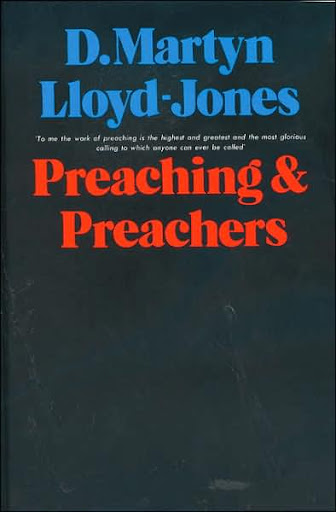
I've blogged before on my favorite book on the subject of preaching, Preaching and Preachers by Martyn Lloyd-Jones. Mark Jones provides a good chapter-by-chapter summary of this book on his blog, Thomas Goodwin. I especially like his statement concerning chapter two, "No Substitute":
Because man is a rebel and under the wrath of God, he needs to be told, through preaching, how he can be reconciled to God, and no other medium accomplishes this task like preaching. When we try other mediums like "preaching" morality without godliness, in trying to reach man, the results have the opposite effect and churches subsequently empty because there is no gospel basis.
A theology of preaching rather than a homiletics book, Preaching and Preachers is a must-read for ministers and theological students. Mark's summary is a good introduction to Lloyd-Jones' book.


HT:(James Grant)


Available from: Amazon ($15.63) | ($16.09) | CBD ($16.99) | Cumberland Valley ($16.25) | WTS ($16.09)


Share/Bookmark

Thursday, July 10, 2008

John Piper is Celebrating John Calvin's Birthday

Piper celebrates Calvin in light of his passion for preaching the Word of God (Click on this link to read his post at Desiring God blog.):
(Author: John Piper)

Happy birthday, John Calvin. Today we celebrate your 499th birthday. Your preaching inspires me to press on with this great and glorious task of heralding the Word of God.

Share/Bookmark

Friday, June 6, 2008

The Nature of Public Worship: Priestly or Prophetic?

I’ve been Baptist all my life and have observed that the preaching of the Word is the focus of our public worship services, as in most other Protestant churches. The pulpit takes center stage. In sacramental assemblies, like Catholicism and much of Anglicanism, the focus of public worship is the Eucharist. The altar takes center stage.

Though this difference may sometimes be taken for granted by Protestants today, the prophetic position on worship wasn’t a given in the 17th Century, the age of the Puritans. The Puritans were the evangelical wing of the Church of England. They came into being because of a desire to rid the Church of the unscriptural vestiges of Catholicism, to complete the English Reformation.

Through their voluminous writings the Puritans developed a doctrine of preaching the Word of God. They also developed a doctrine of hearing the Word of God. Together these aspects of a church service form the Puritan conception of public worship. In his book The Genius of Puritanism Peter Lewis states that

the tension between the Anglican and Puritan modes and ideals of worship arose largely from the difference between the Anglican conception of public worship as fundamentally a priestly act, and the Puritan idea of it as fundamentally a prophetic one. To the Puritan mind the priestly element in worship rested on the two great truths of Christ’s perpetual High Priesthood and the consequent priesthood of all believers. Thus, any mediation of grace through the minister was not through any supposed priestly act of his, but through the Word of Christ spoken by him in the Spirit of Christ to the people of Christ. In public worship, therefore, the Puritan conceived of the prophetic element as the grand climactic and dominating factor.

Peter Lewis, The Genius of Puritanism (Carey Publications Limited, 1979), p. 53.

I found it interesting that the Puritans had to hammer out this conception of worship that I frequently take for granted, as though this position had always been the norm in churches. It had to be fought for. Today it seems that some professing evangelicals are flirting with sacramentalism and focusing less on the preached Word. Could it be partly because some preachers have seemingly lost the conception of the momentous event that is taking place when a man of God stands before a congregation and opens the Word of God?

Just like it was in the Puritans’ day, our society will be most impacted by ministers and listeners who view the sermon as “the climax of public worship…the principal mediating instrument of the power of God unto salvation and sanctification” (Lewis, p. 53).

______________________

Recommended reading:

Peter Lewis, The Genius of Puritanism (paperback, 144 pages - reprinted by Soli Deo Gloria)

Using abundant quotes from the Puritans, Lewis provides a valuable introduction, emphasizing “the preaching and pastoral activities of those remarkable men of the 17th Century” (from the Foreword by Martyn Lloyd-Jones, p. 5). Available from Reformation Heritage Books ($11.00) and Amazon ($11.00).

D. Martyn Lloyd-Jones, Preaching and Preachers (Zondervan, hardback, 325 pages)

This is not a book on homiletics; it is essentially a theology of preaching and should be required reading for every ministerial student. Very helpful.


Share/Bookmark

Friday, February 1, 2008

Spurgeon's Lectures to My Students "Banner-style!"

Following up on Tim's post on C. H. Spurgeon, you ought to know that Banner of Truth has recently reprinted Spurgeon's Lectures to My Students. Steve Burlew, manager of the BOT warehouse in Carlisle, PA, announced the arrival of this title two days ago. We've quoted from this volume a few times before and will surely continue to mine it's gold. We highly recommend this to ministerial students and preachers!

C. H. Spurgeon, Lectures to My Students (Edinburgh: Banner of Truth, 2008). Clothbound. 928 pages. [BOT $39.00 | WTS $27.30]
Share/Bookmark

Saturday, January 26, 2008

G. Campbell Morgan on Exegesis

I found the following summary by Steven Ingino of a portion of G. Campbell Morgan's book entitled Preaching (New York: Fleming H. Revell, 1937). Does anyone have a copy of this book who could share with us the exact quote regarding Morgan's preference toward exegetical commentaries rather than devotional commentaries?

The following quote is from "Learning from Preachers of the Past: Lessons from John Chrysostom, Martin Luther, Phillips Brooks, and G. Campbell Morgan." By The Rev. Canon David Roseberry and Steven Ingino.

"Choose appropriate chunks of texts, preach the central idea, do not preach your conviction/ideas, preach the text or you lose authority, craft the message carefully with exposition of the text, illustrations, quotes, etc., read commentaries that give exegesis and give them priority over devotional works, be creative, and use your imagination to think of ways to present the Bible, stay away from allegorizing, have a clear outline in your head and make your divisions clear to the people." (emphasis mine)

From Morgan, G. Campbell. Preaching. New York etc.: Fleming H. Revell Company, 1937.
Share/Bookmark

Friday, December 7, 2007

Book Review: The Expository Genius of John Calvin by Stephen Lawson

A few weeks ago I made contact with the folks at Reformation Trust (an imprint of Ligonier Ministries) about reviewing some of their books. They have been very gracious in providing review copies of some wonderful titles. Doug Smith has reviewed one of these already and we have posted his comments on SharperIron. I hope that you'll take a moment to read his review. This looks to be an excellent beginning to a historical look at expository preaching.

Lawson, Steven J. The Expository Genius of John Calvin. Lake Mary, FL: Reformation Trust Publishing, 2007. Hardcover, 142 pages. $15.00.

(Review copy courtesy of Reformation Trust.)

Purchase: Ligonier Ministries | CBD | Monergism | CVBBS | WTS | Amazon

ISBNs: 1567690858 / 9781567690859

LCCN: BX9418 L37

DCN: 251.0092

Subjects: John Calvin / Preaching

Steve Lawson is senior pastor at Christ Fellowship Baptist Church (Mobile, AL). Dr. Lawson serves on the board of directors of The Master’s College and on the ministerial board for Reformed Theological Seminary. He also teaches with Dr. John MacArthur at the Expositor’s Institute. In addition, Dr. Lawson has written numerous books, including Foundations of Grace and Famine in the Land: A Passionate Call for Expository Preaching.

(Read the full review here.)
Share/Bookmark

Thursday, October 4, 2007

Thinking About Dever, Sibbes and Healthy Churches

I just finished Mark Dever's first book entitled Richard Sibbes: Puritanism and Calvinism in Late Elizabethan and Early Stuart England (Mercer UP: 2000). I'm a slow reader and had a number of other books and projects to handle so it took me a while to finally finish this. It isn't an easy read, but it was well worth it. Dever proves himself to be a very careful scholar. His meticulously detailed account of the various aspects of Sibbes's life, works, theology and practice will be an invaluable help to all future students of Sibbes.

This work is a history, not only of the life of Richard Sibbes, but also of the late Elizabethan and early Stuart eras. As a work of history I was interested to see if I could determine any of Dever's perspective and prejudices. I came to this book with a sincere interest in learning about Richard Sibbes, but reading this volume served as my first introduction to the writings of Mark Dever.
Mark Dever is the senior pastor of Capitol Hill Baptist Church in Washington, DC and the Executive Director of 9Marks Ministries. He has made his mark upon contemporary evangelicalism and a good bit of fundamentalism (at least what some are calling "the emerging middle"of fundamentalism) with his books Nine Marks of a Healthy Church [WTS] and The Deliberate Church [WTS]. I've not read either of these books yet, but have skimmed through some of the Nine Marks literature, and an abridged edition of Nine Marks of a Healthy Church.
Knowing the little that I did about Dever as I took up reading Richard Sibbes, I found a few interesting connections between Sibbes's philosophy of ministry and what I had heard about and read of Nine Marks of a Healthy Church. Now that I've finished this book, I'm skimming back through it trying to put things together in my mind as I prepare to write my book review. Here are some of things I've found:
  1. Sibbes was a conformist
    1. "Sibbes was a hesitater, and a questioner, but not a dissenter." (p. 47)
    2. "To suggest that Sibbes was a nonconformist, not to mention a crypto-separatist, is unwarranted by the alleged Cambridge deprivations; it is also unwarranted by his associations." (p. 70)
    3. "...Sibbes's associations do not suggest religious radicalism." (p. 70)
    4. "...Sibbes was apparently a conformist, as were his closest friends." (p. 70)
    5. "If any time after 1616 could have driven him to open conformity, and even separation, it would have been the last two years of his life, yet even they did not." (p. 93)
    6. "Yet Sibbes remained a reforming conformist to the end...." (p. 94)
    7. "To discover what Sibbes thought to be the essence of the church theologically--godly preaching, right administration of the sacraments, some discipline--is to discover what Sibbes thought to be essential to the church practically (and by implication, those things, too, that were non-essential). Divisions caused in the church for reasons other than these essential matters Sibbes relegated to divisions for merely 'private aims.' Even if the divider was right on the particular, he was wrong to cause division about anything that was not 'necessary.' ... Furthermore, the cause of much unnecessary division, Sibbes said, was a lack of faith in God's future provision based on his promises, a childish kind of peevishness that, 'when they have not what they would have, like children, they throw all away.' Such childishness, combined with ignorance of true Christian liberty led to unnecessary scruples. ... Therefore, 'in some cases peace...is of more consequence than the open discovery of some things we take to be true; ...open show of difference is never good but when it is necessary.'" (pp. 204-206)
    8. "To Sibbes, any conscientiousness that led to separation was over-scrupulousness and the consciences of such were to be educated." (p. 209)
  2. Sibbes was a pacific moderate
    1. Pacific is not a word that I use or have heard very often, so I took note of it and found that Dever carries this description of Sibbes, along with that of moderate, throughout the book. Since pacific was not logged in the subject index I've taken pains to run down every mention of this modifier (pp. 6, 72, 82, 88, 109, 216) [unpacific, 109].
    2. "By the end of his life, he recognized more clearly than ever that 'all Christians in this life have both a different light and a different sight.'" (p. 86)
    3. "Sibbes did, of course, favor moderation: 'Where most holiness is, there is most moderation, where it may be without prejudice of piety to God and the good of others.'" (p. 87)
    4. "...moderation was important in Sibbes's response to those who would separate from the Church of England." (p. 88)
  3. Sibbes was concerned about identifying the marks of a true church
    1. "Sibbes's proof of the Church of England as a true church of Christ is that it has all the necessary marks of a true Church--'sound preaching of the Gospell, right dispensation of the Sacraments, Prayer religiously performed, evill persons justly punisht (though not in that measure that some criminals and malefactors deserve)'--and the production of 'many spirituall children to the Lord.'" (pp. 89-90; cf. 88, 204-205)
  4. Of these marks of a true church Sibbes identifies the most important as that of Gospel preaching
    1. "'preaching is that whereby God dispenseth salvation and grace ordinarily...'." (pp. 80-81)
    2. "Thus Sibbes, through his preaching especially, and through other careful measures, sought to advance the concerns of the godly." (p. 82)
    3. "Godly preaching, as the means of the Spirit's activity, rather than historical organizational continuity was the heart of Sibbes's vision of the church." (pp. 92-93)
    4. "Sibbes taught that the primary means Christ used to prepare his elect's hearts for salvation was 'by the ministry of the gospel.'" (p. 129)
    5. "Preaching was the 'chariot that carries Christ up and down the world. Christ does not profit but as he is preached.' Thus 'it is a gift of all gifts, the ordinance of preaching. God esteems it so, Christ esteems it so, and so should we esteem it.'" (p. 129)
    6. "Preaching was preeminently the means to grow such loving affections, especially affectionate preaching. According to Sibbes, this was the preaching in which 'Christ [was] truly laid open to the hearts of people...the knowledge and preaching of Christ in his state and offices.' 'Indeed, "preaching" is the ordinance of God, sanctified for the begetting of faith, for the opening of the understanding, for the drawing of the will and affections to Christ.... Therefore, as we esteem faith and all the good we have by it, let us be stirred up highly to prize and esteem of this ordinance of God." (pp. 155-156)
As I've considered these points, I've wondered, not only, how Dever's presuppositions have influenced his analysis, but also, how Sibbes philosophy of ministry has influenced Dever. I'm not finished with my analysis, but for the time being I will offer you an artistic impression of the influence of these two men upon each other...

You may also be interested in this:
This morning Adrian Warnock posted notes from a talk given by Dever at the recent Theology for All

Adrian is also offering a recorded interview with Dever here.
Conference in London. In this lecture Dever argues that preaching must hold the preeminent position in our worship services.
Share/Bookmark

Thursday, September 20, 2007

Book Review—Preaching the Cross (Together for the Gospel)

The following book review has been posted on SharperIron this morning. I've enjoyed reading this book, so far, and recommend it to you. I appreciate Matt's work reviewing this for us.

Reviewed by Matt Christensen

Dever, Mark, et al. Preaching the Cross. Wheaton, Ill: Crossway Books, 2007. 176 pages, Hardcover. $19.99 USD.

(Review copies courtesy of Crossway Books)

Purchase: Crossway | CBD | CVBBS | Amazon | WTS (currently on sale)

Special Features: Appendix: Together for the Gospel Affirmations and Denials (2006); General Index; Scripture Index

DCN: 251

LCCN: BV4211.3.P735

Subjects: Gospel, Preaching

Mark Dever is senior pastor of Capitol Hill Baptist Church in Washington, DC and Executive Director of 9Marks Ministries.

J. Ligon Duncan III is senior minister of First Presbyterian Church of Jackson, Mississippi, Chairman of the Council on Biblical Manhood and Womanhood, and Moderator of the General Assembly of the Presbyterian Church of America.

R. Albert Mohler, Jr. is President of The Southern Baptist Theological Seminary in Louisville, Kentucky.

C. J. Mahaney is Director of Sovereign Grace Ministries.

(read the full review here)


Share/Bookmark

Tuesday, September 11, 2007

Mid-America Conference on Preaching: Oct. 18-19, 2007

Andy Naselli has posted an announcement about the upcoming Mid-America Conference on Preaching, hosted by Inter-City Baptist Church and Detroit Baptist Theological Seminary, is scheduled for Thursday and Friday, October 18–19, 2007.

"Learning from the Past, Pressing toward the Future"

This year’s speakers include Doug McLachlan, Mark Minnick, Sam Horn, David Saxon, David Doran, and the faculty of DBTS.

Here's some more information on the conference...

A Message to Pastors

Sample Workshop Topics

Conference Schedule


Share/Bookmark

Thursday, August 2, 2007

Book Review--The Majesty of God in the OT

Andy Efting has written a review of the following book and we have posted it on SharperIron. Kaiser is one of my favorite contemporary theologians. I've got my copy and I'm looking forward to diving into it.

Kaiser, Walter C., Jr. The Majesty of God in the Old Testament: A Guide for Preaching and Teaching. Grand Rapids, MI: Baker Academic, 2007. 174 pages. $16.99

(Review copy courtesy of Baker Academic)

Purchase: Baker | CBD | Amazon | WTS

Special Features: Bibliographic references and index

ISBNs: 080103244X / 97800801032448

LCCN: BT130.K35 2007

DCN: 231’.4—dc22

Subjects: Preaching, Old Testament

Read an excerpt.

KaiserWalter C. Kaiser (Ph.D., Brandeis University) is president emeritus and Colman Mockler Distinguished Professor of Old Testament at Gordon-Conwell Theological Seminary. He is the author of more than 30 books, including Mission in the Old Testament and Preaching and Teaching from the Old Testament.

In his classic book, The Knowledge of the Holy, A.W. Tozer says the following:

The most portentous fact about any man is not what he at a given time may say or do, but what he in his deep heart conceives God to be like. We tend by a secret law of the soul to move toward our mental image of God. . . . Always the most revealing thing about the Church is her idea of God, just as her most significant message is what she says about Him or leaves unsaid, for her silence is often more eloquent than her speech. (read more here…)


Share/Bookmark

Saturday, July 14, 2007

Common Pitfalls with Expository Preaching


I found this great list of "Common Pitfalls with Expository Preaching" by Paul Lamey over at Expository Thoughts.

Here are a few things we all struggle with at times. These are items to either avoid or amend in our expository preaching (in no particular order):

1. Not taking enough time to observe the text of Scripture.
2. Observing things that are not there or are not significant.
3. Not checking and double-checking your observations.
4. Rushing exegesis for the sake of exposition.
5. Being slavishly dependent on commentaries.
6. Preaching too long.
7. Preaching too short.
8. Missing the point(s) of a passage.
9. Abusing the aorist tense .
10. Losing site of the context.
11. Having all heat (passion) and no light (content).
12. Having all light and no heat.
13. Flattening out a text for the sake of a theological system.
14. Erecting a theological “mountain” in the place of a mere theological “hill.”
For our purposes, here, I'm particularly interested in the inclusion of #5 "Being slavishly dependent on commentaries."

This reminds me of a lecture I recently listened to by John Piper (John Owen: The Chief Design of My Life--Mortification and Universal Holiness) in which he answered a question during the Q&A time regarding commentaries. I found it interesting that three of the four he mentioned were older classics (Alford, Murray, and Broadus). Then he concluded by saying that he rarely uses commentaries. He said,
I don't use commentaries very often, frankly. If I think I'm unsure about what I've seen, I'll check it out. But, by and large, assiduous... See, a pastor only has so much time to get ready for Sunday morning. If you've got a block of ten to twenty hours; wherever you fit in there, and you can only do so much, assiduous meditation on the original languages and prayer are much more important than reading six commentaries. Both is better. Because you might guard yourself from a really stupid mistake if you check it out with another mind. But if you've gotta choose, I'd choose assiduous meditation.
Just prior to this Q&A session, he concluded his lecture on the life of John Owen with this imperative concerning preaching:

Do not preach anything that you have not spiritually tasted.

In this same vein, Proverbs 12:27 says "Whoever is slothful will not roast his game, but the diligent man will get precious wealth." We need to be sure to roast what we take in. To assiduously meditate upon the Word of God. Turn it over and over in your thoughts. Prayerfully.

Spurgeon, in his Lectures to My Students writes,
You will not be able to extemporise good thinking unless you have been in the habit of thinking and feeding your mind with abundant and nourishing food. Work hard at every available moment. Store your minds very richly, and then, like merchants with crowded warehouses, you will have goods ready for your customers, and having warehouses, you will have goods ready for your customers, and having arranged your good things upon the shelves of your mind, you will be able to hand them down at any time without the laborious process of going to market, sorting, folding, and preparing.
So, assiduous meditation and storing up your minds carefully are indispensable for the expository preacher.
Share/Bookmark

Monday, June 11, 2007

Summing Up

This is the last in a five-part series on Lloyd-Jones on Ministerial Reading. It is based on the chapter, “The Preparation of the Preacher,” from his book, Preaching and Preachers. He has given wise counsel on what and how a preacher should read in general to keep himself in shape for pulpit work. In addition to rightly reading the Scriptures Lloyd-Jones recommends reading certain types of books that will always be helpful to the preacher, and he counsels balance in reading these books so that the preacher will be well-read, well-rounded, humble, and useful.

His counsel to preachers in all things, including reading, is, “Know yourself.” The minister must know what books and authors are most likely to counteract his changing moods and help him get back to the place where he can better “understand and enjoy the Scriptures” (p. 174). What he needs most is the Word of God. Yet Lloyd-Jones acknowledges that sometimes we are dull toward the things of God for various reasons, and at such times we need the help that frequently comes from others who have struggled and found the grace of Christ sufficient.

Lloyd-Jones was a voracious reader who apparently outdid many of his contemporaries. He loved good books and consistently urged others to avail themselves of them. When he addressed the students at Westminster Seminary on this subject, he raised and answered the most logical question.

What is the purpose of all this reading? I reiterate that the object of all this reading is not primarily to get ideas for preaching…As men tend to read their Bibles in order to get texts for sermons, so they tend to read books in order to get preaching material. I would almost describe this as the occupational disease of the ministry. I remember a minister telling me in 1930 that he had been to a conference…designed to deepen people’s spiritual experiences…I was expecting him to tell me something about what he had experienced, or of what it had meant to him spiritually; but that is not what he told me. He said, “I got wonderful preaching stuff there.” Preaching stuff! Preaching material! He did not go to the conference to derive spiritual benefit, but simply to get material—illustrations, stories of other people’s experiences, etc—for his sermons…He had become a professional (p. 180).

Lloyd-Jones gives examples of preachers who got their sermons from books bought from a local bookshop. The only problem was…these preachers were frequently preaching the same sermon on the same day…and the people in their respective congregations knew each other. They were caught! There is still frequent discussion and controversy on the topic of plagiarism in the pulpit. And the discussion isn’t always limited to Christian circles.

So if getting “preaching stuff” isn’t the primary purpose for reading, what is? “It is to provide information; but still more important, it is because [reading] is the best general stimulus. What the preacher always needs is a stimulus (p. 181, emphasis added). Lloyd-Jones says that preachers are not gramophone records or tape recording machines. If that lecture were delivered today, he might have said “CDs and mp3 players.” The Doctor promoted books as an aid to our own thinking, not as a substitute for it. “What we preach is to be the result of our own thought. We do not merely transmit ideas” (p. 181).

I once heard a preacher comment on this subject. Referring to his use of books in preparing sermons he said, ”I milk many cows, but I churn my own butter!” Since I can’t remember who that preacher was, can I claim that as original, or would that be plagiarism? Lloyd-Jones says it this way: “Do not just repeat it as you have received it; deliver it in your own way, let it emerge as a part of yourself, with your stamp upon it” (p. 181). That’s good counsel. May we enjoy the constant stimulation of good books and not become mere machines with a playback button we press whenever we face a congregation. “Such a man will soon become barren…and his people will have recognized it long before he does” (p. 181).


Share/Bookmark