Showing posts with label Practical Theology. Show all posts

Tuesday, October 12, 2010

The Value of Parish Ministry for Theological Students

Nothing demonstrates the futility of a purely academic approach to theology so powerfully as parish ministry.  Working with my congregation forced me to confront the shallowness of my understanding of theology at that time: it proved to be cerebral, dry and unrelated to the harsh realities of human experience; unable to cope with the fuzziness of doubt and the messiness of sin.
Alister McGrath, The Passionate Intellect: Christian Faith and the Discipleship of the Mind. IVP Books, 2010, pp. 61-62.   
Share/Bookmark

Sunday, June 7, 2009

Just Do Something by Kevin DeYoung

I've been reading an edifying book on finding God's will for your life. I love its full title—Just Do Something: A Liberating Approach to Finding God's Will*******OR*******How to Make a Decision Without Dreams, Visions, Fleeces, Impressions, Open Doors, Random Bible Verses, Casting Lots, Liver Shivers, Writing in the Sky, Etc.

In this book author Kevin DeYoung tackles a problem we all face at some time or other: what to do when we have to make a decision on something the Bible doesn't specifically address. DeYoung advocates "walking the way of wisdom" in our decision-making through regular intake of Scripture just like our regular intake of food.
But the Bible is not a casebook. It doesn't give us explicit information about dating or careers or when to build a church or buy a house. We've all wished that the Bible was that kind of book, but it's not because God is interested in more than getting us to follow His to-do list; He wants transformation. God doesn't want us to merely give external obedience to His commands. He wants us to know Him so intimately that His thoughts become our thoughts, His ways our ways, His affections our affections. God wants us to drink so deeply of the Scriptures that our heads and hearts are transformed so that we love what He loves and hate what He hates. (pp. 91-92, emphasis added)
As we digest the Word of God over a period of time we gain insight into the character of God; we learn His likes and dislikes. We become more like Him and desire to glorify Him. This is walking in the fear of the Lord, which is wisdom. The wisdom we receive from God will guide us in tough decisions.

I hope to say more about this book in the near future. In the meantime check out the helpful reviews by Tim Challies and Dan Phillips.

DeYoung, Kevin. Just Do Something: A Liberating Approach to Finding God's Will (Chicago: Moody Publishers, 2009) paperback, 128 pages.


Share/Bookmark

Saturday, May 16, 2009

Practical Theology Indeed: Wendy Alsup's Practical Theology for Women

I've already given away two copies, have bought two more copies, and am planning on giving away another copy to a friend tomorrow. This evening I finished reading the book and was not disappointed. On the contrary, I hope to give away more copies, or at the least, continue recommending it.

I'm referring to Wendy Horger Alsup's Practical Theology for Women: How Knowing God Makes a Difference in Our Daily Lives (Crossway, 2008).


Why did I give away this book prior to reading it, you may ask. Well, this question is absolutely fair. First, I am acquainted with Wendy from working at the same Christian camp back in the early 90s. Although it has been many years since that summer, I remember her as being a leader among the lady counselors and as having maintained a fine Christian testimony. Second, I had, in fact, read through the book very quickly (more like reading selected portions and skimming the rest) in order to get a feel for the book. I noticed that the direction of the book was substantive without being overburdened with anecdotal material. Rather, the chapters followed a simple and orderly progression considering three major headings: 1) What is Theology? 2) Who is Our God? 3) Communicating with Our God.

Now that I've gone through the book at a normal pace, I have found that my expectations have been exceeded. I don't get the sense that Wendy is out to make a name for herself, nor do I expect her to give Beth Moore, Kay Arthur and the likes a run for their money producing books for women. That said, if she does write more, I think that she would fill a great void in Bible study material.

God has clearly gifted Wendy to teach. Whereas some are great comedians or storytellers, Wendy is a teacher and you will see this in the way she has crafted this book. Stories and illustrations are at a minimum; used sparingly and purposefully. Rather, Wendy sets before the reader one of the simplest and most fruitful methods of Bible study. First, she turns the readers attention to the Bible over and over again. This point is worth highlighting, especially if any publishers are reading. Too few "Christian" books force you to read the Bible. Rather, they are full of the author's interpretation of the Bible, while Scripture references are left in parenthesis, or demoted to the footnotes. On the contrary, Wendy puts the texts in front of the reader (many texts throughout the book) so that you have to read them to follow her lesson. I must say that this was refreshing, and it is the key to the message of her book.

Second, she utilizes basic tools found in nearly every American household: a dictionary, Strong's Concordance, and alternate translations of the Bible. Some people forget about the dictionary, but defining difficult words is part of Bible Study 101. If you find that you don't understand a verse, don't let it be because you didn't look up the definition of an unfamiliar word. Also, on a basic lever, using a Strong's Concordance of the Bible will give the reader a basic idea of the meaning of Greek and Hebrew words. It may seem intimidating to some, but Strong's is very useful. It was one of my staple resources before I studied the Biblical languages and learned how to use other tools.

Finally, Wendy highlights the necessity of prayer. The third major division of this book, Communicating with Our God, is a superb treatise on prayer. I got a kick out of her take on persevering in prayer: "God is inviting us to nag him in prayer!" (131) I couldn't resist sharing that statement with my wife. All kidding aside, her exposition of the Lord's prayer is insightful, especially her comments on forgiveness.

In the beginning of this book, Wendy states her burden for women who will read this book. She writes,
No matter where our husbands, fathers, or pastors may be in their spiritual journey, when we ladies grow in our understanding of God's character and attributes, it can only be a blessing for our homes, or marriages, and our churches. (22)
The way that women (and men, of course) grow in their understanding of God is through prayerful study of the Scriptures! Wendy argues, "God forbid that women should avoid studying the deep things of the Word lest they surpass the understanding of the men in their lives!" (22) Amen, to that! What a privilege we all (male and female) have to dig deep into the Scriptures! Why settle for Dr. Phil or Oprah? Establish and grow your relationship with the God of the universe! Practical Theology for Women is a passionate plea for women to experience, enjoy, become enriched in, and edified through the study of God's living and active Word.

There are many highlights I would love to share (and, Yes, I learned a thing or two from this "woman's" book), but I'll share the following because it exposes Wendy's perspective--which is what we as readers are supposed to try to uncover as we read any book (right?). In chapter 14, What is the Word?, Wendy admits to a struggle that plagues me too. With regard to the treasure we have in the Scriptures, Wendy writes,
Personally, I have to fight the tendency to place the Word of God down in third place on my priority list, after wise counselors and good Christian books. I find it easier to seek wisdom from people or books rather than from God himself in his Word. However, this attitude works against me in the very areas I need help. No Christian book can claim to be the hammer that breaks the heart of stone. No wise counselor can claim the ability to judge the unspoken attitudes of our hearts. Only God's Word has this type of power, and we must avail ourselves of his revelation to us through his written Word. (135)
From the content of this book, to the organization of the material, to the manner in which this material is presented; this perspective is foundational. I am very glad to have read this book and it is one I will wholeheartedly recommend and give away to others.
Share/Bookmark

Sunday, May 10, 2009

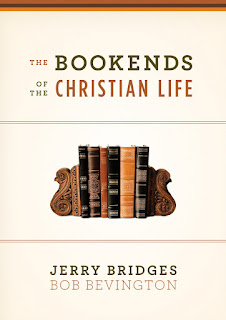
Book Review—The Bookends of the Christian Life

Jerry Bridges & Bob Bevington, The Bookends of the Christian Life. Wheaton, IL: Crossway Books, 2009.


If you’re like me, you may feel a little uncomfortable if someone asks you how you’re doing in your Christian living, especially if he gets too specific. “How’s your prayer-life?” “Are you consistent with daily devotions?” “Are you getting victory over sin and winning others to Christ?” Truth be known, I’m deficient in all these areas. Too often my life gets out of balance and seems hopelessly messed up. And I’m not eager for others to notice, but I could use a little help.

Jerry Bridges and Bob Bevington have co-written a book that aims to help believers stabilize their Christian lives in all of its aspects, whether “spiritual” or “temporal” (p. 13). The Bookends of the Christian Life, published by Crossway, is a 160-page exposition and application of two doctrines that are essential for successful Christian living. The authors use the illustration of books on a shelf supported by bookends to represent the various aspects of our lives being supported by these two doctrines.

The first bookend is the doctrine of the imputed righteousness of Jesus Christ. This is the righteousness that Christ earned for us by His life of perfect obedience all the way to death, even death on a cross. Why is this doctrine so important that believers must lean on it for support? Bridges and Bevington answer:

We know we need a Savior, so we trust in Christ to redeem us from the curse of God’s law. But though we believe we’re saved as far as our eternal destiny is concerned, we may not be sure about our day-to-day standing with God. Many of us embrace a vague but very real notion that God’s approval has to be earned by our conduct. We know we’re saved by grace, but we believe God blesses us according to our level of personal obedience. Consequently, our confidence that we abide in God’s favor ebbs and flows according to how we gauge our performance. (p. 21)

The authors show from Scripture that “[j]ust as God charged our sin to Christ, so he credits the perfect obedience of Jesus to all who trust in him” (p. 25). They also emphasize the scriptural truth that the believer’s justification for Christ’s sake is “a daily, present reality” and that “it’s this reliance on Christ alone, apart from any consideration of our good or bad deeds, that enables us to experience the daily reality of the first bookend, in which the believer finds peace and joy and comfort and gratitude” (p. 29).

Bridges and Bevington anticipate an objection to the doctrine of Christ’s imputed righteousness: What does it matter how I live if God sees me as righteous because of what Christ did? This objection they answer in chapter 2, “The Motivation of the Gospel.” The authors reference three scriptural examples of people who experienced God’s grace, the third being the Apostle Paul. Rather than causing Paul to “slack off in his pursuit of Christlikeness,” the gospel “motivated him to press on and strain forward” out of “love and gratitude for the righteousness of Christ that was his by faith” (p. 38).

The second bookend is the power of the Holy Spirit to supply “the strength to carry out our motivation” (p. 81). Bridges and Bevington make an interesting and convincing argument that “the Spirit applies his power to our lives in two different ways” (p. 86)—through his synergistic work and his monergistic work. The synergistic work referred to “isn’t a pure synergism, as if we and the Spirit each contributed equal power to the task. Rather, we work as he enables us to work, so we use the expression qualified synergism” (p. 87). The authors point us to Philippians 2:12–13 where we are to work out our own salvation because God is working in us. “We are to work—to apply ourselves with utmost seriousness and vigilance. But we’re to do so with the recognition that God provides us with both the motivation (the will) and the power (the work) to obey” (pp. 87–88). The Spirit’s monergistic work means that “he works alone in us and for us but completely independent from us” (p. 88). The authors point to Scriptures showing that believers are born of the Spirit, given new responses to God through the Spirit, and given assurance of salvation and encouragement in spiritual warfare and temptation through the Spirit (pp. 88–90).

But how does the believer apply this teaching of the Spirit’s work? Bridges and Bevington urge believers to take an attitude of “dependent responsibility.” Again, the authors present Paul as an example of working hard to become more Christlike, trusting the Spirit to provide the necessary power. “The Spirit’s role was not to make Paul’s own energy unnecessary but, rather, to make it effective” (p. 96).

The authors teach that leaning on both of these bookends will promote stability, joy, and peace in our lives and help us avoid those detrimental attitudes they label “Gospel Enemies”: self-righteousness, persistent guilt, and self-reliance. They devote a chapter to each of these enemies, providing lists of piercing questions by which we may test ourselves to reveal and defeat the enemy within. The book concludes with “The Bookends Personal Worldview,” that answers the question, “What’s next?” In the authors’ own words:

Instead of page after page and chapter after chapter of a storyline filled with self-righteousness, persistent guilt, and self-reliance, the pages and chapters of books that are stabilized by the bookends should tell an action-packed story of selfless serving, radical giving, and sacrificial living. The impact of being covered by the perfect righteousness of Christ and being enabled by the infinite power of the Holy Spirit should change everything. The result of living between the bookends should be a resounding, “Here am I, Lord; send me!” (p. 154)

I found this book enjoyable, yet challenging to read. The writing style is easy to follow, and their approach to explaining and applying Scripture reminds me of the Puritans; there is scholarship in all these pages, but the presentation is warmly devotional. In fact, Bridges and Bevington quote or paraphrase John Owen, Thomas Wilcox, Thomas Chalmers, and John Newton, along with several contemporary writers.

All believers, regardless of occupation or level of Christian growth, should be able to profit from reading this book. The gospel is so well-presented that the book might even be used in evangelism with people who are more thoughtful and open to discussion about theological matters. Pastors would also be helped by the message of this relatively short book. Bridges and Bevington tell the story of a pastor of a performance-driven mega church who recently rediscovered the gospel of Christ’s imputed righteousness and how that has changed his outlook on himself and his ministry.

I found myself thanking the Lord several times for the precious scriptural truths expounded and illustrated in Bookends. Though I’ve been in Christ a long time now, it’s been only in recent years that I’ve come to a clearer understanding of what Christ’s perfect obedience means for me. With God’s enabling, perhaps the books of my life will stand on the shelf a little more neatly, leaning firmly on the bookends!
Share/Bookmark

Sunday, June 15, 2008

"Doctrinal Preaching at its Best"

Today marks 8 years since the passing of James Montgomery Boice, who died June 15, 2000. Dr. Boice wore many hats: pastor, radio preacher, Christian leader, defender of the faith. I never heard Dr. Boice preach in person or even on his radio program. So, on this anniversary of his home-going I’d like to spotlight JM Boice in the role in which I know him best—author.

According to Theopedia, “Boice was a prolific author, having published over 50 different works, including a collection of hymns.” Many of Boice’s books are expositions of books of the Bible. Probably the first Boice book I ever purchased was his three-volume commentary on Genesis. Among others, I also have his commentary on the Minor Prophets and one of the volumes in his Romans series. How I wish I had bought all four volumes in that series when it was available in hardback!

Dr. Boice wrote other kinds of books as well as expositional commentaries. He wrote biblical/topical studies like Christ’s Call to Discipleship and Renewing Your Mind in a Mindless World: Learning to Think and Act Biblically. He also published a fine collection of his Easter sermons under the title, The Christ of the Empty Tomb.

Possibly the most important book Boice ever wrote (and this is just an opinion) is the four-books-in-one Foundations of the Christian Faith: A Comprehensive & Readable Theology (Downers Grove, Ill: InterVarsity Press. 1986). This 740-page hardcover consists of sermons he first preached to his own church, Tenth Presbyterian in Philadelphia. He revised the sermons and published them in four books from 1978 – 1981. The books appear as the four parts of the one-volume edition: The Sovereign God, God the Redeemer, Awakening to God, and God and History. What he gives us is a detailed, theological explanation of the Christian life, “a basic theology from A to Z” (Boice, Foundations of the Christian Faith, p. 11).

In this way Boice’s book is like Calvin’s Institutes of the Christian Religion, but without being a mere rehash. Boice describes his book as

an attempt (a) to cover the same ground in highly readable language yet at the same time (b) to introduce themes which Calvin did not treat but which call for treatment today and (c) to seek to relate all doctrine to contemporary rather than ancient views and problems. Book one deals with the doctrine of God and how we know God, book two with sin and the redemptive work of Christ, book three with the Holy Spirit and the application of redemption to the individual, and book four with the church and the meaning of history.

(Boice, p. 12)

Would we be able to comprehensively explain Christian theology to a new believer? Dr. Boice explained it to his congregation and made it available to the church at large. There is solid meat here. Even Christians from a non-Reformed tradition will find much to chew on. I highly recommend Foundations of the Christian Faith and agree with Cyril Barber that a work such as this “illustrates doctrinal preaching at its best” (Cyril J. Barber, The Minister’s Library, Vol. 2. Chicago: Moody Press, 1987. p. 187).

Do you have this book? What are your thoughts on it? Or do you have another favorite book by James Montgomery Boice? I hope we will soon see a book about James Montgomery Boice. Know of any biographies?


Share/Bookmark

Saturday, April 5, 2008

Resource on the Keswick Movement

Andy Naselli has posted links to a series of lectures he recently gave at Detroit Baptist Theological Seminary on the early Keswick movement. Andy wrote his doctoral dissertation on Keswick and has condensed it for these lectures, which are well worth listening to. You can also download his PowerPoint presentation and a five-page handout, both in PDF format. The handout contains an informative outline and a chart showing the different theological views on sanctification. “The manuscript for this lecture series is scheduled for publication in the fall 2008 Detroit Baptist Seminary Journal” (Andy Naselli). Andy’s work on Keswick is enlightening; it will help you understand the background and problems of some erroneous views of holiness that survive today.

mp3 lectures:

A Historical and Theological Survey of the Early Keswick Movement

A Theological Analysis of the Early Keswick Movement - Part 1

A Theological Analysis of the Early Keswick Movement - Part 2 (with Q & A)

Presentation

Handout


Share/Bookmark

Monday, January 21, 2008

Tim Challies' Blog Tour: The Discipline of Spiritual Discernment

Today is the final stop for Tim Challies' blog tour and he has answered a short series of questions for the SharperIron audience. I hope that you have been able to follow some of this tour. I have found it to be very interesting and challenging.

Challies, Tim. The Discipline of Spiritual Discernment. Forward by John MacArthur. Wheaton, Ill: Crossway Books, 2007. Softcover, 208 pages.

Purchase: [WTS ($11.04) | CBD ($12.99) | Amazon ($11.55)]

Read an excerpt
: The Heart and Head (BOUNDLESS webzine)

Endorsements

Tim Challies, a self-employed web designer, is a pioneer in the Christian blogosphere, having one of the most widely read and recognized Christian blogs. He is also editor of Discerning Reader, a site dedicated to offering thoughtful reviews of books that are of interest to Christians.

Review
: I have received a review copy of Tim's book and have made a quick skim of its contents. I found this book to be very readable and, in general, deliberately concerned with what the Scriptures teach as opposed to merely what Tim Challies thinks. Because of this, I believe that many Christians will find this to be a welcome addition to their reading lists. That said, I do not think, nor do I imagine that Tim would want us to think, that in this book the subject has been thoroughly exhausted. Rather, I hope that this little book will encourage others to pick up a Bible and pen to further the discussion of this vitally important spiritual discipline.

I hope that you will, at least, take the time to read up on today's Q&A with Tim at SharperIron.org and join the conversation.


____________________
Tim's Blog Tour
:

January 7Evangelical Outpost
January 8Tall Skinny Kiwi
January 9A-Team
January 10Adrian Warnock
January 11Gender Blog
January 14Jollyblogger
January 15Between Two Worlds
January 16TeamPyro
January 17Michael Spencer
January 18Church Matters
January 21SharperIron
____________________
Some Other Reviews of Tim's Book:

Share/Bookmark