Showing posts with label Today in Church History. Show all posts

Thursday, December 24, 2009

First Performance of Silent Night, 1818

On Christmas Eve in 1818 the song, "Silent Night" was performed for the first time. The setting was the Christmas Eve service at the Church of St. Nicholas in Oberndorf, Austria. Traditions abound concerning the circumstances of the song's composition. One of the most popular claims that the church's organ broke, so the pastor, Joseph Mohr, wrote something simple that could be played on guitar. However, a manuscript of the song was found in Mohr's handwriting that has 1816 as the year the words were written. Franz Gruber wrote the music probably in 1818, and John Freeman Young translated the original German into English in 1859 or 1863. Wikipedia gives 1859 as the year.

Whatever were the actual circumstances, it is obvious that "Silent Night" has become one of the most popular Christmas carols ever. It's popularity was seen dramatically almost a hundred years later in the trenches of World War I during the Christmas Truce of 1914. On Christmas Eve German troops began singing some of their carols , and the British responded with English carols. Both sides sang "Silent Night" in their own languages because it was one of the few carols that they all knew. It was a time of unofficial cease-fire, peace, and even camaraderie. The opponents shouted greetings to each other, came out of their trenches, and exchanged gifts before the fighting resumed a few days later.

The song's message of "the dawn of redeeming grace" arouses our desire for the noon day, when redeeming grace shines brightest at Christ's return and we have real, lasting peace.

Silent night, holy night,
All is calm, all is bright
Round yon virgin mother and Child.
Holy Infant, so tender and mild,
Sleep in heavenly peace,
Sleep in heavenly peace.

Silent night, holy night,
Shepherds quake at the sight;
Glories stream from heaven afar,
Heavenly hosts sing Alleluia!
Christ the Savior is born,
Christ the Savior is born!

Silent night, holy night,
Son of God, love’s pure light;
Radiant beams from Thy holy face
With the dawn of redeeming grace,
Jesus, Lord, at Thy birth,
Jesus, Lord, at Thy birth.

Silent night, holy night
Wondrous star, lend thy light;
With the angels let us sing,
Alleluia to our King;
Christ the Savior is born,
Christ the Savior is born!


A good resource on this and other hymns is Treasury of Great Hymns and Their Stories by Mrs. Guye Johnson (appears to be out of print).
Share/Bookmark

Monday, December 21, 2009

D.A. Carson (December 21, 1946)

Happy birthday to D.A. Carson, born in Ottawa, Canada on this day in 1946. A pastor's son, Dr. Carson is research professor at Trinity Evangelical Divinity School in Deerfield, Illinois, where he has been since 1978. From the Gospel Coalition website:

Carson came to Trinity from the faculty of Northwest Baptist Theological Seminary in Vancouver, British Columbia, where he also served for two years as academic dean. He has served as assistant pastor and pastor and has done itinerant ministry in Canada and the United Kingdom.

Carson received the Bachelor of Science in chemistry from McGill University, the Master of Divinity from Central Baptist Seminary in Toronto, and the Doctor of Philosophy in New Testament from the University of Cambridge.

Dr. Carson is a biblical scholar with a pastoral heart. For more reflections on this theme see Jason's article on Carson from last December. I have profited from Carson's technical commentaries and from the more popular-level biblical studies he has written. Quite possibly the most helpful books I've read from him so far have been Exegetical Fallacies and A Call to Spiritual Reformation: Priorities from Paul and His Prayers. The former helped me to rightly interpret Scripture better; the latter helped me pray more scripturally-informed prayers.

A bibliography of D.A. Carson's published works can be found here on the Gospel Coalition website. Also available is an extensive collection of mp3 sermons and lectures by Carson, collected by Andy Naselli.

Do you have favorite books or sermons by D.A. Carson? How has he helped you the most? Let us know in the comments.
Share/Bookmark

Tuesday, December 8, 2009

The Triumph of John and Betty Stam

75 years ago today John and Betty Stam, missionaries to the Chinese, were killed by Communist soldiers in a public execution, along with the town doctor, who had pleaded for their lives. The Stams were captured while trying to leave the town of Tsingteh with their 3 month old daughter, Helen. Mrs. Stam managed to hide her baby, who was later found by Christians and returned to America. John and Betty showed the courage of those who know who holds their future. In the words of Mrs. Howard Taylor:

Those who witnessed the tragedy marveled, as they testify, at the calmness with which both John and Betty faced the worst their misguided enemies could do. Theirs was the moral, spiritual triumph in that hour when the very forces of hell seemed to be let loose. Painfully bound with ropes , their hands behind them, stripped of their outer garments and John barefooted (he had given Betty his socks to wear), they passed down the street where he was known to many, while the Reds shouted their ridicule and called the people to come and see the execution.

Like their Master, they were led up a little hill outside the town. There, in a clump of pine trees, the communists harangued the unwilling onlookers, too terror-stricken to utter protest. But one man broke the ranks! The doctor of the place and a Christian expressed the feelings of many when he fell on his knees and pleaded for the life of his friends. Angrily repulsed by the Reds, he still persisted, until he was dragged away as prisoner, to suffer death when it appeared that he too was a follower of Christ.

John had turned to the leader of the band, asking mercy for that man, when he was sharply ordered to kneel - and the look of joy on his face afterward told of the unseen Presence with them as his spirit was released. Betty was seen to quiver, but only for a moment. Bound as she was, she fell on her knees beside him. A quick command, the flash of a sword, which mercifully she did not see - and they were reunited.
--Mrs. Howard Taylor. John and Betty Stam: A Story of Triumph (Chicago: Moody Press, 1982) pp. 119-120

Though they had only a short ministry, John and Betty Stam's faith in Christ encouraged many nationals to continue giving the Gospel and inspired many others to become missionaries. God made the wrath of man to praise Him. He didn't forget or forsake His suffering servants; He honored them.

Others suffered mocking and flogging, and even chains and imprisonment. They were stoned, they were sawn in two, they were killed with the sword. They went about in skins of sheep and goats, destitute, afflicted, mistreated— of whom the world was not worthy.
--Hebrews 11:36-38
See also-
Vance Christie. John and Betty Stam: Missionary Martyrs (Christian Focus Publications, 2008)
Share/Bookmark

Wednesday, July 29, 2009

Herman Bavinck - "I have my faith, and in this I have all"

In the providence of God, Bavinck's life ended unexpectedly, at a time when he was still engaged in a variety of academic, political, cultural, and church activities. After offering an eloquent address on the floor of the synodical meeting of the Reformed churches in Leeuwarden, Bavinck suffered a heart attack, from which he first rallied but never fully recovered. After a prolonged period of illness, Bavinck "fell asleep" in the Lord on July 29, 1921. Among the poignant memories recorded of visits with Bavinck at the time was his reply to the question of whether he was afraid to die: "My dogmatics avail me nothing, nor my knowledge, but I have my faith, and in this I have all."

(Cornelis P. Venema, "Herman Bavinck: His Life and Theology,"New Horizons, October 2008)
For a helpful introduction to the life and theology of Herman Bavinck, I recommend the following brief articles:
I also commend to you his magnum opus, Bavinck's Reformed Dogmatics. 4 Volumes. Edited by John Bolt and translated by John Vriend. Grand Rapids, Mich.: Baker Academic, 2003 - 2008. Hardcover, 3,008 pages.


Share/Bookmark

Friday, July 10, 2009

Calvin Glorifies God for His Mercy

Today is the 500th birthday of one of the most loved and most hated men in the history of Christianity—John Calvin. Much misunderstanding and misrepresentation of his character and teaching persist to this day despite abundant evidence that he truly was a man whose heart God had touched. In the hope of shedding some light on Calvin's Christian character, I'd like to offer this excerpt from his Last Will and Testament, quoted in Thine Is My Heart as the devotion for December 30:
In the first place, I render thanks to God, not only because he has had compassion on me, his poor creature, to draw me out of the abyss of idolatry in which I was plunged, in order to bring me to the light of his gospel and make me a partaker of the doctrine of salvation, of which I was altogether unworthy, and continuing his mercy he has supported me amid so many sins and shortcomings, which were such that I well deserved to be rejected by him a hundred thousand times—but what is more, he has so far extended his mercy towards me as to make use of me and of my labor, to convey and announce the truth of his gospel; protesting that it is my wish to live and die in this faith which he has bestowed on me, having no other hope for refuge except in his gratuitous adoption, upon which all my salvation is founded; embracing the grace which he has given me in our Lord Jesus Christ, and accepting the merits of his death and passion, in order that by this means all my sins may be buried; and praying him so to wash and cleanse me by the blood of this great Redeemer, which has been shed for us poor sinners, that I may appear before his face, bearing as it were his image.

I protest also that I have endeavored, according to the measure of grace he has given me, to teach his word in purity, both in my sermons and in my writings, and to expound faithfully the Holy Scriptures; and moreover, that in all the disputes I have had with the enemies of the truth, I have never made use of subtle craft nor sophistry, but have gone to work straightforwardly in maintaining his quarrel. But alas! the desire which I have had, and the zeal, if so it must be called, has been so cold and so sluggish that I feel myself a debtor in everything and everywhere, and that, were it not for his excellent goodness, all the affection I have would be but as smoke, nay, that even the favors which he has accorded me would render me so much the more guilty; so that my only recourse is this, that being the Father of mercies, he will show himself the Father of so miserable a sinner.
Though Calvin was aware of his redemption by God, his affection for God, and his usefulness to God, he knew himself to be a sinner and dared not trust the sweetest frame, but wholly leaned on Jesus' Name. Sounds like a brother to me!
Share/Bookmark

Sunday, June 14, 2009

Thomas Smyth, A Gospel-Centered Pastor

Today marks the 201st anniversary of the birth of one of Charleston, South Carolina's notable pastors, Thomas Smyth (June 14, 1808 - August 20, 1873). I have already offered highlights of his life and ministry here, so I'll use this post to share an excerpt from his little book Why Do I Live? I just recently found this copy for sale and it is the first of his works that I have purchased. I have also recently downloaded most of the 10-volumes of his collected works from Google Books.

Upon receiving this book in the mail, I immediately sat down and began reading through it. I found it to be a breath of fresh, Gospel-saturated air. This excerpt shows Smyth's passion for calling Christians to live the life they have been freed to live in Christ (something woefully absent from many contemporary books). This is from Chapter VIII, The Living Christian Stimulated.
To be a Christian is a glorious privilege, and a divine honor. It is "a high calling, a royal priesthood." It is to be "a Son of God," "a joint-heir with Christ," and "a partaker of the divine nature." It is to be filled with heaven-borrowed thoughts of joys to come, and to walk the earth with inward glory crowned.
"Earth's fairest scenes the Christian calls his own;
He is a monarch, and his throne
Is built amid the skies."

But to be a Christian is to be more than a member of the church. That which makes any man a Christian is union to Christ, and conformity to him. The sum of religion, as even a heathen could express it, is to be like God whom thou worshipest. This then is Christianity, to believe in Christ as "God manifest in flesh," to come to Christ, to be united to Christ, to be in all things subject to Christ, to live in Christ, to live for Christ, and in all things, in all ways, and in all events to follow Christ. It is to become partakers in the benefits of Christ's obedience, sufferings, and death, that we may have fellowship with him also in his life and glory. It is to be crucified together with Christ, dead with Christ, buried with Christ, and risen with Christ. Oh, see to it that thy heart is sincerely Christ's. As this piety alone will meet acceptance at the inevitable day of heart-revealing, heart-approving, or heart-condemning, "work out your salvation with fear and trembling." Be very sure that your heart closes with Christ, and is fixed upon him, and living by faith on him.

Are you indeed a Christian? Then you have seen the plague of your own heart, felt the direful corruption of sin, and are most anxious for deliverance from it. You know how it defiles, like leprosy, our houses, the very walls and floors, our meat and our drink, and every thing we touch. Polluting when alone, and polluting in society, it leads to misery and death, burdens the whole creation, and "presses groans out of the very frame of the earth itself." You cannot but desire to have your soul purified from this foul and loathsome disease, that, elevated above all the mists and impurities of inordinate worldly affections, the light of divine grace may shine unobstructed into your heart and be reflected with power upon the observing hearts of those around you. Let it be thus seen that you are not a mere hearer of the word, but a doer of it; a partaker of Christ; one who feels his guilt and the greatness of that love which led Christ to die for him; one who has been washed and made clean in the fountain opened in Christ's blood for sin and uncleanness; one who constantly draws living waters from the wells of salvation, and one whose whole conduct savors of his secret and habitual converse with Christ in the recesses of his own heart.

Christ became like us, for the very purpose that we might thus become like him. Christ took upon him our nature that he might, by the mighty working of his Holy Spirit, make us alive unto God, new creatures, a peculiar people, zealous of good works, finding our meat and our drink in doing his will.

Yes, Christian, you are set for the rising or fall of those around you. You are an epistle of Christ, read either to the conviction and conversion, or to the condemnation of many. Your life is your testimony for or against Christ. By it you proclaim the truth or falsity of your own profession, and as far as your influence extends, even of the religion you profess. (pp. 67-68)

Share/Bookmark

Thursday, April 9, 2009

Dietrich Bonhoeffer Suffered the Cost of His Theology

On that Low Sunday of April 9th, 1945 - less than a month before General Patton's Allied armies closed in and overthrew the Nazi regime, Bonhoeffer was taken to the notorious concentration camp at Flossenbürg. Several of his friends from the Resistance were already there, being tried and executed - by special order of the High Command. The final testimony of Bonhoeffer's faith and courage was given by a camp doctor who would never quite understand that what he witnessed at the scaffold, was the costly application of a man's theology. (Ben Alex, Dietrich Bonhoeffer: The Pastor Who Followed Christ to the Cross, illustrated by Musio Cosimo. Waynesboro, GA: OM Literature, 1996, pp 46-47.)

This evening I read John Piper's brief post on Bonhoeffer which informed me that today is the 64th memorial of his death. I Twittered a quick note about this and sat down to browse through a book that was sent to me by the publicist at Augsburg Books titled 40-day Journey with Dietrich Bonhoeffer. This is a wonderful book to use devotionally, but I was interested to see what was providentially included for the 9th day. For Day 9, Ron Klug, the editor, chose a portion of Bonhoeffer's comments on the second Beatitude (Mathew 5:4). Here is an excerpt from today's reading:
The community of disciples does not shake off suffering, as if they had nothing to do with it. Instead they bear it. In doing so, they give witness to their connection with the people around them. At the same time this indicates that they do not arbitrarily seek suffering, that they do not withdraw into willful contempt for the world. Instead, they bear what is laid upon them and what happens to them in discipleship for the sake of Jesus Christ. ... The disciples bear the suffering laid on them only by the power of him who bears all suffering on the cross. As bearers of suffering, they stand in communion with the Crucified. (p. 36)
This selection is taken from Dietrich Bonhoeffer. Discipleship, Dietrich Bonhoeffer Works, Vol. 4. Minneapolis Fortress Press, 2001; p. 104. You can also find it in Dietrich Bonhoeffer, The Cost of Discipleship, New York: Touchstone, 1995; part II, chapter 6, pp. 105-14.
Share/Bookmark

Thursday, March 26, 2009

John Baillie's A Diary of Private Prayer

John Baillie, a Scottish theologian, was born on March 26, 1886. I am still learning about his life and ministry, but in the meantime I have been waiting for an opportunity to introduce to you his little book titled A Diary of Private Prayer (1936). It is regarded as a devotional classic and has been a tremendous blessing to me as I have used it over the past year.

Many of you are familiar with The Valley of Vision: A Collection of Puritan Prayers and Devotions which is also an excellent devotional tool. I have turned to Baillie's book far more often for its readability, adaptability to your own praying, and clarity. I have found three or four copies at yard sales and flea markets for very cheap. You can also purchase and inexpensive paperback edition online.

This book is designed to guide the worshiper in developing a regular pattern of offering morning and evening prayers. Here is this morning's prayer:
O Thou to whom I owe the gift of this day's life, give to me also, I beseech Thee, the spirit to use it as I ought. Forbid that I should stain the brightness of the morning with any evil thought or darken the noontide with any shameful deed. Let Thy Holy Spirit breathe into my heart to-day all pure and heavenly desires. Let Thy truth inform my mind. Let Thy justice and righteousness make a throne within me and rule my errant will. Let Christ be formed in me, and let me learn of Him all lowliness of heart, all gentleness of bearing, all modesty of speech, all helpfulness of action, and promptness in the doing of my Father's will.

O Thou who compassest the whole earth with Thy most merciful favour and willest not that any of Thy children should perish, I would call down Thy blessing to-day upon all who are striving towards the making of a better world. I pray, O God, especially--
for all who are working for purer and juster laws:
for all who are working for peace between the nations:
for all who are engaged in healing disease:
for all who are engaged in the relief of poverty:
for all who are engaged in the rescue of the fallen:
for all who are working towards the restoration of the broken unity of the Holy Church:
for all who preach the gospel:
for all who bear witness to Christ in foreign lands.
Cast down, O Lord, all the forces of cruelty and wrong. Defeat all selfish and worldly-minded schemes, and prosper all that is conceived among us in the spirit of Christ and carried out to the honour of His blessed name.
Amen.
For more biographical information about Baillie, I would direct you to begin with The Baillie Project.
Share/Bookmark

Sunday, March 1, 2009

Martyn Lloyd-Jones Faced Death with Joy

On this day in 1981 Welsh preacher Martyn Lloyd-Jones finished his earthly pilgrimage and entered the presence of his Savior. He had suffered from throat cancer for many months until he was no longer able to speak. When he realized his condition would not improve, he decided to suspend further treatments and requested his family not to pray for healing: "Do not hold me back from the glory." He was ready to meet the Lord.

Lloyd-Jones' refusal to take antibiotics caused his doctor to say, "It grieves me to see you sitting here 'weary and worn and sad.'" ML-J's reply was one of the last things he was heard to say: "Not sad!". . ."Not sad!" While reading Scripture with his daughter Elizabeth (2 Cor. 4:16-18), she asked her father if his experience was like the Apostle Paul's—the inner man being renewed and his light affliction working glory for him. Though unable to speak, "he nodded his head with great vigour."

Martyn Lloyd-Jones faced death the way he had faced life, trusting completely in Christ and His imputed righteousness. He was a successful and well-respected preacher, but he didn't rely on his success for his joy. Several months before his death he impressed upon his biographer, Iain Murray, the importance of Christ's command to His disciples after a successful mission: "Notwithstanding in this rejoice not that the spirits are subject unto you; but rather rejoice, because your names are written in heaven" (Luke 10:20).
'Bear that in mind,' he said solemnly. 'Our greatest danger is to live upon our activity. The ultimate test of a preacher is what he feels like when he cannot preach.' Our relationship to God is to be the supreme cause of joy. To lean upon our sermons or words of testimony from others is 'a real snare for all preachers'. 'We cannot lean on them'. (Iain H. Murray, D. Martyn Lloyd-Jones: The Fight of Faith 1939-1981; Edinburgh: Banner of Truth Trust; 1990. p. 738, emphasis mine)
On the night of February 28, 1981 Lloyd-Jones read Scripture, and his daughter Ann prayed with him before he fell asleep. Sometime during the early morning hours of March 1 he awoke in the presence of the Lord. On this day we remember David Martyn Lloyd-Jones, who faithfully expounded the Word, gave us a sense of the presence of God, and modeled what he preached in his living and dying.

As for me, I will behold thy face in righteousness: I shall be satisfied, when I awake, with thy likeness (Psalm 17:15).
Share/Bookmark

Thursday, January 8, 2009

Martyrdom of Jim Elliot and his missionary team, 1956

Yesterday evening I browsed through a local LifeWay bookstore with my children. Just before we left I noticed a display stand that had a number of beautifully reprinted classic biographies. Upon further investigation I discovered that they were Hendrickson's Classic Biographies Series. This is a series I had overlooked during 2008 but would have gladly been included on my list of Noteworthy Book Recommendations 2008. In this series is a reprinting of Elizabeth Elliot's Shadow of the Almighty: The Life and Testament of Jim Elliot. The story of Jim Elliot was a great inspiration to me during my college years, and while I contemplated service on the foreign mission field. This book truly is a classic and it ought to owned and read by every Christian family.

Fred Sanders has written another fine article (Today Jim Elliot Was Killed [1956]) on the martyrdom of Jim Elliot and his friend on January 8, 1956.

_______________
Other titles in the Hendrickson Classic Biography Series are as follows:
forthcoming:
All of these volumes are hardback (cloth) with dust jackets and have been freshly typeset. These truly are beautiful volumes, some of which I only own in paperback editions. At very affordable prices this series of biographies would serve the Christian home very well. I can think of other biographies that ought to be in this series, but they may be in the works already.
Share/Bookmark

Wednesday, January 7, 2009

The Athanasian Canon Declared in 367

In his Thirty-Ninth Festal Letter of 367, Athanasius set forth a list of OT and NT books that he and many other Christians had accepted as canonical (standard) and authoritative for obtaining the knowledge of life and godliness. Here is an excerpt from this letter:

4. There are, then, of the Old Testament, twenty-two books in number; for, as I have heard, it is handed down that this is the number of the letters among the Hebrews; their respective order and names being as follows. The first is Genesis, then Exodus, next Leviticus, after that Numbers, and then Deuteronomy. Following these there is Joshua, the son of Nun, then Judges, then Ruth. And again, after these four books of Kings, the first and second being reckoned as one book, and so likewise the third and fourth as one book. And again, the first and second of the Chronicles are reckoned as one book. Again Ezra, the first and second (i.e. Ezra and Nehemiah) are similarly one book. After these there is the book of Psalms, then the Proverbs, next Ecclesiastes, and the Song of Songs. Job follows, then the Prophets, the twelve being reckoned as one book. Then Isaiah, one book, then Jeremiah with Baruch, Lamentations, and45454545 i.e. Baruch vi.—The Syriac has the conjunction, which is rejected by the Benedictine editors. the epistle, one book; afterwards, Ezekiel and Daniel, each one book. Thus far constitutes the Old Testament.

5. Again it is not tedious to speak of the [books] of the New Testament. These are, the four Gospels, according to Matthew, Mark, Luke, and John. Afterwards, the Acts of the Apostles and Epistles (called Catholic), seven, viz. of James, one; of Peter, two; of John, three; after these, one of Jude. In addition, there are fourteen Epistles of Paul, written in this order. The first, to the Romans; then two to the Corinthians; after these, to the Galatians; next, to the Ephesians; then to the Philippians; then to the Colossians; after these, two to the Thessalonians, and that to the Hebrews; and again, two to Timothy; one to Titus; and lastly, that to Philemon. And besides, the Revelation of John.

6. These are fountains of salvation, that they who thirst may be satisfied with the living words they contain. In these alone is proclaimed the doctrine of godliness. Let no man add to these, neither let him take ought from these. For concerning these the Lord put to shame the Sadducees, and said, ‘Ye do err, not knowing the Scriptures.’ And He reproved the Jews, saying, ‘Search the Scriptures, for these are they that testify of Me (Matt. xxii. 29; John v. 39).’ (read in full at Bible Research or CCEL)

Read also:

Share/Bookmark

Tuesday, January 6, 2009

C. H. Spurgeon's Conversion

We have noted on the TheoSource Calendar that today marks the "traditional" date of C. H. Spurgeon's conversion. The account of this event is a favorite and one I have heard used as an illustration more times than I can count. Fred Sanders provides a great article about Spurgeon's conversion, a bit of "useful" controversy regarding the precise date of the event, and Spurgeon's own recounting of this life-changing event. Give it a read!

Many thanks to Fred Sanders for posting this article. (I wish we could contract him to contribute to our Today in Church History Series. ;) He's been doing a great job over the past few days: Zwingli, Thérèse of Lisieux, E. Stanley Jones, James Ussher, Robert Morrison.)

You may also be interested in reading our articles on Spurgeon's birthday and the day he passed away.
Share/Bookmark

Sunday, January 4, 2009

Archbishop James Ussher (1581 - 1656)

James Ussher, Anglican bishop of Armagh, Ireland, was born January 4, 1581 in Dublin. He was a godly scholar whose best-remembered work is probably his Annals of the Old Testament, deduced from the first origins of the world. Ussher traces the date of creation to 4004 BC. Fred Sanders at The Scriptorium tells about Ussher's scholarly work, especially in producing his famous chronology:

Ussher excelled all previous attempts mainly by his precision and his encyclopedic learning: he correlated Biblical accounts with classical and Middle Eastern history, and with Jewish calendar systems. He made independent judgments about the superiority of the Hebrew text to the Greek translation of the Old Testament, about reconciling the Julian calendar to the Gregorian, and about anything else that got in his way. All in Latin, all festooned with quotations from classical authors. The sheer erudition of Ussher’s work convinced many people, and his dates made it into the margins and headers of a series of influential Bibles, from eighteenth-century editions of the King James Bible down to Scofield’s Reference Bible.

Ussher’s chronology is famous now because of controversies of our own time: His Annals are back in print because of young-earth creationist demand, and his dating of creation has been ridiculed in public discourse since Inherit the Wind.

Read the whole article. It's very interesting.

It's also interesting to note Ussher's reputation for godliness and scholarship in his own time. During England's Civil War Ussher was loyal to King Charles I and turned down an invitation to be part of the Westminster Assembly of Divines in 1643. He lived out his last years in London under the protection of a Countess. Yet when he died in 1656 Oliver Cromwell insisted that the archbishop have a state funeral and be buried in Westminster Abbey. Wikipedia has more on the life of Archbishop Ussher.

Master Books reprinted Ussher's chronology in 2003 in updated English under the title, Annals of the World. Copies are also available from Amazon in both hardback and paperback.
Share/Bookmark

Saturday, January 3, 2009

Martin Luther Excommunicated, 1521

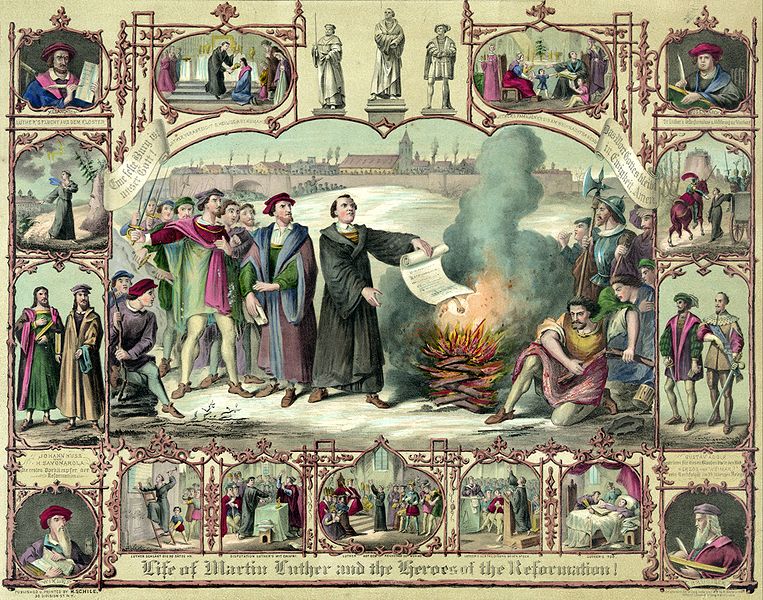
On January 3, 1521 the Vatican published the bull Decet Romanum Pontificem ([It] Befits [the] Roman Pontiff), excommunicating Martin Luther for Luther's refusal to recant. The pope had issued a previous bull, Exsurge Domine (Arise, O Lord), giving Luther 60 days to recant and another 60 days to make his recantation known to Rome. Meanwhile, Luther's books were being burned for allegedly containing heresy. On December 10, 1520 Luther responded by publicly burning his copy of Exsurge Domine.

The Church usually handed excommunicated persons over to civil authorities to be burned at the stake. However, circumstances prevailed that spared Martin Luther this fate and paved the way for Luther's stand at the Diet of Worms in April 1521. The pure teaching of Scripture would not be snuffed out by the flames.

Luther wasn't looking to split the Church; he wanted the Church to institute reforms and took a more conciliatory tone at first in his writings. When it became clear that the pope cared not at all for Scripture and reason, only for Luther's recantation, Luther rose to the challenge and prepared to take his stand. The truth of God's Word, long muffled or distorted by the noise of human traditions, would find a voice in Martin Luther and others willing to risk everything on the authority and benevolence of Sola Scriptura.
___________________
Sources:
Roland H. Bainton, Here I Stand: A Life of Martin Luther (Plume, 1995)
[Republished in a very nice hardcover by Hendrickson Publishers in 2009: see here.]
Encyclopedia Britannica
Wikipedia
Share/Bookmark

Thursday, January 1, 2009

Courage in Light of History

“To know the limbs and leaps of history is hardly worth a cent. The only thing which counts is that you become more certain of your God as you contemplate the past, and that you then show more courage in the face of present needs!”
--Ulrich Zwingli, Swiss Reformer and contemporary of Martin Luther and John Calvin, born January 1, 1484

For information on the life and ministry of Ulrich Zwingli see Jason's article on Zwingli and take note of his biographical sources.

Praise the LORD! Blessed is the man who fears the LORD, who greatly delights in his commandments! . . . He is not afraid of bad news; his heart is firm, trusting in the LORD. (Psalm 112: 1, 7)
Share/Bookmark

Monday, December 29, 2008

James Petigru Boyce as Seminary Librarian

Yesterday was the 120th anniversary of the death of James Petigru Boyce. Below you will find a notice from the Boyce Centennial Library (at the Southern Baptist Theological Seminary, Louisville, KY) regarding a special exhibit currently on display.
James P. Boyce as Seminary Librarian

December 28th marks the 120th anniversary of the death of James P. Boyce. In honor of this occasion, the Archives and Special Collections of the James P. Boyce Centennial Library is currently displaying an exhibit entitled, “James P. Boyce as Seminary Librarian”. The exhibit includes the two-volume catalog of Dr. Boyce’s personal library, as well as representative materials from the his personal library that he bequeathed to the seminary. The exhibit will be on display until March 10, 2009, and is available for viewing from 9 AM to 5 PM, Monday through Friday in the Billy Graham Room on the second floor of the library.

The library also offers a short biography and listing of the works of Boyce: James P. Boyce Papers (inventory).

There is also some helpful information on James P. Boyce posted at the Reformed Reader.

Boyce's Abstract of Systematic Theology can be read online at the Founders Ministries website.

Two other helpful biographical sources on Boyce are as follows:
To the left are three pictures I took of street signs in the Pettigru Historic District in Greenville, SC. The Southern Baptist Theological Seminary has its origin in Greenville very near to the location of this beautiful neighborhood. Prior to the Civil War the seminary was founded by John Albert Broadus, Basil Manl, Jr., Wiliam Williams, and James Petigru Boyce in 1859. The seminary was located within First Baptist Church and Boyce served as the first president.

Boyce's estate was located in the area now desgnated as the Pettigru Historic District. Many of the streets bear the names of the founders and professors of the seminary (Boyce, Pettigru, Manly, Broadus, Williams, Whitsett, and Toy). (View this at Google Maps.) The top photo is the intersection of Manly and Pettigru. The middle photo shows a sign for the Pettigru Historic District along with Boyce avenue. The bottom photo is another intersection of Boyce avenue.

HT: Michael Haykin at The Andrew Fuller Center for Baptist Studies
Share/Bookmark

Saturday, December 27, 2008

B.H. Carroll - Southern Baptist Pastor and Educator

Benajah Harvey Carroll was born December 27, 1843 in Carroll County, Mississippi to Baptist minister Benajah Carroll. The younger Carroll was "a dedicated infidel until his conversion in 1865" (Warren W. Wiersbe, Walking with the Giants, Grand Rapids: Baker Book House, 1976, p. 123). Wiersbe describes this self-made scholar's struggle to maintain his unbelief and Christ's ultimate victory over human wisdom and stubborn resistance (ibid., pp. 123-124). Shortly after fighting in the Confederate army (1862-64) Carroll turned to Christ and devoted his life to the Lord's service in the ministry.

B.H. Carroll had a remarkable intellect. Excelling as a debater in matters of theological controversy, Carroll rose to leadership in the Baptist General Convention of Texas and the Southern Baptist Convention. For more information on these controversies see the Wikipedia article on Carroll. He was pastor of the First Baptist Church of Waco, Texas and went on to become one of the founders of the Southwestern Baptist Theological Seminary in Fort Worth, Texas, serving as president until his death in 1914.

Though Carroll was Southern Baptist, he was not a premillennial dispensationalist. He was postmillennial, believing in the power of the Holy Spirit to convert the majority of people through the church's testimony. Then Christ would come and establish His kingdom on earth. Carroll attacked dispensationalists for "their pessimism about the success of the Holy Spirit and the success of churches" (Wikipedia).

BH Carroll's greatest legacy is probably his 13-volume magnum opus, An Interpretation of the English Bible, reprinted in 6 volumes by Baker Book House in 1973.
It is not actually a commentary; it is an "interpretation" on a grand scale. Sometimes Carroll pauses to preach a sermon; he may linger for pages on one verse, or he may skip over entire sections. I am glad the editors have not deleted his "asides," because they are sometimes the most interesting parts of a chapter! . . .

Some students differ with Carroll's doctrine of the church or his views on prophecy, but these differences should not rob them of the values of this set of Biblical studies . . . If a young pastor started reading this set faithfully and read only fifty pages a week, he would complete the set in about two years and would have a knowledge of the Word of God from which he would profit for the rest of his ministry. If you only "consult" these books, you may be disappointed; but if you read them seriously, you will be enriched.
(Wiersbe, pp. 125-126)
Happy birthday to one of the lesser known giants of the faith! At the very least, BH Carroll's example should inspire us to excel in the serious study of the Bible that we are called to live and preach.
Share/Bookmark

Sunday, December 21, 2008

D. A. Carson, A Gospel-Centered Man

The second of three children, Donald Arthur Carson was born on December 21, 1946, to Thomas Donald McMillan Carson and his wife Elizabeth Margaret (née Maybury).
(D. A. Carson," by Andreas J. Köstenberger in Bible Interpreters of the 20th Century [Baker Books, 1999], 423)
While many know D. A. Carson for his mind and his impressive scholarly writings, few people know the heart that produces those works. It is especially obvious in How Long, O Lord? Reflections on Suffering an Evil and A Call to Spiritual Reformation: Priorities from Paul and His Prayers, which give evidence of a deeply personal faith.

Though Carson is a very private person, his friends attest to his devotion to family and his true pastor's heart. (ibid, 423)

I would add that Carson's biographical sketch of his father, Memoirs of an Ordinary Pastor: The Life and Reflections of Tom Carson (Crossway, 2008), naturally opens the veil to understanding more about Carson himself. I began by titling this post, "D. A. Carson, A Gospel-Centered Pastor/Scholar," and while this is true, I think that it falls a bit short. I have been deeply impressed through what I have read and heard that Carson strives to be a well-rounded man: husband, father, friend, pastor, teacher, scholar, etc. That's a goal many tragically loose sight of: striving for faithfulness and balance in each God-given role. I'm sure that he is not a perfect example (who is?), but his testimony in this regard has been encouraging to me.

It has only been during the past few years that I have begun to read some of his works and listen to some of his sermons and lectures. I just recently finished listening to a series of sermons he preached on the Doctrine of the Last Things, a five part series dealing with chapters 4, 5, 12, 13 and 21 of the book of Revelation, and was tremendously blessed by it. I would recommend that you also check out Andy Naselli's theology blog for more links and information about D. A. Carson.
Share/Bookmark

Tuesday, December 16, 2008

George Whitefield, A Preacher with Power

Today is the 294th anniversary of the birth of George Whitefield, December 16, 1714. Last year, Tim Ashcraft wrote a fine biographical sketch of Whitefield that I would encourage you to read. A list of resource on Whitefield is also offered there.

This morning, I opened up Iain Murray's Lloyd-Jones: Messenger of Grace (BOT, 2008) and found a section in chapter two, "Preaching and the Holy Spirit," where Murray draws a comparison between Whitefield and Lloyd-Jones in order to illustrate the necessity of power in preaching. This is penetrating:
There is an obvious reason why preaching too often lacks the ability to hold the interest of those who listen. It is because the word spoken has no more than a fleeting access to the hearer's mind. A statement is briefly heard only to be crowded out by the individual's own thoughts, which he may well find more interesting and pleasant. Thus the twenty or forty minutes of a sermon may pass, with a person in the pose of a listener, yet actually paying attention to very little. In contrast, powerful preaching takes hold of the whole person. It gets within a man. It first arrests the mind and then speaks to the heart, the conscience, and the will. Where this element is present inattention becomes a near impossibility. Skilful oratory and carefully crafted speech can go some way to hold the hearers but it does not command attention in this manner. Powerful preaching penetrates more than the surface of the mind; it does more than merely present teaching; it is capable of causing a moral and emotional earthquake - 'not simply with words, but also with power, withthe Holy Spirit, and with deep conviction' (1 Thess. 1:4).

An eighteenth-century church-goer who was also a shipbuilder confessed that he had often built a ship from stem to stern during a sermon, but when he heard George Whitefield he found himself unable to lay a single plank. The reason for this was noted by another of the evangelist's hearers: 'Whitefield preached like a lion, he spoke as one conscious of his high credentials, with authority and power.' So it was with Lloyd-Jones. His message often carried the conviction that it was more important than any other possible consideration. (pp. 34-35, emphasis mine)

Share/Bookmark

Saturday, December 13, 2008

Notes on the Life of John B. Adger (December 13, 1810 - January 3, 1899)

The Adger family has deep roots in Charleston, SC, and John Bailey Adger was the son of a prominent businessman in Charleston. North and South Adger's Wharf are two short, cobblestone roads near the Charleston Battery named for the location of his father's shipping company, James Adger & Co.

As I began to study the history of John L. Girardeau, about five years ago, I got drawn into the mix of his associates. Two, in particular, are Thomas Smyth and John B. Adger. Today, I have been rediscovering some of the highlights of the life of John B. Adger in the books I've collected and in a few sources I've located online. What follows are quotes from some of these sources and links to others.

"REVIEWS AND NOTICES," in Publications of the Southern History Association, Volume IV, (Washington, DC: The Association, 1900), pp. 482-84.

My Life and Times, 1810-1899. By John B. Adger, D. D. Richmond, Va.: The Presbyterian Committee of Publication, 1899, large 8vo., pp. 681, cloth, portraits, $3.00.

The Adgers were Huguenots who found their way from France into the province of Ulster, Ireland. They aided in the defense of Londonderry in 1689. James Adger sailed into Charleston harbor in the year 1802. Eight years later his third son, John B. Adger, first saw the light. The earliest recollections of the latter are associated with the city of his birth, Charleston, South Carolina. He tells us how he stood, at the age of four years, before his grandmother, to read the New Testament and to listen to her prophesy that he would become a preacher. He recalls also the ringing of handbells and the illumination of the streets by means of candles in honor of the treaty of peace made between the United States and England in 1814.

In 1824 the young Adger was sent northward beyond the Potomac to receive education. A year at Kinderhook Academy made him ready to enter the Sophomore class in Union College, New York, from which he was graduated in the year 1828. During this collegiate period he became a Christian and connected himself with the Presbyterian church. The following quotation is here given from Adger's story of these youthful days:

"The astute old President of Union College [Dr. Nott] was the father of many New York politicians. The famous William H. Seward, Secretary of State in 1861, was one of them. When I was a boy at college, Mr. Seward came there once, a young and rising lawyer of Central New York; he came on a visit to his college society, of which I was a member. I gave him an invitation to ride in a buggy with me to the Cohoes Falls, seven miles from Schenectady. He honored me by accepting. I have often thought what a change there might have been in the history of the United States, if I had happened unfortunately to upset the buggy and broken Seward's neck. Possibly there had been no "irrepressible conflict" in our country between free and slave labor, and possibly no war between the States."

From 1829 until 1833 the author of our volume was a member of the classes of the Princeton Theological Seminary. A photograph of the theological student is inserted in the volume. The face of the young Adger might well serve as a study in the portrayal of the face of the Apostle John. Grace and strength in rare union are stamped upon the countenance. The lips are firmly set together in a curve of beauty. The eye, seems to speak of the candid, pure soul within. Candor and humility of spirit mark the narrative in which Adger tells the story of the spiritual struggles and of the friendships of his life in Princeton.

As a Christian missionary among the Armenians, Adger spent the years from 1834 until 1846. His chief task then was to aid in the translation and publication of the New Testament and the Psalms, sermons, tracts and D'Aubigne's History of the Reformation. In 1846 the American Board refused to keep him longer in the mission field because Adger happened to own some negro slaves in South Carolina. In this connection our author has somewhat to speak concerning Southern slavery:

"A grand civilizing and Christianizing school, providentially prepared of train thousands of negro slaves, brought hither from Africa by other people against our protest some two hundred years ago. Never was any statement more absurdly false than that slavery degraded the negroes of the South from a higher to a lower position. * * *

* * * * In the great and good school of slavery, then, our slaves were receiving the most needful and valuable education for this life, and very many of them for the life to come. The two races were steadily and constantly marching onwards and upwards together. Hence, when emancipation was suddenly forced upon us, it found a good many pupils in the school of slavery who were ready to be graduated, while it found all of them considerably educated. One hundred years more of the school of slavery might hare fitted them all for graduation."

These words were written by a man who gave up five of the best years of his life (1847-51), to the work of preaching the Gospel to the negroes of Charleston. He secured the erection of a church building, in which the principal seats were set apart for the slaves. He continued to labor among the negroes until weakness of eyesight turned him aside from the work. Dr. John L. Girardeau immediately stepped into Dr. Adger's place. A larger building was erected, and for many years the Gospel was taught to the colored people after the manner inaugurated in 1847 by the author of these memoirs.

In 1857 Dr. Adger took up the work of teacher in the Presbyterian Theological Seminary at Columbia, South Carolina. This was his last great field of labor .until physical infirmity kept him permanently in his chamber. There he began to write the story of his life and times. He was not permitted to live to complete the work. The two chapters at the end of the volume contain discussions of the principal ecclesiastical controversies that took place within the period covered by his own life. Apparently the last portion of the memoir prepared by Dr. Adger is published as Chapter X. It bears the title, "Reminiscences of the war between the States." In many respects these are the most interesting pages in the entire volume. They tell the story of Dr. Adger's life in Columbia, when he stood like a brave man and true among his own people and gave aid and encouragement during the days of the war and desolation.—Henry Alexander White.

Notes from History of the Presbyterian Church in South Carolina, by George Howe, D. D. 2 volumes. (Columbia, SC: W.J. Duffie, 1883)
Education
J. B. Adger, a graduate of Union College, and of the Seminary at Princeton (II:560)

Ordination
John B. Adger, a native of Charleston [SC], and James L. Merrick, a native of Amherst, Mass., were ordained as foreign missionaries in the Second Presbyterian Church, Charleston, on the 16th of April, 1834, by Charleston Union Presbytery. (II:560)

Sent to Turkey (Asia Minor)
John B. Adger, D. D., and Mrs. Elizabeth Adger, missionaries to the Armenians, at Smyrna, October 25, 1834-1846. (II:575)

Transition from Foreign Missions to Home Missions

Another project of the session [of Second Presbyterian Church (Charleston, SC)] was to collect a congregation and ultimately to form a church consisting exclusively of colored persons, under the management and pastoral labors of Rev. John B. Adger, D.D. This brother had entered into the service of the American Board of Commissioners for Foreign Missions, had been stationed in Smyrna, connected with the mission to the Armenians, where the Board had two presses and seven fonts of native type in use. Dr. Adger then edited an Armenian magazine, and brought out Zohrah's popular translation of the New Testament, at the expense of the British and Foreign Bible Society. "After a laborious and useful service in the literary department of the Mission, he was constrained by his health, in 1847, to retire from the field," having been twelve years in the service of the Board. The Presbytery entered into this project--not yet of separate churches for colored people, but of separate congregations--gave its opinion that, under the circumstances of the case, Dr. Adger was called upon to abandon his mission in the East, and devote himself, for the present, to this much needed work. From this time his name appears as domestic missionary to the colored people, they remaining, as yet, under the jurisdiction of the session of the Second Church. [MS. Minutes of Presbytery of Charleston, 426-429, 432. Dr. Anderson's Missions of the American Board, Oriental Churches, Vol. I, 102, 126; Vol. II,II.] (II:595-96)

In 1847, the Rev. John B. Adger (having, in consequence of the failure of his eyes, returned from his mission among the Armenians) conceived the plan of devoting himself to the religious instruction of the colored people of Charleston. He was warmly seconded by the Rev. Dr. Thomas Smyth, and the church of which he was pastor. (II:606)

On the 30th of April, 1848, separate services for the colored people were begun by Mr. Adger in the basement of the lecture-room of the Second Presbyterian church, a building situated in Society street, near Meeting street. In this house the services continued to be conducted until the completion of a church building for the purpose, in Anson street, between George and Calhoun streets. This house, a neat and commodious one of brick, was dedicated May 26, 1850, the sermon on the occasion having been preached by the Rev. J. H. Thornwell, D. D. Subsequently, the number of congregation became so great as to necessitate the erection of another edifice. That building, situated in Calhoun street, 80 by 100 feet in dimensions, was, until the breaking out of the war, filled by an immense congregation, both of blacks and whites; and the colored membership of the congregation was rapidly increasing until that critical event arrested further progress. (II:610)
The Torch Passed to John L. Girardeau

Mr. Girardeau continued to serve [Wilton Presbyterian Church] as pastor until November, 1853, when he accepted a call from the session of the Second Presbyterian Church of Charleston, to take charge of the Anson street colored congregation connected with that church. He preached his farewell discourse at Wilton Church on the first Sabbath of December, 1853. (II:625)

The Life Work and Sermons of John L. Girardeau (Columbia, SC: The State Company, 1916; reprint ed.; Sprinkle Publications, [1996])


Rev. Dr. John B. Adger having returned from Smyrna Mission, the Second Presbyterian Church arranged to transfer their negro membership to him in a separate church building. The Anson Street edifice was erected with Rev. Dr. Adger in charge--the negroes still retaining their membership under the care of Rev. Dr. Smyth, it being the hope that the African race at large would be attracted to this mission, but the work was not a success. In 1852 Rev. Dr. Post took a summer vacation and Rev. Dr. Girardeau was engaged to fill the Circular Church pulpit. [*A well-known independent church.] During these services quite a number were attracted to the ministrations of Dr. Girardeau, and thus opened the way for his usefulness in Charleston. Rev. Dr. Adger concluding to withdraw from the mission work, Dr. Girardeau was induced to take charge o this work, but with their negro membership still remaining under Rev. Dr. Smyth's church. To assist Dr. Girardeau, a call was made form the several Presbyterian churches for two white members from each to unit with Dr. Girardeau's work. No response was made, with the exception of myself, and while my membership was n the Central Presbyterian Church, I was set aside to unite with Dr. Girardeau's mission work to which I became devotedly attached so that I regularly attended the two weekly night meetings and the three Sabbath services, and in addition, Dr. Girardeau spent an evening each week at my house to mature plans for carrying on the work.
...
Thus, starting with the thirty-six members in 1854, there was in 1860 over six hundred enrolled members, with a regular congregation of 1,500 attendance.
(Edward C. Jones, "Work Among the Negroes," 31-32)
Finally, I found the following notice that may prove fruitful to this study:

Of note...

Sunday, March 15, 2009 at 3:00pm in the sanctuary “The Past and Future of the Presbyterian Church in Charleston, South Carolina”

The speaker for this lecture is Adger Smyth and Colin Kerr. Adger and Colin will be introduced by Patterson Smith.

Adger Smith who lives in Raleigh, NC is a freelance writer and editor. He has done extensive research on several of the prominent families of Second Presbyterian Church including the Smythes, Robinsons, and Adgers.

[UPDATE (3/16/09)] Adger Smyth contacted me with the following corrected biographical data:

Adger Smyth’s ties with Second Presbyterian go back over two hundred years when two of his ancestors, James Adger and John Ellison, were among the original founders of the church. His great great grandfather, Dr. Thomas Smyth, was pastor for over forty years, from 1832-1873. James Adger Smyth, Dr. Smyth’s son, served in several capacities ranging from Deacon to Elder and finally President of the church for over thirty years. Other relatives in the church’s history include John Bailey Adger, Robert Adger, James Allan, John Caldwell, Andrew Flinn, John Robinson, Augustine T. Smythe, William Gildersleeve Vardell and Thomas A. Vardell.

Adger was in the photographic industry for over twenty years and then served as a consultant in the automotive industry, working with Volvo, Saab and Chrysler dealerships in the Southern region. He is presently working on a manuscript on the life of James Adger Smyth, the mayor of Charleston from 1896-1903.

Colin Kerr is director of Christian Education at Second Presbyterian Church, where he is also founder of Holy City Consulting and host of the city’s philosophical forum, Talks on Tap. In addition, Colin is author of two books on Christianity. Colin will discuss the church of the 21st century.


Share/Bookmark