Prayer should never be simply a private me-and-God matter. Such a view of Christian spirituality is far too egocentric. Recall the patter...in the Lord's Prayer, the Our Father. Our prayer may feel like our own, but we offer it as part of a community who address God collectively as "Our Father." (127)This could be revolutionary to your prayer-life; it has been for mine in recent days. Benner's argument is echoed in John Stackhouse's sermon on the Lord's Prayer which he preached at Regent College this past January. I recommend Benner's book and Stackhouse's sermon (available for free download) as excellent resources on the praying-life.
Monday, May 20, 2013
Prayer is Essentially Corporate
Friday, August 3, 2012
Learning How to Cry Out to God
- Direct Address
- Petition
- Motivation
- Lament or Description of Trouble
- Expressions of confidence or trust
- Offer or vow
Learning How to Cry Out to God
Wednesday, August 1, 2012
The Biblical Story Viewed Through the Lens of Prayer
Address to God in the Bible and in human life generally moves back and forth between plea or petition and praise or thanksgiving. In that movement, one is at the heart of what prayer is all about. The Biblical story as a whole and in many of its parts may be charted along that movement also. It begins in human address that is the cry of a suffering one (Gen 4:10), and it ends when those cries have ceased (Rev 21:1-4) and the world is filled with the praise of God (Psalm 150 and Revelation 19). That movement, however, from plea to praise happens only because between those words to God things happen to transform the human situation or attitude and turn weeping to joy, tears to laughter.
The Biblical Story Viewed Through the Lens of Prayer
Friday, July 27, 2012
Prayer By Any Name
Holy place and private room, sanctuary and sickbed are all places of prayer. Set times and any time, morning and night are all times of prayer. The Scriptures identify prayer as an act that could be set in particular moments and places and routinized in definite ways. But it was not confined to such settings. Formality and fixity interchange with openness and freedom in the time and place of prayer. (50, empahsis mine)
"Praying is so much a verbal act, even if only in the mind, that one is inclined to neglect the nonverbal dimension that is frequently indicated in the texts. But in ancient times as much or more than the present, dimensions of prayer were expressed with the body and in acts, movements, and gestures" (50).
All these gestures and actions serve to recognize that the act of praying to God, of setting one's case before God or presenting prayers in behalf of another in need, is not simply a routine action. In some sense, one moves one's whole being into a stance of prayer. There is a break from whatever is happening, an acknowledgement that now one is coming before God. ... Not all praying assumes a specifically holy ground, but this kind of action is not done matter-of-factly, and the reaching to heaven or to the holy place, the sanctuary, symbolizes that fact, that the very act of prayer takes one into another world, reaches out toward the transcendent. (51, emphasis mine)
__________
Related:
Notes on the Introduction and Chapter 1
Prayer By Any Name
Friday, July 20, 2012
Books that have Impacted My Christian Walk (Part 3 -Learning to Pray)
A godly man is much in private prayer.…when a gracious heart is alone, it wrestles in prayer and will not leave God till it has a blessing. A devout Christian exercises eyes of faith and knees of prayer.Private prayer keeps up the trade of godliness. When private holiness is laid aside, a stab is given to the heart of religion. (The Godly Man’s Picture, pp. 167-8)
The dedicatory page of this little book simply states “For Ian”, who was then the author’s fifteen year old son. Ian passed away in November of 2008 and expressed his desire that this book be updated on account of the somewhat dated language it contains. I have not heard any more about an updated edition but it may very well be in the works.
There are a good many helpful books on prayer, such as the works of E. M. Bounds, Andrew Murray, D. A. Carson, Bill Hybels, and Richard Pratt. However, the difficulty in reading about prayer is that you often take up the task with a desire to pray, but then end up spending most of your time reading rather than praying. I have loved using Baillie’s Diary because it guides me and teaches me how to pray while directing me in prayer. So, I learn to pray while I pray.
Two Examples
Permit me to offer you two examples which will give you a sense of the language used and which also happen to be the two places where the pray-er is lead in prayer with regard to reading.
Twenty-First ~ Morning
Leave me not, O gracious Presence, in such hours as I may to-day devote to the reading of books or of newspapers. Guide my mind to choose the right books and, having chosen them, to read them in the right way. When I read for profit, grant that all I read may lead me nearer to Thyself. When I read for recreation, grant that what I read may not lead me away from Thee. Let all my reading so refresh my mind that I may the more eagerly seek after whatsoever things are pure and fair and true.
O Thou who art the Source and Ground of all truth, Thou Light of lights, who has opened the minds of men to discern the things that are, guide me to-day, I beseech Thee, in my hours of reading. Give me grace to choose the right books and to read them in the right way. Give me wisdom to abstain as well as to persevere. Let the Bible have proper place; and grant that as I read I may be alive to the stirrings of The Holy Spirit in my soul.
Books that have Impacted My Christian Walk (Part 3 -Learning to Pray)
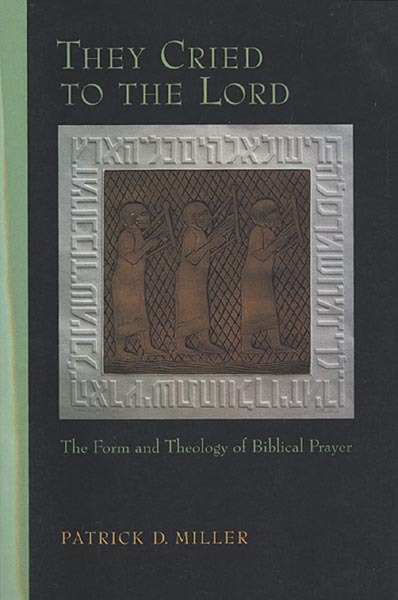
Reading Note: Patrick Miller on Biblical Prayer (Intro, Ch. 1)
AUDIENCE
The audience for which Miller wrote is suggested by Michael Welker in his endorsement on the back cover--"This volume will become a standard work not only for exegetes but also for both practical and systematic theologians, for pastors, and for anyone interested in understanding the foundations of piety." Having found numerous references to this work in commentaries and studies on the Psalms, I believe that Welker's statement has been amply validated.
This study of biblical prayer arises form teaching seminary students, pastors, and lay people about the Psalms and, more broadly, about prayer in Scripture. All of these groups have taught me as I have taught them and thus have helped to shape this book in large and small ways. (xv)
THEME
This book is introduced with the thought-provoking declaration that "No single practice more clearly defines a religion than the act of praying" (1). Furthermore, by arguing that belief is shaped by prayer, Miller contends for the necessary interdependence and essential unity of prayer and the theological task. He continues,
"So prayer and theology exist in relation to each other in a correcting circle, the one learning from the other and correcting the other. Religious faith seeks not to think one way and to pray another but to come before God in a manner that is consistent with what we believe and profess about God and God's way and to think about God in a way that is shaped by the experience of actual encounter in prayer. Learning to pray teaches about God" (1).
The stated aim of this book is "to look fairly comprehensively and broadly at biblical prayer," yet this volume is not to be taken as "a theology of prayer in general," but rather "a theology of biblical prayer" (2).
Chapter 1, "Israel's Neighbors at Prayer," was an introduction to new territory for me, yet I found it fascinating to see the many parallels and contrasts between the examples of Mesopotamian prayers provided. One lesson that stood out to me (and which is promised to be dealt with more fully later on in the book) was the note that whereas the prayers of Israel's neighbors typically
Miller concludes this chapter with the following observation:
The commonality that does exist between Israel's prayers and those of its neighbors suggests structures and modes of prayer that are not precisely identical but sufficiently related that we can assume there is something universal here, that it is in the shared and common history that we learn what God seeks in prayer, that the modes receive a confirmation in part because they seem to be common human ways belonging to the creatureliness of every human being and the imperfect and partial effort on the part of the creature to communicate with the divine. (31)I didn't expect to find so much in common although it is clear that, beyond the polytheistic and monotheistic differences between Israel and her early neighbors, the openness and freedom which Israel and all of her children enjoy in prayer is unmistakable.
____________________
* NOTE - I love connecting the dots between books, authors and history. Here is a hint to the significance of the title chosen for the Festschrift in honor of Patrick Miller: Brent A. Strawn and Nancy R. Bowen (eds.), A God So Near: Essays on Old Testament Theology in Honor of Patrick D. Miller (Eisenbrauns, 2003).
Reading Note: Patrick Miller on Biblical Prayer (Intro, Ch. 1)
Wednesday, February 1, 2012
Eugene Peterson on Praying the Psalms and the Origin of The Message
In fact, the fifteen Songs of Ascents (Psalms 120-134) that provide the text here for developing "discipleship in an instant society" provided the impetus for embarking on the new translation. All I had in mind at first was translating the Psalms into the idiomatic North American language that I heard people using on the streets and in the shopping malls and at football games. I knew that following Jesus could never develop into a "long obedience" without a deepening life of prayer and that the Psalms had always been the primary means by which Christians learned to pray everything they lived, and live everything they prayed over the long haul.
But the people I was around didn't pray the Psalms. That puzzled me; Christians have always prayed the Psalms; why didn't my friends and neighbors? Then I realized that it was because the language, cadenced and beautiful and harmonious, seemed remote from their jerky and messy and discordant everyday lives. But when these Psalms were first prayed and written by our Hebrew ancestors, they were every bit as jerky and messy and discordant as anything we experience today. I wanted to translate them from their Hebrew original and convey the raw, rough and robust energy that is so characteristic of these prayers. I wanted people to start praying them again, not just admiring them from a distance, and thereby learn to pray everything they experienced and felt and thought as they followed Jesus, not just what they thought was proper to pray in church.
(Eugene Peterson, A Long Obedience in the Same Direction, page 12)
Eugene Peterson on Praying the Psalms and the Origin of The Message
Monday, August 16, 2010
"Prayer is the measure of the man, spiritually..." Packer
One of the foundational steps in knowing God, and one of the basic demonstrations that we know God, is prayer—spiritual, persistent, biblically minded prayer. Writing a century and a half ago, Robert Murray M'Cheyne declared, "What a man is alone on his knees before God, that he is, and no more."
I do not write these things to manipulate you or to be engendering guilty feelings. But what shall we do? Have not many of us tried at one point or another to improve our praying, and floundered so badly that we are more discouraged than we ever were? Do you not sense, with me, the severity of the problem? Granted that most of us know some individuals who are remarkable prayer warriors, is it not nevertheless true that by and large we are better at organizing than agonizing? Better at administering than interceding? Better at fellowship than fasting? Better at entertaining than worship? Better at theological articulation than spiritual adoration? Better—God help us!—at preaching than praying?
What is wrong? Is not this sad state of affairs some sort of index of our knowledge of God? Shall we not agree with J. I. Packer when he writes, "I believe that prayer is the measure of the man, spiritually, in a way that nothing else is, so that how we pray is as important a question as we can face"? (J. I. Packer, in My Path of Prayer)

"Prayer is the measure of the man, spiritually..." Packer
Thursday, July 1, 2010
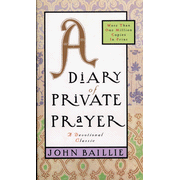
Baillie's A Diary of Private Prayer to be Updated
Special thanks to John who left a note about this in the comments to this post.
Baillie's A Diary of Private Prayer to be Updated
Wednesday, January 6, 2010
Personal & Family Devotional Resources (James Grant)
- Resources for Family Worship & Discipline
- Resources for Family Devotions
- Spiritual Disciplines for the Christian Life
- Prayer and the Christian Life
If I could be so bold as to suggest a few other titles (and I'm sure James did not expect his list to be exhaustive), I would recommend the following additions to this list.
The following titles deviate slightly from the type James has recommended under the heading "Spiritual Disciplines for the Christian Life," but I think that they are excellent for encouraging spiritual growth:
- Paul David Tripp's Broken Down House: Living Productively in a World Gone Bad (Shepherd Press, 2009). This is a simple, yet sound and foundational introduction to living the Christian life. I read this through very quickly last summer just after it was released and was greatly humbled. I gave a copy to a friend and recommended it to my dad who, in turn, has given away a handful of copies to others. Last fall, our Bible study group chose this book for next group study. Just before Christmas we finished working through Part One (Knowing). Brent, one of our teachers, put together an excellent summary of Part One. You are welcome to view/download it here. This book has made for a wonderful group study. I believe that we all have grown together as we have adjusted our view of God, ourselves, and living in this broken world with both humility and confidence. Part Two is filled with practical and pointed application. We just began our journeyt through this section this week.
- C. J. Mahaney's The Cross-Centered Life: Keeping the Gospel the Main Thing (Multnomah, 2002) is a short, excellent challenge to those of us who have been tempted to think that the Christian life begins with the Gospel but then moves on to something else. Mahaney clearly shows us that the gospel (the cross-work and resurrection of Jesus Christ) not only introduces us to life in Christ, but that it also guides us and sustains us throughout life. In 2006, Mahaney followed up with a second book titled, Living the Corss-Centered Life which also comes highly recommended.
- Tullian Tchividjian's Unfashionable: Making a Difference in the World by Being Different (Multnohmah, 2009) is likewise excellent. Tchividgian's challenge to the Church is to offer a Christian counter-culture to the world rather than conforming to the world's culture. Tchividjian believes that people, especially estranged children of Christian families, are looking to the Church for something different, rather than the same thing they get everywhere else. The heart of this little book is a call to apply Ephesians 4-5 to our lives. This book would make for an excellent starting point for a small group discussion, for personal study or for a family study (particularly for those families that have teenagers).
- Finally, I would add John Piper's Desiring God: Meditations of a Christian Hedonist (revised & expanded, Multnomah, 2003). This surely is a modern classic.
- John Baillie's A Diary of Private Prayer
(reprint, paperback edition, Fireside, 1996). This is absolutely fantastic. I have been using it throughout this past year and plan to continue doing so. It is also excellent for helping you teach your children how to pray. I recommend you search for a hardcover edition. It will be more durable for frequent use. Printing this in paperback was a foolish idea.
- Andrew Murray's classic With Christ in the School of Prayer
(reprint, Hendrickson, 2007). This is an excellent exposition of key passages in the NT related to Jesus praying or teaching his disciples to pray. Passages from the epistles are also included. In all, there are 31 short chapters, perfect for reading devotionaly throughout a month.
- Bill Hybels' Too Busy Not to Pray
(20 Anv Rev edition, IVP, 2008). I found this book at the local library and checked it out not knowing what to expect. It turns out that his handling of the subject was very helpful. I appreciated his pastoral approach which supplied a more theological and expositional foundation to the subject of prayer. I didn't get to finish the book, but I was helped by the portions I read. Hybels aim was to convince Christians of the necessity and joy of praying to a God who hears. He offers an introduction to the ACTS system of praying (Adoration, Confession, Thanksgiving, and Supplication), although he readily admits that one program will not fit all persons. This is one of many helpful tools for pray-ers.
- Leonard Allen's compilation The Contemporaries Meet the Classics on Prayer
(Howard Publishing, 2003). This is another book that I found at the local library. It gathers together under 10 headings the best passages on prayer from classic works to contemporary works. Selections are included from John Bunyan, George Muller, Martin Luther, John Calvin, Jonathan Edwards, Andrew Murray, E. M. Bounds, C. S. Lewis, Simon Chan, Thomas Merton, Bill Hybels, Joni Eareckson Tada, Eugene Peterson , Walter Brueggemann, Richard Foster, and more. It is a fantastic volume to add to your library. The broad range of authors in one book is a treasure. This is a fantastic entry-point into the literature on prayer.
Personal & Family Devotional Resources (James Grant)
Wednesday, July 22, 2009
Calvin Urges Christians to Pray with Passion
Another rule of prayer is, that in asking we must always truly feel our wants, and seriously considering that we need all the things which we ask, accompany the prayer with a sincere, nay, ardent desire of obtaining them. Many repeat prayers in a perfunctory manner from a set form, as if they were performing a task to God, and though they confess that this is a necessary remedy for the evils of their condition, because it were fatal to be left without the divine aid which they implore, it still appears that they perform the duty from custom, because their minds are meanwhile cold, and they ponder not what they ask. A general and confused feeling of their necessity leads them to pray, but it does not make them solicitous as in a matter of present consequence, that they may obtain the supply of their need. Moreover, can we suppose anything more hateful or even more execrable to God than this fiction of asking the pardon of sins, while he who asks at the very time either thinks that he is not a sinner, or, at least, is not thinking that he is a sinner; in other words, a fiction by which God is plainly held in derision? But mankind, as I have lately said, are full of depravity, so that in the way of perfunctory service they often ask many things of God which they think come to them without his beneficence, or from some other quarter, or are already certainly in their possession. There is another fault which seems less heinous, but is not to be tolerated. Some murmur out prayers without meditation, their only principle being that God is to be propitiated by prayer. Believers ought to be specially on their guard never to appear in the presence of God with the intention of presenting a request unless they are under some serious impression, and are, at the same time, desirous to obtain it. Nay, although in these things which we ask only for the glory of God, we seem not at first sight to consult for our necessity, yet we ought not to ask with less fervour and vehemency of desire. For instance, when we pray that his name be hallowed — that hallowing must, so to speak, be earnestly hungered and thirsted after.(John Calvin, "Of Prayer" in Institutes of the Christian Religion. Translated by Henry Beveridge. 1845. III, ch. XX, no. VI.)
- The words appearing in black, bold print highlight the various terms Calvin used to describe the passion with which we ought to pray.
- The words appearing in red, bold print highlight the various terms Calvin used to describe the way we ought not to pray.
- The words appearing in blue, bold print highlight the various terms Calvin used to describe God's response to thoughtless, emotionless prayers.
Calvin Urges Christians to Pray with Passion
Saturday, June 13, 2009
A Few More Sources on Prayer
Another impetus was a Prayer Challenge associated with the reading of Paul Miller's new book, A Praying Life: Connecting With God in a Distracting World (NavPress, 2009). The plan was to read this book for thirty days, to implement some of the ideas presented in the book, and to report to the readers of this blog regarding my experience with this exercise. I must admit that I reluctantly joined the challenge. I realize that there is much that I need to learn about prayer and praying, and I certainly need to be more disciplined in the practice of prayer. However, I already had a handful of books waiting to be read, and this book was supplied as a PDF which made it even more difficult for me to handle.I decided to print off the first few chapters in very small print. After reading these pages, I felt like I had an idea of the direction Miller was taking. I went to the computer and began to scan through the rest of the book.
What I found is that the basic principles are the same as you will find in many other classic works on prayer. After speed-reading through the book, I searched through my own shelves for books on prayer and began to compare them with what I had read in Miller's A Praying Life. Some of these titles where as follows:
- With Christ in the School of Prayer by Andrew Murray (reprint, Hendrickson, 2007) - this is an excellent exposition of key passages in the NT related to Jesus praying or teaching his disciples to pray. Passages from the epistles are also included. In all, there are 31 short chapters, perfect for reading devotionaly throughout a month.
- On Praying in the Spirit by John Bunyan (in Bunyan's 3 volume Works) - this is a classic and I thoroughly enjoyed reading it. In it is Bunyan's classic definition of prayer (you can find the quote here). The Banner of Truth Trust has reprinted this work along with Bunyan's The Throne of Grace in the Puritan Paperback series: Prayer by John Bunyan. Spanish: I just found that BOT also published a small volume titled La Oración combining The Nature of True prayer, by John Bunyan, and The Answer to Prayer, by Thomas Goodwin.
- Too Busy Not to Pray by Bill Hybels (20 Anv Rev edition, IVP, 2008) - I found this book at the local library and checked it out not knowing what to expect. It turns out that his handling of the subject was very helpful. I appreciated his pastoral approach which supplied a more theological and expositional foundation to the subject of prayer. I didn't get to finish the book, but I was helped by the portions I read. Hybels aim was to convince Christians of the necessity and joy of praying to a God who hears. He offers an introduction to the ACTS system of praying (Adoration, Confession, Thanksgiving, and Supplication), although he readily admits that one program will not fit all persons. This is one of many helpful tools for pray-ers.
The Contemporaries Meet the Classics on Prayer compiled by Leonard Allen (Howard Publishing, 2003) - this is another book that I found at the local library. It gathers together under 10 headings the best passages on prayer from classic works to contemporary works. Selections are included from John Bunyan, George Muller, Martin Luther, John Calvin, Jonathan Edwards, Andrew Murray, E. M. Bounds, C. S. Lewis, Simon Chan, Thomas Merton, Bill Hybels, Joni Eareckson Tada, Eugene Peterson , Walter Brueggemann, Richard Foster, and more. It is a fantastic volume to add to your library. The broad range of authors in one book is a treasure. This is a fantastic entry-point into the literature on prayer.
Miller's A Praying Life is a fine book and comes highly recommended by some well-known Christian leaders. It offers another great strategy for keeping up with specific prayer request and many will find this helpful. My disappointment with the book was that the chapters were too long and overloaded with anecdotes. I realize that the anecdotes serve to show what a praying life looks like, however, I found myself hungry for the meat, the exposition, the shot-in-the-arm that prepared me to get on my knees. (Every reader is different, so read this with a grain of salt.) If you wade through the full book, you certainly will be challenged to pray, but the progression from major point to major point is very slow. The text of the book covers more than 250 pages.
The point of all of the books I read or perused is to avoid being stiff and systematic like a robot. Rather, I ought to take advantage of enjoying the intimate relationship I possess in Christ, full of frequent communication with my God and Savior. Miller makes this point well, as does Hybels.
I have tried cards in the past. I have attempted to simplify a list onto one page with columns for each day of the week and specific requests/persons to remember on each day of the week. This is the pattern that a dear, sweet friend of ours utilized for years before passing away. She was a true prayer warrior and this method worked well for her and for everyone on her list (which included my dear wife and I). Each of these approaches have been helpful, but the point is not to be a slave to a system. Nor should we be a slave to a list of pre-recorded requests. Rather, whatever system you use, it is your servant to aid you in the discipline of praying. And whenever you pray, (as Bunyan put it) let it be an affectionate pouring out of [your] heart and soul to God.
William Cowper
Olney Hymns
Prayer makes the darkened cloud withdraw,
Prayer climbs the ladder Jacob saw;
Gives exercise to faith and love,
Brings every blessing from above.
Power of Prayer (verse 4)
John Newton
Olney Hymns
Wrestling prayer can wonders do,
Bring relief in deepest straits;
Prayer can force a passage through
Iron bars and brazen gates.
A Few More Sources on Prayer
Sunday, May 3, 2009
Quick & Helpful Sources on Prayer
Well, if you are looking for a simple, straightforward and motivational place to begin reading on the topic of prayer, I recommend chapters 7 (Discipline of Devotion) and 8 (Discipline of Prayer) of R. Kent Hughes' Disciplines of a Godly Man. Although this books is geared specifically toward men, these two chapters are equally applicable to women.Why pray? Hughes answers this important question very simply offering two reasons:
- Because of what prayer does to our character.
- Because prayer bends our wills to God's will.
In chapter 8, Hughes identifies and briefly explains five aspects of prayer:
- In-spirited Prayer
- Continual Prayer
- Varied Prayer
- Persistent Prayer
- Intercessory Prayer
Another source that is quick, helpful and a favorite of mine, is Thomas Watson's The Godly Man's Picture. Section 12 identifies the godly man as a praying man (pp. 87-96).A Christian is better after prayer. He has gained more strength over sin, as a man by exercise gets strength. The heart after prayer keeps a tincture of holiness, as the vessel favours and relishes the wine that is put into it. Having been with God on the mount, Moses' face shone. So, having been on the mount of prayer, our graces shine and our lives shine. This is the right kind of praying. The gift of prayer is ordinary, like culinary fire. But spiritual prayer is more rare and excellent, like elemental fire which comes from heaven. (93)
Finally, you may consider reading John Bunyan's treatise On Praying in the Spirit (found in volume one of The Works of John Bunyan. This has also been published in the Puritan Paperbacks series by the Banner of Truth: Prayer by John Bunyan.Bunyan begins with What Prayer Is, and offers a classic definition:
Prayer is a sincere, sensible, affectionate pouring out of the heart or soul to God, through Christ, in the strength and assistance of the Holy Spirit, for such things as God hath promised, or according to the Word, for the good of the church, with submission, in faith, to the will of God.
Quick & Helpful Sources on Prayer
Saturday, May 2, 2009
Prayer Challenge: A Praying Life by Paul Miller
I also began two weeks ago to pray through Baillie's A Diary of Private Prayer (see my earlier posts here and here) with my family (mornings only). This has been a sweet and instructive exercise, and the kids look forward to it each morning. I highly recommend this to you!
In the meantime, I was made aware of a new book on prayer that comes highly recommended. I was challenged to read through the book, apply some of the concepts to my prayer life for thirty days, and then share some of the lessons learned on the blog. The challenge is called Real Prayer in Real Time: A 30-Day Challenge and the books is A Praying Life: Connecting with God in a Distracting World by Paul E. Miller (NavPress, 2009).

I began reading this book on May 1st. I read the first few chapters slowly and speed read through the rest. I will be reviewing it a bit more slowly and will be applying some of the concepts during the remainder of the month. This matter has been heavy upon my heart. I have already identified major problems in my view of and approach to prayer. I'm looking forward to growing in this area.Here are some details about this book:
THE AUTHOR:
Paul Miller is director of seeJesus.net, a discipling mission that develops interactive Bible studies. The PrayerLife Study and Seminar, which form the basis for the book A Praying Life, is the second curriculum released by seeJesus.net. The first curriculum, called The Person of Jesus Study, centers on what Jesus is like as a person and is equally effective with both Christians and non-Christians. Paul’s book Love Walked Among Us is based on The Person of Jesus Study and, similarly, is written for both Christians and non-Christians. Paul also teaches seminars that train people to lead the study with friends and neighbors.LENGTH: 288 pages
CONTENTS: Five Parts (32 chapters)
ENDORSEMENTS:Introduction
Part One: Learning to Pray Like a Child
Part Two: Learning to Trust Again
Part Three: Learning to Ask Your Father
Part Four: Living in Your Father’s Story
Part Five: Praying in Real Life
“Honest, realistic, mature, wise, deep. Warmly recommended.”— J.I. PACKER, professor of theology, Regent College; author of Knowing God
“A Praying Life is a deeply moving testimony to God’s power in prayer. Paul Miller shares his life and biblical wisdom to instill in us, his readers, a ‘heart that becomes a factory of prayer’—that is, a passion to speak to God honestly and in a way that will change our life and the lives of others for whom we pray.”— TREMPER LONGMAN III, PhD, professor of Biblical Studies, Westmont College; author of Reading the Bible with Heart and Mind
“Paul Miller refuses to separate the spiritual life from the rest of our daily living. In A Praying Life, he shows the difference that constant communication with Christ makes in the everyday experiences of life, especially the life of the family. Reading this book will help you make prayer a more important part of your own life story by integrating prayer into the daily routines of life.”— DR. PHILIP RYKEN, senior minister, Tenth Presbyterian Church, Philadelphia, Pennsylvania; author of The Message of Salvation
“This is as fine a book on prayer that you will ever read, but it is so much more. It is the story of our struggle to actually live like we believe that our Heavenly father really does love us. If we did, nothing could keep us from being committed to the day by day hard work of prayer. Paul exegetes our struggle in a way that is convicting, insight giving and encouraging. This is a book on prayer that actually makes you want to pray!”— PAUL DAVID TRIPP, president, Paul Tripp Ministries; author of Instruments in the Redeemer's Hands, Age of Opportunity
Prayer Challenge: A Praying Life by Paul Miller
Thursday, March 26, 2009
John Baillie's A Diary of Private Prayer
John Baillie, a Scottish theologian, was born on March 26, 1886. I am still learning about his life and ministry, but in the meantime I have been waiting for an opportunity to introduce to you his little book titled A Diary of Private Prayer (1936). It is regarded as a devotional classic and has been a tremendous blessing to me as I have used it over the past year.Many of you are familiar with The Valley of Vision: A Collection of Puritan Prayers and Devotions which is also an excellent devotional tool. I have turned to Baillie's book far more often for its readability, adaptability to your own praying, and clarity. I have found three or four copies at yard sales and flea markets for very cheap. You can also purchase and inexpensive paperback edition online.
This book is designed to guide the worshiper in developing a regular pattern of offering morning and evening prayers. Here is this morning's prayer:
O Thou to whom I owe the gift of this day's life, give to me also, I beseech Thee, the spirit to use it as I ought. Forbid that I should stain the brightness of the morning with any evil thought or darken the noontide with any shameful deed. Let Thy Holy Spirit breathe into my heart to-day all pure and heavenly desires. Let Thy truth inform my mind. Let Thy justice and righteousness make a throne within me and rule my errant will. Let Christ be formed in me, and let me learn of Him all lowliness of heart, all gentleness of bearing, all modesty of speech, all helpfulness of action, and promptness in the doing of my Father's will.For more biographical information about Baillie, I would direct you to begin with The Baillie Project.
O Thou who compassest the whole earth with Thy most merciful favour and willest not that any of Thy children should perish, I would call down Thy blessing to-day upon all who are striving towards the making of a better world. I pray, O God, especially--for all who are working for purer and juster laws:Cast down, O Lord, all the forces of cruelty and wrong. Defeat all selfish and worldly-minded schemes, and prosper all that is conceived among us in the spirit of Christ and carried out to the honour of His blessed name.
for all who are working for peace between the nations:
for all who are engaged in healing disease:
for all who are engaged in the relief of poverty:
for all who are engaged in the rescue of the fallen:
for all who are working towards the restoration of the broken unity of the Holy Church:
for all who preach the gospel:
for all who bear witness to Christ in foreign lands.
Amen.
John Baillie's A Diary of Private Prayer
Sunday, November 16, 2008
Beale's Prayer Against Idolatry
NOTE: I have collected a lot of names for the book giveaway. Tonight is the final night to submit your name. The two winners will be announced in the morning.
Beale's Prayer Against Idolatry
Saturday, November 1, 2008
Calvin on Prayer and The Christian Life FREE from ChristianAudio
Free Audiobook of the Month -
Calvin: Of Prayer and The Christian Life
"Let the first rule of right prayer then be, to have our heart and mind framed as becomes those who are entering into converse with God." So begins John Calvin and his treatise on prayer. These seminal writings are from his Magnum Opus The Institutes of the Christian Religion. Prayer as Calvin describes it is not giddy, and he goes on to give Scriptural definitions of proper thought, engagement, and attitude. What do the roles of patience and self-denial play in the role of the Christian life and what does Christian piety look like? What should our views be of the present life and the future life? John Calvin is one of the giants of Christian history. These two sections of The Institutes guide us ever so thoughtfully and gracefully into his theology and practice of Christian living. Wonderfully narrated by James Adams, these are sure to both challenge and encourage one to a fuller devotion to Christ.
Just use the coupon code NOV2008 during checkout. Add the download format of Calvin: Of Prayer and The Christian Life to your cart and then enter the coupon code NOV2008 when prompted during checkout.
Narrator: James Adams
Run Time: 4.5 hoursOur Price: $0.00
List Price: $14.98
Coupon: NOV2008
Calvin on Prayer and The Christian Life FREE from ChristianAudio
Thursday, July 10, 2008
John Calvin Encourages Us to Pray
The thing which most of all [impairs] prayer, did not God indulgently interpose, is weakness or imperfection of faith; but it is not wonderful that this defect is pardoned by God, who often exercises his people with severe trials, as if he actually wished to extinguish their faith. The hardest of such trials is when believers are forced to exclaim, “O Lord God of hosts, how long wilt thou be angry against the prayer of thy people?” (Ps. 80:4), as if their very prayers offended him. In like manner, when Jeremiah says “Also when I cry and shout, he shutteth out my prayers” (Lam. 3:8), there cannot be a doubt that he was in the greatest [agitation]. Innumerable examples of the same kind occur in the Scriptures, from which it is manifest that the faith of the saints was often mingled with doubts and fears, so that while believing and hoping, they, however, betrayed some degree of unbelief, But because they do not come so far as were to be wished, that is only an additional reason for their exerting themselves to correct their faults, that they may daily approach nearer to the perfect law of prayer, and at the same time feel into what an abyss of evils those are plunged, who, in the very cures they use, bring new diseases upon themselves: since there is no prayer which God would not deservedly disdain, did he not overlook the blemishes with which all of them are polluted.
I do not mention these things that believers may securely pardon themselves in any faults which they commit, but that they may call themselves to strict account, and thereby endeavour to surmount these obstacles; and though Satan endeavours to block up all the paths in order to prevent them from praying, they may, nevertheless, break through, being firmly persuaded that though not disencumbered of all hindrances, their attempts are pleasing to God, and their wishes are approved, provided they hasten on and keep their aim, though without immediately reaching it. (Italics added)
What an encouragement to pray! What a gracious, merciful, and patient Father to pray to! Here is the prayer that comes to my mind right now: “Lord, I believe; help my unbelief” (Mark 9:24). As He heard and helped then, He will do so now, if only we will “always pray and not lose heart” (Luke 18:1).
_________________________
The Institutes of the Christian Religion (book):
Two-volume hardcover, translated by John T. McNeill—$51.99 from Monergism Books
One-volume, unabridged hardcover, translated by Henry Beveridge—$15.95 from Monergism Books
John Calvin Encourages Us to Pray
Monday, May 5, 2008
Pray for the Land of Judson
Last Saturday the Southeast Asian country of
The military-led Burmese government is slow to help their people and allow foreign aid into the country. With electricity out and drinking water scarce, a humanitarian crisis is unfolding in
Pray that the Lord would move this government to fulfill its responsibilities to its people and allow other countries to help. Pray that people affected by the storm will receive shelter, medical treatment, and help in rebuilding. Pray that profiteers will not be allowed to continue their price-gouging for things like gas and food. The military junta ruling
American missionary Adoniram Judson (1788 – 1850) served over three decades in
Pray for the Land of Judson
Thursday, January 31, 2008
How To Pray for Missionaries
- How to pray for missionaries (from Colossians1:9-12)
- How to pray for missionaries (thoughts from Mark Dever's The Gospel and Personal Evangelism)
How To Pray for Missionaries