Showing posts with label Reading. Show all posts

Monday, December 2, 2013

A Wearied Reader's Prayer

"O God, You Who are the truth, make me one with You in love everlasting. I am often wearied by the many things I hear and read, but in You is all that I long for. Let the learned be still, let all creatures be silent before You; You alone speak to me."

- Thomas à Kempis
Share/Bookmark

Monday, February 25, 2013

Tony Reinke's Lit! is Discounted for 24 Hours Only

Here's a deal I didn't want to pass up.  I've heard so many good things and read excellent excerpts.  I'm glad to now own at least the digital copy and am looking forward to learning from Tony, who is a very discerning reader.
 
Share/Bookmark

Friday, August 10, 2012

The Book as Friend

"It's Alive!" is a great essay on the "animated" book by Gillian Silverman posted today in The New York Times.  Check it out here.

Just a few days ago I was explaining my view of my library as a place where I can study and learn from friends and teachers through their written works.  Some would be better characterized as philosophical or theological rivals, and I get to read them in a non-combative atmosphere gleaning from the variety of their perspectives.

In her essay, Silverman strings together a number of great quotes about the "animation" and "companionship" of books.  I really like the quote from Bronson Alcott, "Books are 'living friends...the more life embodied in the book, the more companionable.'"
Share/Bookmark

Friday, July 20, 2012

Books that have Impacted My Christian Walk (Part 3 -Learning to Pray)

Of prayer, Thomas Watson wrote:‎

A godly man is much in private prayer.‎

‎…when a gracious heart is alone, it wrestles in prayer and ‎will not leave God till it has a blessing. A devout Christian ‎exercises eyes of faith and knees of prayer.‎

Private prayer keeps up the trade of godliness. When private ‎holiness is laid aside, a stab is given to the heart of religion. ‎‎(The Godly Man’s Picture, pp. 167-8)

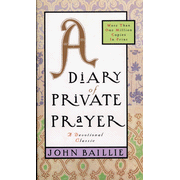
John Baillie, a Scottish theologian born in 1886, produced a classic guide to private prayer ‎which was first published in 1936.  The title of this little book is A Diary of Private ‎Prayer. This is the third book that I would like to recommend to you in this series on Books that have Impacted My Christian Walk.  Of all the books that I have mentioned here, this is the one that I ‎hope gets the most use of all.‎

The dedicatory page of this little book simply states “For Ian”, who was then the ‎author’s fifteen year old son. Ian passed away in November of 2008 and expressed his ‎desire that this book be updated on account of the somewhat dated language it contains.  I have not ‎heard any more about an updated edition but it may very well be in the works.  ‎
However, if you are familiar with The Valley of Vision: A Collection of Puritan Prayers ‎and Devotions, you will quickly recognize that the language of Baillie’s Diary is much ‎easier to follow although it does make use of “thees” and “thous” throughout.‎

There are a good many helpful books on prayer, such as the works of E. M. Bounds, ‎Andrew Murray, D. A. Carson, Bill Hybels, and Richard Pratt. However, the difficulty in ‎reading about prayer is that you often take up the task with a desire to pray, but then end ‎up spending most of your time reading rather than praying. ‎ I have loved using Baillie’s Diary because it guides me and teaches ‎me how to pray while directing me in prayer.  So, I learn to pray while I pray.

The prayers are purposefully Trinitarian.  They show variety of expression, and ‎adaptability to common life settings.  They are saturated in scripture and scriptural ‎language.  They are short guides that encourage further, deeper, experiential praying.‎  They are evangelical, grace-filled, Christ-centered, Spirit dependent and mission-oriented.‎

Two Examples
Permit me to offer you two examples which will give you a sense of the language used and which also happen to be the two places where the pray-er is lead in prayer with regard to reading.

Twenty-First ~ Morning
Leave me not, O gracious Presence, in such hours as I may ‎to-day devote to the reading of books or of newspapers.  ‎Guide my mind to choose the right books and, having ‎chosen them, to read them in the right way.  When I read for ‎profit, grant that all I read may lead me nearer to Thyself.  ‎When I read for recreation, grant that what I read may not ‎lead me away from Thee. Let all my reading so refresh my ‎mind that I may the more eagerly seek after whatsoever ‎things are pure and fair and true.‎
Sunday ~ Morning
O Thou who art the Source and Ground of all truth, Thou ‎Light of lights, who has opened the minds of men to discern ‎the things that are, guide me to-day, I beseech Thee, in my ‎hours of reading.  Give me grace to choose the right books ‎and to read them in the right way.  Give me wisdom to ‎abstain as well as to persevere.  Let the Bible have proper ‎place; and grant that as I read I may be alive to the stirrings ‎of The Holy Spirit in my soul.‎

Read the introductory post to this series: Thoughts on Christian Reading
Part 1 - Discipleship

Share/Bookmark

Monday, July 9, 2012

Books that have Impacted My Christian Walk (Part 1 - Discipleship)

"Which books have most significantly impacted your life as a Christian?"  This question was posed to me a couple months ago and I was kindly granted an opportunity to share a few recommendations one Wednesday evening at Trinity Church (Montgomery, AL).

At first, a number of recently read titles came to mind.  However, I quickly recalled one book by ‎a Puritan author that I picked up and read during my undergraduate years which I have ‎always kept at arms length: Thomas Watson's The Godly ‎Man's Picture.  This book represents a primary area of study that I believe should be a ‎part of every Christian's reading diet, namely, Discipleship.

Let me begin by introducing this Puritan author author to you.  Thomas Watson was a Presbyterian minister during the 17th century who at one time was ‎imprisoned and nearly lost his head for sympathizing with the king over against ‎Cromwell.  Mercy was shown to him and he was released.

During his ministry Watson suffered many persecutions against nonconformists (or ‎Dissenters) by the hands of the ruling parties, yet he remained steadfast.  This particular ‎volume was written during a period of time when he, along with many other ministers ‎who opposed the Act of Uniformity, was ejected from his pulpit and restricted to live at ‎least five miles away from his old congregation. As C. H. Spurgeon wrote, "Bread eaten in ‎secret is proverbially sweet, and the word of God in persecution is peculiarly delightful."  This is a key fact worth remembering whenever you read any Puritan work.  Many of these pastors were writing and publishing books in order to minister to the congregations from which they had been exiled.  Their setting was one of great opposition.

I am not sure how this fact plays into the reception of the first edition of this work, but The Godly Man's Picture was published in 1666, the year of the Great Fire in London.‎  If nothing else, these words would be a great help to many who needed encouragement during a very trying time.

Of Watson, Spurgeon wrote:‎ "Watson was one of the most concise, racy, illustrative, and suggestive of ‎those eminent divines who made the Puritan age the Augustan period of ‎evangelical literature.  There is a happy union of sound doctrine, heart ‎searching experience and practical wisdom throughout all his works, and ‎his Body of Divinity is, beyond all the rest, useful to the student and the ‎minister.‎"

When one recommends the reading of the Puritans, a common reaction is the perception that they all are very difficult to read.  This is so in many cases, but Watson, I believe, is an exception.  A friend recently told me that one of the ladies in a church in which he previously ‎ministered was well acquainted with the works of Thomas Watson and had read through ‎his Body of Divinity (which is an explanation of the Westminster Shorter Catechism) at least twice with great profit.‎  Although Watson's Body of Divinity is arguably his best known work (or even his greatest ‎work), The Godly Man's Picture paved the way for it.  ‎

The full title of this work is The Godly Man's Picture: drawn with a scripture pencil, or, ‎some characteristic marks of a man who is going to heaven. ‎

Permit me now to introduce the various parts of this book and supply a selection of quotations to illustrate the readability and the richness of the content.  Rather than following the structure of the catechism, Watson unpacks twenty-four ‎characteristics of a godly person. Another way of stating this would be "the marks of ‎grace upon a Christian."  In this volume you will find practical Christianity, or radical ‎discipleship, explained from a perspective of free grace and evangelical zeal.‎

Watson begins this treatise on godliness by rooting the matter in the forgiveness of sins ‎found in God's free grace by Jesus Christ.  ‎
  • He defines godliness as "the sacred impression and workmanship of God in a man, ‎whereby from being carnal he is made spiritual" (12).  ‎
He, then, clears the way by reproving pretenders of godliness.‎
  • How many are painted only with the vermilion of profession, whose ‎seeming lustre dazzles the eyes of beholders, but within there is nothing but ‎putrefaction! (15)‎
  • He who has only a painted holiness shall have a painted happiness. (17)‎
Some of my favorite sections include: ‎
  • A Man Fired with Love to God
  • A Man Who Prizes Christ
  • A Man Who is an Evangelical Weeper
  • A Man Who Loves the Word
  • A Man of Prayer
  • A Heavenly Man
  • A Zealous Man
  • A Thankful Man
  • A Few Quotes
Some of the most memorable quotes include:
Fired with Love to God
Where is the man whose heart is dilated in love to God? Many court him, ‎but few love him. (31)‎
Many say they have Christ in high veneration, but they are not industrious ‎in the use of means to obtain him.  If Christ would drop as a ripe fig into ‎their mouth, they could be content to have him, but they will not put ‎themselves to too much trouble to get him.  Does he who will not take ‎medicine or exercise prize his health? (51)‎
He who sets a high value on Christ will part with his pride, unjust gain and ‎sinful fashions (Isa. 30:32).  He will set his feet on the neck of his sins.‎

A Zealous Man
When we are zealous in devotion, and our heart waxes hot within us, here ‎is a fire from heaven kindling our sacrifice.  How odious it is for a man to ‎be all fire when he is sinning, and all ice when he is praying! (115)‎

A Thankful Man
Many have tears in their eyes and complaints in their mouths, but few have ‎harps in their hand and are blessing and praising the name of God. (131)‎
That which may put another string into the instrument of our praise and ‎make it sound louder is to consider what spiritual blessings God has ‎conferred on us. He has given us water from the upper springs; he has ‎opened the wardrobe of heaven and fetched us out a better garment than ‎any of the angels wear. He has given us the best robe and put on us the ring ‎of faith, by which we are married to him. These are mercies of the first ‎magnitude, which deserve to have an asterisk put on them. And God keeps ‎the best wine till last. Here he gives us mercies only in small quantities; the ‎greatest things are laid up. Here there are some honey drops and foretastes ‎of God's love; the rivers of pleasure are reserved for paradise. Well may we ‎take harp and viol and triumph in God's praise. Who can tread on these ‎coals of God's love and his heart not burn in thankfulness? (136)‎

Thoroughly Trained in Religion
Evangelical obedience is true in its essence, though not perfect in its degree, ‎and where it comes short, Christ puts his mercies into the scales, and then ‎there is full weight. (174)‎

Conclusions
The Scripture speaks of the cedar and the bruised reed, the latter of which ‎is a true plant of the heavenly paradise as the other. So the weakest ought ‎not to be discouraged. Not all have these characteristics of godliness ‎written in capital letters. If they are only faintly stamped on their souls, God ‎can read the work of the Spirit there. Though the seal is only faintly set on ‎the wax, it ratifies the will and gives a real conveyance of an estate. If there ‎is found just some good thing towards the Lord (as it was said of Abijah), ‎God will accept it (I Kings 14:13). (190)‎

To conclude this book, Watson adds six final chapters including encouragements, ‎exhortations, counsel and comfort, capped off with a delightful discourse on the spiritual ‎union between Christ and believers.  Another highlight of this final section is the chapter ‎on Comfort to the Godly in which Watson exposits Matthew 12:20, ‎‎"A bruised reed shall he not break and smoking flax shall he not quench, ‎till he send forth judgment unto victory."‎

Supplemental Reading
As I mentioned above, The Godly Man's Picture represents to me an excellent introduction into the study of discipleship.  There are many other books worth recommending under this heading, however, permit me to suggest a few others.  Two books that I recently read and used in a Sunday School setting are Eugene Peterson's A Long Obedience in the Same Direction and Eric Routley's Ascent to the Cross. These are ‎studies through the Pilgrim Psalms with an eye toward the theme of discipleship.

I have also been studying through the Gospel of Mark which has a dual theme of discipleship and christology.  I would recommend James Edwards's commentary The Gospel According to Mark in the Pillar New Testament series.  Edwards does an excellent job of exposition and offers a very readable text.  Although a knowledge of Greek will assist the reader, it is not necessary at all in order to read through this commentary.  This is not a devotional commentary by any means, but it would be well worth the effort to be used devotionally.

A classic work that I read a couple of years ago is Dietrich Bonhoeffer's The Cost of Discipleship. You don't have to agree with all that Bonhoeffer represented in his theological connections to appreciate this excellent study.

An even great classic is John Bunyan's The Pilgrim's Progress.

Finally, I want to recommend to you Paul David Tripp's Broken-Down House: Living Productively in a World Gone Bad.  This is an excellent intermingling of worldview and discipleship.  This revolutionized my understanding of my calling in God's world.  I read through it, reviewed it and then discussed it with a small group.  We all came away from this study having been greatly helped.

I recommend all of these to you!

Related:
Read the introductory post to this series: Thoughts on Christian Reading
Part 2 - When You Pass Through the Fire
Part 3 - Learning to Pray

Share/Bookmark

Tuesday, July 3, 2012

Thoughts on Christian Reading

How do you read? What do you read? What principles of reading do you follow? A text that has guided me in my reading and study habits has been Proverbs 13:20, "He that walketh with wise men shall be wise: but a companion of fools shall be destroyed".

Whenever I enter my library I recognize that each volume represents the voice of one or more counselors with whom I have the opportunity to converse. By taking up and reading these books I have the privilege of interacting with teachers throughout much of world history and from around the globe. Reading is a conversation and a walk with those who are knowledgeable and, hopefully, wise. I love what C. H. Spurgeon said nearly a century ago, "He who will not use the thoughts of other men's brains proves he has no brains of his own."

The kind of books I like to read are those that are practical, thought-provoking and useful (this holds true for me even when it comes to reading fiction). I especially delight in books steeped in scriptural thought and that warm my heart toward Christ and Christian obedience. I enjoy reading and most always carry a book (or two) with me wherever I go. I am not a fast reader, but I strive to be a thoughtful reader.

In his introductory essay to an English translation of Athanasius's On the Incarnation, C. S. Lewis offers a classic argument for the reading of old books. Truly, this essay ought to be required reading for every Christian reader. Lewis is here addressing students/readers with regard to non-fiction, but I believe that what he has to say is valuable for all, especially those who claim to be non-readers and those who have nestled themselves in the imaginative and no-less-dangerous world of fiction.

Old or New? 
Lewis's essay aims to be a corrective for those who prefer modern books over the older ones, especially in the area of theology. He attributes this aversion to an unfounded sense of humility and shyness. In essence, Lewis urges readers to face the masters and giants of the faith, embrace them, walk with them, learn from them. Lewis is so confident in this recommendation that he proclaims, "knowledge is not only more worth acquiring than secondhand knowledge, but is usually much easier and more delightful to acquire." 

The preference for modern books is a grave "mistake" and "is nowhere more rampant than in theology." He writes, "Wherever you find a little study circle of Christian laity you can be almost certain that they are studying not St. Luke or St. Paul or St. Augustine or Thomas Aquinas or Hooker…but Niebuhr or Miss Sayers or even myself. Now this seems to me topsy-turvy."

Rather, Lewis continues, "if he must read only the new or only the old, I would advise him to read the old."

A new book (in any field of science and in particular theology) must be "tested against the great body of Christian thought down the ages, and its hidden implications (often unsuspected by the author himself) have to be brought to light." For similar reasons, Samuel Davies, the Father of Southern Presbyterianism, once wrote, "The venerable dead are waiting in my library to entertain me and relieve me from the nonsense of surviving mortals." 

R. Kent Hughes, in his modern classic, Disciplines of a Godly Man, lays down the following charge: "Men, to deny ourselves the wealth of the accumulated saints of the centuries is to consciously embrace spiritual anorexia." 


A Rule for Reading 
As readers and thinkers, we need perspective. Perspective comes from breadth of reading, and so, Lewis lays down the following rule that will enrich your understanding and strengthen your reading: 
It is a good rule, after reading a new book, never to allow yourself another new one till you have read an old one in between. If that is too much for you, you should at least read one old one to every three new ones. 
This may seem rigid, and I do not follow this rule exactly myself, but the more I read, especially when I set out to review a book, the more clearly I understand how critical this rule is. 

Two Kinds of Books 
When it comes to theological reading, there are two broad categories: devotional and doctrinal. There is a place for both kinds, but I agree wholeheartedly with Lewis who writes: 
For my own part I tend to find the doctrinal books often more helpful in devotion than the devotional books, and I rather suspect that the same experience may await many others. I believe that many who find that "nothing happens" when they sit down, or kneel down, to a book of devotion, would find that the heart sings unbidden while they are working their way through a tough bit of theology with a pipe in their teeth and a pencil in their hand. 
…or a cup of hot coffee or tea; and, YES, a thoughtful reader is an active note-taker. Fill the margins as you converse with a book. Resist the urge to remain passive and silent! 

D. Martyn Lloyd-Jones shared some harsh criticism of 'devotional'commentaries in his book Preaching and Preachers: 
I abominate 'devotional' commentaries. I do not want other people to do my devotions for me; yet I cannot think of a better term here. I am thinking of a type of reading which will help you in general to understand and enjoy Scriptures, and to prepare you for the pulpit. This type of reading comes next to the Scriptures. What is it? I would not hesitate to put into this category the reading of the Puritans. That is precisely what they do for us. Those men were preachers, they were practical, experimental preachers, who had a great pastoral interest and care for the people. So as you read them you find that they not only give knowledge and information, they at the same time do something to you. (174-5) 
How to Read Profitably 
I recently found another essay by the Puritan pastor, Thomas Brooks, which offers excellent advice for reading profitably. In his "A Word to the Reader" prefaced to his treatise Precious Remedies Against Satan's Devices, Brooks writes: 
Solomon bids us buy the truth (Prov. 23:23), but doth not tell us what it must cost, because we must get it though it be never so dear. Remember, it is not hasty reading, but serious meditation upon holy and heavenly truths, that makes them prove sweet and profitable to the soul. It is not the bee's touching of the flower that gathers honey, but her abiding for a time upon the flower that draws out the sweet. It is not he that reads most, but he that meditates most, that will prove the choicest, sweetest, wisest, and strongest Christian. &c. Reader, if it be not strong upon thy heart to practice what thou readest, to what end dost thou read? 
It is this art of meditation that has been lost upon many readers, and the Puritan authors are among some of the best guides. 

A couple of months ago, I was asked to recommend to my home church two or three books that have greatly influenced my life. A number of books recently read came to mind, but as Lewis has so ably taught us, some of these contemporary books still need a bit more time to steep. Rather, it has been some of the older books that have made the most enduring impression upon my life and thinking. In the next few posts I would like to introduce to you the books I recommended in my talk. I have mentioned most of these titles on the blog in previous posts, but I am convinced that they are well worth the repetition.
Share/Bookmark

Monday, January 23, 2012

"The person who has learned to read well is..."

I encourage you to read the rest if these excellent thoughts on the discipline of reading!

The Vocation of a Lifetime (This is a short except from John Piper's article, “Teaching, Schooling and Reading” (September 1, 1974) posted by Tony Reinke on his blog, Miscellanies.)

Truly, degrees and credentials are one thing and disciplined learning is quite another!
Share/Bookmark

Thursday, December 15, 2011

Reading and Warming by the Fire: Kindle Fire

Warming up to the Kindle Fire

Since the debut of the first Kindle e-reader in 2007, I have carefully read reviews, tinkered with display models at local stores, compared features with other e-readers, and have asked for the opinions of friends who own e-readers.  I love hard copy books (some would say, "real books") and I also recognize the inherent benefits of digital editions and using an e-reader. However, I had been hesitant about taking the plunge and buying and e-reader, until recently.  With the incentive of a couple monetary gifts, I went out and purchased the recently released Kindle Fire.  Needless to say, I am very impressed!

Although the Kindle Fire does not sport the paper-like, e-ink screen found on other Kindle models, it by design does an amazing job of encouraging reading.  It may be argued in some cases that the device may increase your delight in reading.  Here's why I think that this is so.

1) Versatility - By design, the Kindle Fire is able to toggle between a variety of types of media.  On this one device readers are able to access periodicals, Kindle ebooks, PDF books and documents, as well as word processing documents.  Additionally, the Kindle Fire allows the user to stream movies and videos, download and use a myriad of apps, view photos, and browse the internet.  These items are often major distractions to reading, but they can also allow for opportunities to enhance the pleasure of reading books and periodicals when videos are included and immediate access to word definitions and internet articles and sites are linked.

Since I currently do not have Wi-Fi in my home, I avoid much of the distraction of browsing and fiddling with apps that require an internet connection.  This is great because I am forced to manage my time more wisely (still working on this) and plan on when I need Wi-Fi to update the Kindle and when I should just relax and read.

2) Portability & Size - One of my apprehensions about e-readers has stemmed from my dislike for reading on computer monitors.  Out of habit, I am a browser when it comes to sitting at a computer.  I have downloaded the Kindle Apps for both my desktop and laptop, but I rarely use them.  The primary trouble I have with reading on a computer monitor is the difficulty in getting into a comfortable reading posture.  Location and position are critical for me when it comes to reading.  There are two chairs in my home in which I can relax and enjoy reading or studying.  I can use my laptop there, but I cannot get into that specific "book reading position" with the computer.  You know what I mean: that cuddled up, leaning back, or legs-crossed-with-pencil-in-one-hand-and-book-in-the-other position that is just right for extended reading.  I can achieve either of these postures with the Kindle Fire e-reader and I can comfortably read for extended periods of time just as with a "real book"!  The size of the Kindle Fire is smaller than the iPad and it fits very nicely into your hand and along side other books you may be carrying.  I absolutely love the fact that it fits perfectly into the inside pocket of my coats.

3) Functionality - The Kindle Fire, although it is not unique in this respect, offers readers the opportunity to read, take notes and compare multiple texts all on one device.  Granted the note taking function is very limited compared to using an iPad, but nevertheless, note-taking and highlighting is possible.  To this is added the ability to insert multiple bookmarks, to jump quickly to the Table of Contents, the beginning of a book, any particular bookmark, highlight, or note, or to sync to the furthest reading location within seconds.

With regard to comparing texts, I have tested this out in the areas of Bible study, Sunday School small-group study, and sermon note-taking.  I recommend the use of the following items that are invaluable for free: the ESV Bible app, the ESV Kindle Edition text (or one of a number of Bible versions available for the Kindle); the YouVersion Bible app,  the Logos Bible Software app.  Although the Logos app only gives me access to selected books offline (I must select the ones I want to download for use offline) and it does not have a highlight and note taking function, it is still very nice to be able to read these resources I already own no matter where I am.

4) Price - Finally, the affordability of the Kindle Fire is what is most appealing to me.  Well, I must qualify this because on our tight budget I had to wait until I received gift monies before I was able to spring for this tool.  Nevertheless, compared to many of the other e-readers, including the other Kindle models, the Kindle Fire is the best bang for your buck if you want a device centered around reading.  On account of the affordability of the Kindle Fire, I found a way to spring for a second Kindle Fire for my wife.  What we discovered very quickly is that this little, yet powerful, device ranks high on the cool factor.  Once I purchased one we quickly discovered that one was difficult to share.  Because this device is relatively affordable we now own two, which would have never happened if I had initially purchased an iPad.  The cost factor is huge especially since we already have a portable computer.

This is my take on the Kindle Fire.  I agree with iPad users that the Fire is limited in comparison, but for all of us who have not been able to break into the Apple world, the Fire is an awesome alternative.  The Fire is aptly named on account of its ability to warm up users in a flash and take reading to a new level of enjoyment.

I'd love to hear your comments on the e-readers you use.  I'm always grateful for tools that promote reading.

Share/Bookmark

Sunday, December 28, 2008

A Schedule for Reading Through the Psalter in One Month

Richard at תהלים (A blog dedicated to the Psalms) has offered a challenge to join him in reading through the Psalter. He has provided a link to the Psalter of the Book of Common Prayer which follows the following reading schedule:

Week 1: Days 1 through 7, Psalms 1 through 37.
Day 1

Morning Prayer: Pss 1-5
Evening Prayer: Pss 6-8

Day 2

Morning Prayer: Pss 9-11
Evening Prayer: Pss 12-14

Day 3

Morning Prayer: Pss 15-17
Evening Prayer: Ps 18

Day 4

Morning Prayer: Pss 19-21
Evening Prayer: Pss 22-23

Day 5

Morning Prayer: Pss 24-26
Evening Prayer: Pss 27-29

Day 6

Morning Prayer: Pss 30-31
Evening Prayer: Pss 32-34

Day 7

Morning Prayer: Pss 35-36
Evening Prayer: Ps 37

Week 2: Days 8 through 14, Psalms 38 through 74.
Day 8

Morning Prayer: Pss 38-40
Evening Prayer: Pss 41-43

Day 9

Morning Prayer: Pss 44-46
Evening Prayer: Pss 47-49

Day 10

Morning Prayer: Pss 50-52
Evening Prayer: Pss 53-55

Day 11

Morning Prayer: Pss 56-58
Evening Prayer: Pss 59-61

Day 12

Morning Prayer: Pss 62-64
Evening Prayer: Pss 65-67

Day 13

Morning Prayer: Ps 68
Evening Prayer: Pss 69-70

Day 14

Morning Prayer: Pss 71-72
Evening Prayer: Pss 73-74

Week 3: Days 15 through 21, Psalms 75 through 106.
Day 15

Morning Prayer: Pss 75-77
Evening Prayer: Ps 78

Day 16

Morning Prayer: Pss 79-81
Evening Prayer: Pss 82-85

Day 17

Morning Prayer: Pss 86-88
Evening Prayer: Ps 89

Day 18

Morning Prayer: Pss 90-92
Evening Prayer: Pss 93-94

Day 19

Morning Prayer: Pss 95-97
Evening Prayer: Pss 98-101

Day 20

Morning Prayer: Pss 102-103
Evening Prayer: Ps 104

Day 21

Morning Prayer: Ps 105
Evening Prayer: Ps 106

Week 4: Days 22 through 28, Psalms 107 through 138.
Day 22

Morning Prayer: Ps 107
Evening Prayer: Pss 108-109

Day 23

Morning Prayer: Pss 110-113
Evening Prayer: Pss 114-115

Day 24

Morning Prayer: Pss 116-118
Evening Prayer: Ps 119:1-32

Day 25

Morning Prayer: Ps 119:33-72
Evening Prayer: Ps 119:73-104

Day 26

Morning Prayer: Ps 119:105-144
Evening Prayer: Ps 119:145-176

Day 27

Morning Prayer: Pss 120-125
Evening Prayer: Pss 126-131

Day 28

Morning Prayer: Pss 132-135
Evening Prayer: Pss 136-138

Week 5: Days 29 through 31, Psalms 139 through 150.
Day 29

Morning Prayer: Pss 139-141
Evening Prayer: Pss 142-143

Day 30 (and 31)

Morning Prayer: Pss 144-146
Evening Prayer: Pss 147-150

This is a great plan!
Share/Bookmark

Wednesday, October 1, 2008

Doctrine Whets Our Appetite for God

John Bunyan never has his allegorical characters sitting around the dinner table just shooting the breeze. He always injects godly teaching into their conversation. In Part Two of The Pilgrim's Progress Christian's wife Christiana and their four sons, along with several other pilgrims, spend some time near Vanity Fair at an Inn. As the food is being set on the table, Christiana's son Matthew says that the sight of the tablecloth and the bread "begetteth in me a greater appetite to my food than I had before." To which their host Gaius replies,
So let all ministering doctrines to thee, in this life, beget in thee a greater desire to sit at the supper of the great King in His kingdom; for all preaching, books, and ordinances here, are but as the laying of the trenchers, and as setting of salt upon the board, when compared with the feast that our Lord will make for us when we come to His house.

What is our purpose in reading theological books and in listening to sermons and lectures? In Bunyan's picturesque way he is saying we should be preparing ourselves to enjoy the real feast with our Father in His heavenly kingdom. This time of year we can get so busy with things like mid-term exams and preparations for Christmas programs that our studies may seem tedious. Let's remember Bunyan's counsel and transform our tedium into anticipation . . . and worship!

How do you keep your "routine" reading fresh? Let us know in the comments what you do for your reading, or maybe, what it does for you.
Share/Bookmark

Thursday, July 17, 2008

Summer Reading - What Are You Reading?

OPEN POST

I have shared with you what I am reading (and reviewing), and now I am interested in knowing what you are reading. So, here is an "open post" for you to share with us your own summer reading list.

What are you reading, and what would your recommend us to consider reading?

Please respond in the comments of this post.

If you have nothing to read and would like a review copy in exchange for a book review (to be posted here on TheoSource), I'd like to hear from you. Send me a review of something you have read this summer and I'll send you a new book to review. You can find a list of books that I have in hand that need to be reviewed here (bottom of the post).
Share/Bookmark

Tuesday, July 8, 2008

Fasting, Family & Reading

I wonder how your summer is going. This summer has brought about a number of unforeseen turns for me and my family. I can't complain. We've been enjoying good health and I have a steady job.

I'm still working hard at the book reviews; mostly directing books to reviewers and preparing reviews to be posted. I have a growing stack of books I'm reading and some I've read and need to review. I'm still maintaining the TheoSource recommendation lists. I have not posted any of the updates, but I have been adding new book recommendations to the database. I received some very brief instruction on converting my Access database to an SQL database, but I need to spend more time trying to figure out this process. I believe that this would make these lists more user-friendly.

I'm also trying to put some quality time into a review copy of Logos Scholar's Library (ND). I have found this software package to be fantastic. It has taken a good bit of time to feel comfortable with it (mostly because my time in front of the computer on which the software is installed has been limited), but from what I've seen I'm hooked. The Libronix platform is powerful and capable of searches that previously took hours. I highly recommend serious students to get started building their digital libraries on the Libronix platform. I have promised to review this package and this is weighing heavily upon me.

Finally, I have been burdened to spend more time with the family rather than in front of the computer. I do a lot of different things on the computer, mostly ministry related, but I want to keep that time to as much of a minimum as is possible.

Along with this, I have purposed to hit the books even harder. I am currently reading through a handful of Old Testament Theologies for personal growth and for the purpose of reviewing them. Within the past few years three solid evangelical OT Theologies have been published, namely An Old Testament Theology: An Exegetical, Canonical, and Thematic Approach by Bruce Waltke with Charles Yu (Zondervan, 2007), Everlasting Dominion: A Theology of the Old Testament (B&H Academic, 2006), and the two-volume Old Testament Theology by John Goldingay [Israel's Gospel, vol. 1 (IVP Academic, 2003) and Israel's Faith, vol. 2 (IVP Academic, 2006). I've not yet purchased the volumes by Goldingay, but they are on my shopping list.

I happily purchased Waltke's AOTT and graciously received a review copy of Merrill's ED:ATOT. I have been reading these two along with a review copy of The Promise-Plan of God: A Biblical Theology of the Old and New Testaments by Walter C. Kaiser, Jr (Zondervan, 2008). For greater perspective, I am also reading in Walther Eichrodt's two-volume Theology of the Old Testament (Westminster, 1967), Gustave F. Oehler's two-volumes-in-one Theology of the Old Testament (rev. ed.), and Gerhard von Rad's Old Testament Theology (I am using the two-volume HB edition, but this has been republished by WJK Press, 2001 in paperback.). Also, I have purchased and am awaiting the arrival of the paperback edition (with CD-ROM that works on the Libronix platform) of Walter Brueggemann's Theology of the Old Testament: Testimony, Dispute, Advocacy (Fortress Press, 2005). I have found Brueggemann's work to be very thought provoking and I am eager to compare his approach with the others I am reading.

I hope to be able to post more soon, but for now I am "fasting" from the computer when at home in order to enjoying more time with my family and to dig into the books.

Share/Bookmark

Wednesday, April 30, 2008

A Prayer for the Study

Leave me not, O gracious Presence, in such hours as I may to-day devote to the reading of books or of newspapers. Guide my mind to choose the right books and, having chosen them, to read them in the right way. When I read for profit, grant that all I read may lead me nearer to Thyself. When I read for recreation, grant that what I read may not lead me away from Thee. Let all my reading so refresh my mind that I may the more eagerly seek after whatsoever things are pure and fair and true.

"TWENTY-FIRST DAY ~ MORNING" in A Diary of Private Prayer by John Baillie (New York: Charles Scrinber's Sons, 1948 [1936]), p. 89.
Paperback: CBD | Amazon
Hardback (1949 edition): Amazon
Share/Bookmark

Sunday, January 13, 2008

C. S. Lewis on Good and Bad Critics


"The good critics found something to praise in many imperfect works; the bad ones continually narrowed the list of books we might be allowed to read."

("A Word About Praising" in Reflections on the Psalms.)

Share/Bookmark

Wednesday, January 2, 2008

Profitable Reading in 2008

On New years Eve at our annual oyster roast my pastor brought a challenge from Matthew 6:33 "But seek ye first the kingdom of God, and his righteousness; and all these things shall be added unto you." I was very glad to have been reminded of these words as we contemplated the coming year. The first phrase of this verse exhorts the reader to prioritize his pursuits in a Godward fashion. My pastor reminded us that the adverb first does not simply mean before everything else in time, but, more so, first in priority. Pursuing the kingdom of God and His righteousness is not an agenda item to be ticked off when completed. It begins by spending quality time in communion with God each day, but it does not end there. Rather, we are called to adjust our priorities so that the pursuit of the kingdom of God and His righteousness is given the foremost position. Jesus is calling his disciples to let this be their passion. Let me personalize this: This must be what serves as the basis of your decision making, what motivates your work and service, what inflames your love for your spouse, your children, your family, your friends, your neighbors, your co-workers, and so on. This must be what characterizes your lifestyle--where you go, what you enjoy, what you eat and drink, what you watch, what you listen to, what you read.

Here at TheoSource we like books. We like to read them, collect them, talk about them, and recommend them to each other. In all of this we do not want to loose sight of what takes priority. While we recommend good books and write about others we would never have you to neglect the Book of Books. Please make it a priority this year to give the proper priority to the best of all books. May it be your goal to spend even more time in regular, meditative reading of the Scriptures in 2008.

This past year has been very exciting for me in that the Lord has helped me in both my Bible reading and general reading. I've learned that the two go hand in hand. It is very difficult to be discerning without regular spiritual nourishment. My desire is to see even more improvement in 2008.

In 2007 I read a lot more than I have in a long time. I've also read more widely than I've been able to in the past. I'm not a fast reader, and family, ministry, work, and directing reviews has greatly limited my reading time, but I've benefited immensely from what I've been able to glean. I try to make up for the limitations by carrying a pocket Bible and a book with me wherever I can. Traffic around here can get backed up very quickly. I've salvaged scores of minutes by reading while I sit and wait for traffic to move. Better eating habits and exercise have helped me to be more alert to be able to read at other times, too.


Still, I cannot join the ranks of those who read, even, one or two books per week. A part of me wishes that I could join them, but that is not for me at this point in life, and that's okay. As long as I can continue to learn how to be a better reader and maintain a proper balance in my reading schedule I will be happy. In light of this, I'm always on the look-out for good reading advice. I directed your attention a few days ago to a post by Doug Smith at Gazing at Glory on Bible Intake in 2008. This is packed full of great advice for Bible reading, meditation, and memorization. Today, I came across a very helpful post on general reading skills by Trevin Wax at Kingdom People. His post is entitled Can You Read 100 Books this Year? and I recommend it to you. Like me, you may not be able to accomplish this lofty goal, but he offers some excellent tips that will help you to improve your reading skills.

I've added a few links to the sidebar under the label Profitable Reading where you will find helpful reading plans.


Happy and profitable reading for the sake of the kingdom of God and His righteousness in 2008!


Share/Bookmark

Tuesday, October 23, 2007

"On Studies" by Francis Bacon

In his little booklet entitled, Read Any Good Books?, Sinclair Ferguson offers some very insightful quotes from a classic essay by Francis Bacon. This essay is short and packed with keen insights, so I thought that I would offer it here for you to read, too.

From The Essays by Francis Bacon
Francis Bacon 1561-1626
STUDIES serve for delight, for ornament, and for ability. Their chief use for delight, is in privateness and retiring; for ornament, is in discourse; and for ability, is in the judgment, and disposition of business. For expert men can execute, and perhaps judge of particulars, one by one; but the general counsels, and the plots and marshalling of affairs, come best, from those that are learned. To spend too much time in studies is sloth; to use them too much for ornament, is affectation; to make judgment wholly by their rules, is the humor of a scholar. They perfect nature, and are perfected by experience: for natural abilities are like natural plants, that need proyning, by study; and studies themselves, do give forth directions too much at large, except they be bounded in by experience. Crafty men contemn studies, simple men admire them, and wise men use them; for they teach not their own use; but that is a wisdom without them, and above them, won by observation. Read not to contradict and confute; nor to believe and take for granted; nor to find talk and discourse; but to weigh and consider. Some books are to be tasted, others to be swallowed, and some few to be chewed and digested; that is, some books are to be read only in parts; others to be read, but not curiously; and some few to be read wholly, and with diligence and attention. Some books also may be read by deputy, and extracts made of them by others; but that would be only in the less important arguments, and the meaner sort of books, else distilled books are like common distilled waters, flashy things. Reading maketh a full man; conference a ready man; and writing an exact man. And therefore, if a man write little, he had need have a great memory; if he confer little, he had need have a present wit: and if he read little, he had need have much cunning, to seem to know, that he doth not. Histories make men wise; poets witty; the mathematics subtile; natural philosophy deep; moral grave; logic and rhetoric able to contend. Abeunt studia in mores [studies build character]. Nay, there is no stond or impediment in the wit, but may be wrought out by fit studies; like as diseases of the body, may have appropriate exercises. Bowling is good for the stone and reins; shooting for the lungs and breast; gentle walking for the stomach; riding for the head; and the like. So if a man’s wit be wandering, let him study the mathematics; for in demonstrations, if his wit be called away never so little, he must begin again. If his wit be not apt to distinguish or find differences, let him study the Schoolmen; for they are cymini sectores [hair splitters]. If he be not apt to beat over matters, and to call up one thing to prove and illustrate another, let him study 197 the lawyers’ cases. So every defect of the mind, may have a special receipt.

Share/Bookmark

Monday, October 22, 2007

Sinclair Ferguson on Reading Good Books

This past weekend I had the opportunity to visit First Presbyterian Church in Columbia, SC and sit under the preaching ministry of Dr Sinclair Ferguson. The auditorium was packed (both main floor and balcony) with all age groups. The singing was traditional and hearty, and every aspect of the liturgy drew our attention to the great Triune God.

Dr Ferguson preached a Christ-centered message from Genesis 32:1-32, entitled "All Night Wrestling." I can't speak for anyone else there, but I must say that I needed that message. (Here is a link to the First Pres. Sermon Archive.)

While there I took a look at their book rack. On it, I found a Banner of Truth booklet written by Dr Ferguson entitled Read Any Good Books? This is very short, 32 page booklet filled with basic instructions for profitable Christian reading. The book reminded me of Dr Mark Minnick's book talk, "Bring in the Books" at the Whetstone Conference (part 1, part 2, part 3). Both of these, together, have been a great help to me. Now we need to find a publisher to print up a booklet of Dr Minnick's notes. (Tim, maybe we could get you to put a bug in Dr Minnick's ear. What do you think?)

Anyway, please add this little booklet to your next book order. It will greatly repay you, and it's very affordable! [CBD | Amazon]

Share/Bookmark

Wednesday, September 12, 2007

R Albert Mohler on Reading Books

Here are some encouraging thoughts on reading from a true bibliophile. Dr R Albert Mohler is the president of The Southern Baptist Theological Seminary in Louisville, Kentucky. In the T4G video, posted on the Together for the Gospel website, C.J. Mahaney took special care to comment on Dr Mohler's voracious appetite for books. His personal library mounts to over 30,000 volumes of which he has read at least 90 percent. Taking this into consideration, the following post bears a significant amount of weight.


Posted: Wednesday, September 12, 2007 at 3:01 am ET

I cannot really remember when I did not love to read books. I do know that I was very eager to learn to read, and that I quickly found myself immersed in the world of books and literature. It may have been a seduction of sorts, and the Christian disciple must always be on guard to guide the eyes to books worthy of a disciple's attention -- and there are so many. (more...)

I can't claim to have read anywhere near as many books as Dr Mohler (for many reasons), but they say that your are a reader if you carry a book with you in the car to read at stop lights. I tell you what, my time to read is very limited, so I take a book with me nearly everywhere I go so that I can take advantage of possible free moments. I often read at red lights, too, and in traffic jams.

One thing that I have been more mindful of lately is taking along a pocket sized Bible with a good book. I tend to reach for a good book first; which is a habit I need to change!

Are you a reader? When and where do you read? I'd like to hear from you. I know that I rarely ever saw Tim Ashcraft without a good book in his hand. :)
Share/Bookmark

Friday, August 17, 2007

Bring the Books (pt. 3)


Read Part One

My first post (pt. 1) covered the introduction and first point of Dr Minnick's book talk. The nature of our faith leaves little need to urge believer's to read. The first reading priority for believers is the Bible. Any reading that supersedes our desire for and attention to the Bible is improper.

After the Bible, the thoughtful Christian ought to begin with the writings of the Church's best teachers (see pt.2). Dr Minnick provided some very helpful suggestions and recommendations for tackling these writings. Under this heading he had recommended (very highly) James Rosscup's Commentaries for Biblical Exposition. I'm excited to report that I've acquired a copy for myself. This is a fine resource, indeed, and I'm glad to be able to use it.

After the Church's best teachers, one ought to consider the lives of the Church's faithful Christians. We ought to read the lives of those with whom we agree, and of those with whom we disagree (I'd like to visit this point in another post and share some thoughts on a book I read recently).

Now, to conclude our consideration of Dr Minnick's book talk at the Whetstone Conference (2007) we will look at the final three points in his outline.

IV. THE DEVOTIONAL LITERATURE.

This section merely contains a list of recommended devotional literature. I remember hearing him recommend many of these titles from the pulpit while my family worshiped at MCBC. This is a great list of books that ought to have a good representation in every Christian home (well, if not all of Spurgeon's sermons, at least some of his works).

  • John Bunyan, Pilgrim's Progress; The Holy War [Amazon]
  • L. E. Maxwell, Crowded to Christ; Born Crucified [Amazon]
  • E. M. Bounds, Power Through Prayer [Amazon]
  • David Martyn Lloyd-Jones, Spiritual Depression; Revival [Amazon]
  • G. Campbell Morgan, Discipleship; The Life of the Christian [Amazon]
  • William Gurnall, The Christian in Complete Armor [Amazon]
  • Anything by F. B. Meyer
  • Andrew Murray, With Christ in the School of Prayer [Amazon]
  • C. H. Spurgeon (any of his sermons in The New Park Street Pulpit or The Metropolitan Tabernacle Pulpit)

V. OTHER LITERATUrE.

(Quot: Robert Murray M'Cheyne wrote to a friend in school, Beware of the atmosphere of the classics. It is pernicious indeed; and you need much of the south wind breathing over the Scriptures to counteract it. True, we ought to know them; but only as chemists handle poisons--to discover their qualities, not to infect their blood with them [Andrew Bonar, Memoir and Remains of Robert Murray M'Cheyne, 29].)

For Guides:
  • David L. Larsen, The Company of the Creative [Amazon]
  • Leland Ryken, Realms of Gold: The Classics in Christian Perspective [Amazon]
V. SOME SUGGESTIONS OF HOW AND WHAT TO READ:
  1. Surrender your reading to the Lord (love Him with all your mind).
  2. Be very careful about reading known error. (II Tim. 2:16-18)
  3. Pray about what to read/pray when you read.
  4. Read those books which call you.
  5. Consider charting our yearly reading objectives.
    (Exp: This would include (1) Categories, (2) Titlles, and (3) amounts of time.)
  6. Read books of varying difficulty and interest to you.
    (Exp: Read what you want to read, what you don't want to read, and what you should read.
    (Quot: Austin Phelps wrote, A third object of a pastor's study of books [is] assimilation to the genius of the best authors. There is an influence exerted by books upon the mind which resembles that of diet upon the body. A studious mind becomes, by a law of its being, like the object which it studies with enthusiasm. If your favorite authors are superficial, gaudy, short-lived, you become yourself such in your culture and your influence. If your favorite authors are the grand, profound, enduring order, you become yourself such to the extent of yoru innate capacity for such growth (Men and Books, 220).)
    (Exp: If you have difficulty with the mechanics of reading, give some attention to Mortimer J. Adler's How to Read a Book. [Amazon | WTS])

  7. Do not dismiss a writer simply because you encoutner something with which you disagree.
  8. Be careful not to allow yourself to lose objectivity about a man.
  9. Do not be enslaved to finishing books.
    (Exp: God had read some books for only one chapter.)
  10. Note what you read in the margin of your Bible for future use.
    (Quot: Never read without taking notes: all other reading is self-indulgence and an occasion for sleep (John Hutton, That the Ministry be Not Blamed, 152).)
  11. Share what you read with someone else.
    (Exp: This completes the joy and makes it more your own.)
  12. Purchase books for others to read.
    (Quot: Thomas a Kempis, If he shall not lose his reward, who gives a cup of cold water to his thirsty neighbor, what will not be the reward of those who by putting good books into the hands of those neighbours open to them the fountains of eternal life? (Quoted by Sinclair Ferguson, Read Any Good Books?, 18).)
His 9th point was a great relief to me some years ago when I first heard this. A friend of mine had asked Dr Minnick about finishing books and he gave him this piece of advice which liberated my friend's conscience. I like to finish books, but, now, I don't get so torn up about it. I often need to give the book some time to let it "call out to me."

CONCLUSION

(Quot: Andrew Bonar, at age 45 wrote in his journal, Led today to notice that all my books, my many suitable and profitable books that come to help my study and suggest what I might preach, as well as those papers, and the like, that stir up the soul, are all part of God's calling of me. By these He carries on what He began... (Monday, Nov. 12th, 1855).

With this he concluded his talk. This was an enjoyable and helpful session. I hope and trust that sharing his notes (with a few of my own comments) will be of help to you.
Share/Bookmark

Saturday, August 11, 2007

Bring the Books (pt. 2)

Read Part One

Having set the Scriptures in their proper place (preeminent) among other books, Dr Minnick progressed to his second point.

II. THE WRITINGS OF THE CHURCH'S BEST TEACHERS.

(Quot: Spurgeon wrote in his Commenting and Commentaries, It seems odd, that certain men who talk so much of what the Holy Spirit reveals to themselves, should think so little of what he has revealed to others (9).
  1. These Are Christ's Gifts To His Church (Eph. 4:8-11).
  2. All things belong to you, whether Paul or Apollos or Cephas (1 Cor. 3:21-22a).
  3. The Church's Most Gifted Teachers Are All Available Through Their Writings.
(Exp: Their writings continue to be published and read because they are truly classics. Leland Ryken, quotes various authors about what a classic is.
  • A masterpiece that modifies our very being and makes us feel...that we are not the same men and women we were when we began...
  • [L]ays its images permanently on the mind [and] is entirely irreplaceable in the sense that no other book whatever comes anywhere near reminding you of it or being even a momentary substitute for it...
  • [I]n some sense a landmark in our intellectual, spiritual, or literary experience...
  • [A] multiplicity of both content and technique that makes them inexhaustible.

(Sugg: Read them first hand rather than through someone else's analysis. Use Shepherd's Notes to get you started with C. S. Lewis, Augustine (City of God, Confessions), Calvin's Institutes, Justin Martyr, etc. or Google for a Wikipedia article to find out the best authority.)

(Note: A word about help with commentaries. The best annotated commentary bibliography available is Commentaries for Biblical Exposition, by James Rosscup (published by Grace Books International). D. A. Carson's New Testament Commentary Survey and Tremper Longman's Old Testament Commentary Survey are useful, but often lack the conservative discrimination.)

III. LIVES OF THE CHURCH'S FAITHFUL CHRISTIANS.
He that walketh with wise men shall be wise (Prov. 13:20).
...whose faith follow, considering the end of their conversation (Heb. 13:7).
A. Those With Whom We Agree.
(App: Pick out a saint of the past whose theology and philosophy of ministry accords closely with your own. Let him tell you what to expect when you hold those positions. What criticisms? What encouragements? What's required to persist? Where to get inspiration? What are the consequences?)

B. Those With Whom We Disagree.
(Quot: Phillips Brooks, The object of reading biography...is not imitation but inspiration/instruction.)
(Exp: This will give us a necessary sympathetic understanding, combined with an education in what not to do.)

C. Choose By Author Rather Than Subject.

Examples of well-researched and written biographies:
[Also, check the Westminster Seminary Bookstore for many of these titles.]

—2 vols. of Hudson Taylor’s life by Mrs. Howard Taylor [Amazon | CBD]

—Borden of Yale, by Mrs. Howard Taylor [Amazon]

—But Now I See, life of John Newton, by Josiah Bull [Amazon | CBD]

—Mountain Rain, life of James Fraser, by Eileen Crossman [Amazon | CBD]

—John G. Paton: Missionary to the New Hebrides (autobiography) [Amazon | CBD]

—Life of David Livingstone, by William Blaikie [Amazon | CBD]

—To the Golden Shore, life of Adoniram Judson, by Courtney Anderson [Amazon | CBD]

—Isobel Kuhn's autobiographical writings [Amazon | CBD]

—Mary Slessor of Calabar, by W. P. Livingstone [Amazon | CBD]

—C. H. Spurgeon: The Early Years [Amazon | CBD]

—C. H. Spurgeon: The Full Harvest [Amazon | CBD]

—Mrs. C. H. Spurgeon, Charles Ray [Amazon | CBD]

—Andrew Bonar: Diary and Life [Amazon | CBD]

—Man of the Word, life of G. Campbell Morgan, by Jill Morgan [Amazon | CBD]

—Five English Reformers, J. C. Ryle [Amazon | CBD]

—Anything by Iain Murray (Jonathan Edwards [Amazon | CBD | WTS]; David Martyn Lloyd-Jones (2 vols.) [Amazon | CBD | WTS]; A Scottish Christian Heritage [Amazon | CBD | WTS]; etc.)

—Anything by Faith Cook (Singing in the Fire [Amazon | CBD | WTS]; Sound of Trumpets [Amazon | CBD | WTS]; Samuel Rutherford and His Friends [Amazon | CBD | WTS]; Selina: Countess of Huntingdon [Amazon | CBD | WTS]; Hymn-Writers and Their Hymns [Amazon | CBD]; etc.)


(Note: The best survey of the history of preaching is David L. Larsen's, The Company of the Preachers [Amazon | CBD]. Thorough without being tedious, factual though not exhaustive, interesting and well indexed.)
Share/Bookmark