Showing posts with label John Piper. Show all posts

Thursday, January 26, 2012

Vocation and What I Value

Yesterday, Jonathan Parnell posted a note and a link to an an excellent challenge delivered by John Piper to a group of students in 1977.  As these students faced the beginning of their seminary studies, Piper wanted to lay before them "the goal and difficulty of teaching theological studies and the personal traits that fit you for it."  From my limited experience, I found this advice to be true and worth your notice.

The opening lines are excellent on their own with regard to vocation:
The only reason for living is the achievement of what you value. Nobody should ever sacrifice a higher value to a lower one. You should always aspire to deciding what you value. Until that happens you cannot make any reasonable steps toward choosing a vocation (or anything else).
Read the entire, short article here, which goes on to describe the task and traits of a theological teacher.
Share/Bookmark

Monday, January 23, 2012

"The person who has learned to read well is..."

I encourage you to read the rest if these excellent thoughts on the discipline of reading!

The Vocation of a Lifetime (This is a short except from John Piper's article, “Teaching, Schooling and Reading” (September 1, 1974) posted by Tony Reinke on his blog, Miscellanies.)

Truly, degrees and credentials are one thing and disciplined learning is quite another!
Share/Bookmark

Monday, October 31, 2011

John Piper on Thinking to Make Us Lovers of God and Others

Today (10/31/11) is the final day to download a free copy of Think: The Life of the Mind and the Love of God by John Piper at ChristianAudio.com.  

CLICK HERE
I began to listen to this audiobook while I did some driving this weekend.  I am hooked.  I have enjoyed the books, articles, sermons, tweets, and blog posts that I have either read or listened to over the years.  To be honest, when I first saw this book in a bookstore, I thought, "Well, here is another Piper book that will no doubt be very thought-provoking, but I don't have time to read it now."

My thinking has been changed.  I need to hear this message now, and I'm also certain that this book will also be a tremendous aid to the church.  I would love to have our Sunday small group to read, think through, and discuss this book.  We are currently working through the book of Revelation which challenges us at every turn to think carefully about the gospel message without getting tangled up in speculations and fruitless debates.

In the video trailer below, Piper states that his end goal is "that we would love God through thinking well about the world and about the Bible that he has given us. The whole aim is not to make us thinkers, the aim is to use thinking biblically to make us lovers."


Since thinking invariably requires a person to ask questions, Piper points us to a biblical perspective on a very common concern of the average reader of the Bible.  Here's and excerpt that was helpful to me.


Is the Habit of Asking Questions Respectful?

Some may wonder if asking questions of the text is a respectful way to read the Bible.  It can be. Or it may not be.  An illustration may clarify.  Near the time of Jesus' birth, an angel came to Mary and to John the Baptist's father with predictions about what was going to happen.  Both Mary and Zechariah asked a question about what the angel he said.  But the angel was angry with Zechariah, not Mary.  Why?

It had to do with the attitude of their hearts in asking their questions.  The angel said to Zechariah, "Do not be afraid, Zechariah, for your prayer has been heard, and your wife Elizabeth will bear you a son, and you shall call his name John? (Luke 1:13).  But Zechariah was old and his wife was barren.  He was skeptical.  In fact he was unbelieving.  He expressed this with a question, "How shall I know this? for I am an old man, and my wife is advanced in years" (Luke 1:18).

The angel did not like this response. Zechariah did not ask humbly how God would do this.  He was not submissive and trusting in his question.  So the angel said, "I am Gabriel.  I stand in the presence of God, and I was sent to speak to you and to bring you this good news.  And behold, you will be silent and unable to speak until the day that these things take place, because you did not believe my words, which will be fulfilled in their time" (Luke 1:19-20).

But Mary's heart was different when she asked her question.  The angel had said to her, "Do not be afraid, Mary, for you have found favor with God.  And behold, you will conceive in your womb and bear a son, and you shall call his name Jesus" (Luke 1:30-31).  Mary, of course, was perplexed and could not understand how this could be.  So she asked, "How will this be, since I am a virgin?" (Luke 1:34).  Instead of getting angry at her, the angel answered her question as far as he could: "The Holy Spirit will come upon you, and the power of the Most High will overshadow you; therefore the child to be born will be called holy—the son of God" (Luke 1:35).
If you prefer the print edition, see these sources   
Share/Bookmark

Monday, November 1, 2010

Don't Waste this Opportunity! Free Audiobook

Thought you all would be interested in this.  It's free (no commitments at all).  I've downloaded a handful of free books from Christianaudio.com over the past couple of years. Christianaudio.com provides high quality recordings of excellent books.  A few weeks ago, I purchased a hard copy of Don't Waste Your Life and have found it to be very challenging.  Don't waste this opportunity! Enjoy!
christianaudio, Crossway Books, and Desiring God have partnered together for the month of November 2010 to bring you the audiobook download of Don't Waste Your Life for FREE! 

Instructions: Add the download to your cart, login to your christianaudio.com account, and click 'Checkout' to complete the order. If you don't have a free christianaudio.com account, you'll be prompted to open one during the checkout process. 
A coupon code is no longer required
 to receive the free download! 

If you already placed the free order and need to download it again, you can log into your My Account section of our site and re-download from your library, up to one year later.

Download the Don't Waste Your Life PDF study guide for free!
Download the Don't Waste Your Life MP3 message for free!

Share/Bookmark

Friday, September 17, 2010

With Calvin in the Theater of God Available in PDF

With Calvin in the Theater of God: The Glory of Christ and Everyday Life, edited by John Piper and David Mathis, is now available in PDF from Desiring God.


Format: Softcover Book
Pages: 176
ISBN: 9781433514128
Publisher: Crossway


HT: Desiring God Blog 
*******************************
Theater of His Glory: Nature & the Natural Order in the Thought of John CalvinAs a side note, back in 2001 I read Susan Schreiner's The Theater of His Glory: Nature and the Natural Order in the Thought of John Calvin (Baker Academic, 2001) and was introduced to Calvin's use of theater as a metaphor throughout his writings.  Schreiner picked up on Calvin's repeated use of theatrum gloriae Dei, "the theater of God's glory," to describe the created world.  This volume is an edited version of Schreiner's doctoral dissertation and is an excellent, scholarly introduction to the subject.

I also recommend David Hall's short article form Tabletalk Magazine, July 1, 2009.
Share/Bookmark

Sunday, July 11, 2010

The Supremacy of God in Missions Through Worship

This is one of my all-time favorite excerpts.  I've read it many times and commend it to you for your consideration.

Missions is not the ultimate goal of the church. Worship is. Missions exists because worship doesn't. Worship is ultimate, not missions, because God is ultimate, not man. When this age is over, and the countless millions of the redeemed fall on their faces before the throne of God, missions will be no more. It is a temporary necessity. But worship abides forever.

Worship, therefore, is the fuel and goal in missions. It's the goal of missions because in missions we simply aim to bring the nations into the white-hot enjoyment of God's glory. The goal of missions is the gladness of the peoples in the greatness of God. "The Lord reigns; let the earth rejoice; let the many coastlands be glad!" (Psalm 97:1). "Let the peoples praise thee, O God; let all the peoples praise thee! Let the nations be glad and sing for joy!" (Psalm 67:3-4).

But worship is also the fuel of missions. Passion for God in worship precedes the offer of God in preaching. You can't commend what you don't cherish. Missionaries will never call out "Let the nations be glad!", who cannot say from the heart, "I rejoice in the Lord.... I will be glad and exult in thee, I will sing praise to thy name, O most High" (Psalm 104:34; 9:2). Missions begins and ends in worship.

If the pursuit of God's glory is not ordered above the pursuit of man's good in the affections of the heart and the priorities of the church, man will not be well served and God will not be duly honored. I am not pleading for a diminishing of missions but for a magnifying of God. When the flame of worship burns with the heat of God's true worth, the light of missions will shine to the most remote peoples on earth. And I long for that day to come!
John Piper. Let the Nations Be Glad! The Supremacy of God in Missions. Baker Books, 1993, pp. 11-12.

Study Material Also Available
DVD
Let the Nations Be Glad!
Study Guide
Let the Nations Be Glad!

Share/Bookmark

Monday, March 1, 2010

Bonhoeffer & Piper: Free from Christian Audio

This month, ChristianAudio.com is offering two (2) free downloads.

The Cost of Discipleship
by Dietrich Bonhoeffer, read by Paul Michael
Dietrich Bonhoeffer lived a testimony of his thoughtful and engaging writers. Focusing on the most treasured part of Christ's teaching - the Sermon on the Mount with its call to discipleship, and on the grace of God and the sacrifice which that demands. At the same time, it shares with many great Christian classics a quality of timelessness, so that it has spoken, and continues to speak powerfully, to the varied concerns of the contemporary world.

Download Now
Coupon Code: MAR2010

Fifty Reasons Why Jesus Came to Die
by John Piper, read by Robertson Dean
WHY? The most important questions anyone can ask are: Why was Jesus Christ crucified? Why did he suffer so much? What has this to do with me? Finally, who sent him to his death? The answer to the last question is that God did. Jesus was God's Son. John Piper has gathered from the New Testament fifty reasons. Not fifty causes, but fifty purposes—in answer to the most important question that each of us must face: What did God achieve for sinners like us in sending his Son to die?

Download Now
Coupon Code: MAR2010B
Share/Bookmark

Friday, February 26, 2010

Let the Nations Be Glad Study Packs

This is a fantastic idea. As far as I'm concerned, this is one Piper book you should not neglect!

Let the Nations Be Glad Group Special
Intended for use in Sunday school, youth groups, small groups, or leadership teams, this package includes the Let the Nations Be Glad DVD and 12 corresponding Study Guides.

(HT: Desiring God Blog)
Share/Bookmark

Saturday, January 30, 2010

Jesus Is Worth It!

My family was blessed to have the Gibson family in our home yesterday and this morning.  AJ has been a true friend and it has been a rich blessing to watch and hear how the Lord has been molding and shaping him in His image.  The Lord has blessed AJ with an amazing wife and three beautiful children!  Together they have been serving in the Lord's vineyard for a number of years in Monterrey, Mexico.  They have a passion for the gospel of Jesus Christ, they are committed to giving of themselves to take this priceless message by means of word and deed to the nations, and they are now serving with To Every Tribe Ministries (TETM), which appears to be an excellent fit. 

I love the vision statement of TETM, which is rooted in Romans 15:20-21:
To Every Tribe exists to spread a passion for the supremacy of God
    among unreached peoples throughout the earth.
Here are two endorsements worth considering:
I have been acquainted with David Sitton since 1989, when we co-operated together in the Institute Of Tribal Studies at the U.S. Center for World Mission in Pasadena, California.  I have followed David's ministry of church planting in Papua New Guinea as well as his Tribal Seminar teaching and authoring of important mission resources since then.  I highly recommend him and his endeavors for the reaching of the unreached.
Don Richardson, Missionary Statesman and best selling author,
(Peace Child; Lords of the Earth, Eternity in their Hearts)

All I have read and heard and watched inclines me to rejoice over the vision and theology and mission of David Sitton.  I thank God for his Christ-exalting, God-centered, Bible-based courage to focus his life and ministry on the unreached tribal peoples.  Like no one else I know, David Sitton puts his body where his mouth is. The risks are high; the reward is overwhelming.  I commend To Every Tribe Ministries for your support and involvement.  May the Lord of glory spread his fame through all who partner with this ministry to make a name for Jesus among the nations.
Dr. John Piper, Pastor for Preaching and Vision,
Bethlehem Baptist Church, Minneapolis, MN
Now, please take a few minutes to watch this introductory video and browse through the ministry websiteTo Every Tribe Ministries.
Share/Bookmark

Friday, October 16, 2009

The Mystery of Marriage

This evening I was thumbing through John Piper's Desiring God and spent a few moments rereading his chapter entitled "Marriage: A Matrix for Christian Hedonism." Weddings are fun (BTW: Congratulations to Tim & Doris Ashcraft on the marriage of their daughter, Diane), but, more so, they are also excellent occasions for those who are already married to soberly re-consider the mystery of marital union. I'd like to share a few excellent thoughts from Piper's Desiring God.

Ephesians 5:22-33

Wives and Husbands

22 Wives, submit to your own husbands, as to the Lord. 23 For the husband is the head of the wife even as Christ is the head of the church, his body, and is himself its Savior. 24 Now as the church submits to Christ, so also wives should submit in everything to their husbands.

25 Husbands, love your wives, as Christ loved the church and gave himself up for her, 26 that he might sanctify her, having cleansed her by the washing of water with the word, 27 so that he might present the church to himself in splendor, without spot or wrinkle or any such thing, that she might be holy and without blemish. 28 In the same way husbands should love their wives as their own bodies. He who loves his wife loves himself. 29 For no one ever hated his own flesh, but nourishes and cherishes it, just as Christ does the church, 30 because we are members of his body. 31 “Therefore a man shall leave his father and mother and hold fast to his wife, and the two shall become one flesh.” 32 This mystery is profound, and I am saying that it refers to Christ and the church. 33 However, let each one of you love his wife as himself, and let the wife see that she respects her husband.

Piper:
The mystery is this: God did not create the union of Christ and the church after the pattern of human marriage; just the reverse! He created human marriage on the pattern of Christ's relation to the church.

...marriage is a mystery--it contains and conceals a meaning far greater than what we see on the outside. God created man male and female, and ordained marriage so that the eternal covenant relationship between Christ and his church would be imaged forth in the marriage union. As Geoffrey Bromiley has written, "As God made man in his own image, so he made marriage in the image of his own eternal marriage with his people."

...It is not enough to say that each spouse should pursue his or her own joy in the joy of the other. It is also important to say husbands and wives should consciously copy the relationship God intended for Christ and the church. (178)

...As each pursues joy in the joy of the other and fulfills a God-ordained role, the mystery of marriage as a parable of Christ and the church becomes manifest for his great glory and for our great joy. (184)

Share/Bookmark

Thursday, August 13, 2009

Suffering and the Sovereignty of God edited by John Piper and Justin Taylor

This week Crossway is highlighting Suffering and the Sovereignty of God edited by John Piper and Justin Taylor. The quotes below remind me of the maxim of Gregory of Nazianzus, "The unassumed is the unhealed."

Why does suffering exist? How does it advance the mission of the church? How does God’s grace enter suffering? What is the role of hope when things look utterly hopeless?

Suffering and the Sovereignty of God is written to the white-robed army of martyrs “…until the number of their fellow servants and their brothers should be complete.” Editors John Piper and Justin Taylor along with a number of contributors deal with the issue of human suffering as it relates to God’s sovereignty.


Excerpts:

Here’s a taste of what you’ll find:

“But when God chooses to overcome our rebellion and Satan’s resistance, nothing can stop him. And when God overcomes him and us, we repent and Satan’s power is broken. Here it is in 2 Timothy 2:24-26.” (Piper, 28).

“The mystery of why God has ordained the evils he has is as deep as the mystery of the evils in our hearts. And just as only God can plumb the depths of our hearts, so only God knows how the hurts we do to each other and to ourselves figure into his loving cure of us who shelter ourselves under the blood and righteousness of his Son.” (Talbot, 77).

“In the life and death of Jesus Christ, suffering finds its ultimate purpose and ultimate explanation: suffering exists so God might display the greatness of the glory of the grace of God by suffering in himself to overcome our suffering. Everything—everything—that Christ accomplished for us sinners he accomplished by suffering. Everything we will ever enjoy will come to us because of suffering.” (Piper, 87).

“If we are going to emulate our Savior, we have to identify with the people to whom we take his good news. I don’t advocate that we look for suffering; life brings enough on its own. But what I do advocate is that suffering is an important prerequisite to ministering to hurting people. Christ took on our likeness and subjected himself to the suffering that plagues us.” (Saint, 121).

“So often the initial reaction to painful suffering is Why me? If all that God promises only comes true, then why not me?” (Powlison, 172-173).

“Our fears, anger, doubts, and everything else we feel in our pain don’t make God nervous or uncomfortable with us. God still loves us, and he is still for us.” (Shramek, 189).


Share/Bookmark

Wednesday, December 3, 2008

Two Book Lists Worth Considering

These lists are not in response to my call, but they are very helpful:


Share/Bookmark

Sunday, October 26, 2008

“What’s God Got to Do With It?”

Newsweek has an interesting article on Victoria Osteen and her new book, Love Your Life. Ms. Osteen and her husband Joel are pastors of one of the largest churches in America, and tens of thousands are buying into their idea of religion as “appreciating what God's given us. He's given us this life, and he wants us to live it to the fullest” (from Lisa Miller's interview with Victoria). The writer’s response to Victoria’s prosperity-gospel: “All this is fine, in the pages of a women's magazine or a self-help book. But what has God got to do with it?”

I don’t know the writer of the article or if she is a true believer in Christ, but what was striking to me was that an editor of a news source not known for its adherence to evangelical belief would come to that conclusion. That seems to show more discernment than many of the followers of prosperity-gospel philosophy. Despite the counsel of much contemporary Christianity, I think the world is looking for something different in Christians, especially ministers. If Christianity has nothing transcendent to offer, why bother?

Everyone wants to be happy and live life to the fullest. But how would we counsel a seeker or practice it ourselves? John Piper puts it this way in the opening words to his book, The Supremacy of God in Preaching:
People are starving for the greatness of God. But most of them would not give this diagnosis of their troubled lives. The majesty of God is an unknown cure. There are far more popular prescriptions on the market, but the benefit of any other remedy is brief and shallow. Preaching that does not have the aroma of God’s greatness may entertain for a season, but it will not touch the hidden cry of the soul: “Show me thy glory!” (The Supremacy of God in Preaching. Grand Rapids, MI: Baker Book House. 1990, p. 9)
In times like these, when the economy is down and people are losing their jobs, how do we find comfort and practice our faith? By looking inside ourselves? How about gazing on God in His greatness and believing that since He gave us His Son, He will provide us with everything we need! That's the essence of the Christian life: to trust and enjoy God now amidst suffering and uncertainty and to be willing to wait for our best life then, when we're with Him.

How would you summarize Christianity? What is religion all about?

(HT:JT)
______________________________
Also by John Piper on happiness and the greatness of God—

Share/Bookmark

Thursday, July 10, 2008

John Piper is Celebrating John Calvin's Birthday

Piper celebrates Calvin in light of his passion for preaching the Word of God (Click on this link to read his post at Desiring God blog.):
(Author: John Piper)

Happy birthday, John Calvin. Today we celebrate your 499th birthday. Your preaching inspires me to press on with this great and glorious task of heralding the Word of God.

Share/Bookmark

Tuesday, January 15, 2008

Brothers, Ballard was a Recovering Alcoholic

Yesterday, I posted some comments on John Piper's "Brothers, Bitzer Was A Banker" from Brothers, We are Not Professionals: A Plea to Pastors for Radical Ministry (Nashville: B&H, 2002). I received a very encouraging anecdote from Paul Nelson, the one who initially encouraged me to read this chapter, and he has granted me permission to share it with you. I hope that this will be a blessing to you as it was to me.
By Paul Nelson

I grew up as a PK in Michigan. My father knew both Greek and Hebrew, but never taught either one to his four sons, none of whom followed him into full-time ministry. I don’t fault him for that, as he spent his entire ministry in rural or small-town churches where he often had to take secular employment to support his family in addition to pastoring a church.

When I was about 9 years old, we moved to the church where my father had the longest tenure of about 17 years. There was an older couple in that church whom I got to know very well. There names were Sid and Frances Ballard. Since they were in very poor health my father gave me the responsibility of cutting their grass during the summer, shoveling snow during the winter, and doing various small chores to assist them.

The Ballards had been saved under the ministry of the previous pastor, and it was an amazing work of God’s grace, as both had been alcoholics. They had both been divorced and out of alcoholic misery for one another married each other. In an effort to escape the taverns of Detroit, they bought a ramshackle house out in the country about 175 miles northwest of the city. It was no use. The hold of alcohol was so great that they would walk (they were too poor to own a car) the couple miles to the nearest village to buy a bottle. Sometimes they would pass out in the road or in someone’s field on the way home, since they couldn’t wait to get home to consume it.

The previous pastor witnessed to the Ballards, gave them a Bible, and challenged them to read it. While Sid professed to be a skeptic, he did read it. And the Holy Spirit convicted him of sin and self-righteousness, and he was saved. Frances was skeptical of her husband’s profession, but after she saw his changed life, she too was saved. Amazingly, even after salvation, it was more difficult for them to give up their cigarettes than it was to give up alcohol, but God gave them victory over both.

The amazing thing was that this man was truly a genius. While in the Army during World War II, he had worked in counter-intelligence. After the war ended, even though he had no more than a high school diploma, he taught math on the junior college level until he couldn’t keep his job because of his alcoholic habits. When he got saved, he had a desire to study the Word like I’ve never seen in any other man who wasn’t a full-time pastor. He had the time to do so because his health prevented him from working any kind of job. So, he literally taught himself to read both Greek and Hebrew. The previous pastor of the church knew Greek, but had never taken any Hebrew. When my dad came to the church, he was literally God-sent. My dad and this man spent many precious hours studying the Word together in the original languages. And as he studied the Word, God actually renewed his alcohol-besotted mind (Romans 12:2).

Both Sid and his wife, Frances, had children living in the Detroit area from their previous marriages. Their children would occasionally drive up to see them and bring booze, as long as they were unsaved. But after they were saved, when the parents started witnessing to them, the visits from the children became more and more scarce. However, the closeness of this couple to the church family grew ever closer and more precious as their health failed. Because of many years of alcoholism and tobacco use, they both had repeated heart attacks while battling emphysema. During my senior year of high school, Sid went to the hospital, yet again, with another heart attack and died there. Eight days later, Frances followed her husband into heaven.
What impressed me most about this story was the evident hunger for the Word of God displayed on the part of Mr Ballard. One doesn't have to learn Greek and Hebrew to be able to profit from Bible study. However, learning the Biblical languages will greatly sharpen one's understanding of the texts. I'm reminded of Frances Ridley Havergal, whose hymns we love to sing ("Take My Life and Let it Be", "Like a River Glorious", and others). She may have been a bit advanced intellectually, but she learned Greek and Hebrew so that she could better understand the Bible. This ought to be a "no-brainer" for preachers. Not all of us will be first rate linguists but we ought to be as well-equipped as we can.

Considering the power of the Scriptures to restore life, here is Psalm 19:7-11.

תורת יהוה תמימה
משיבת נפש
עדות יהוה נאמנה
מחכימת פתי׃

The law of the LORD is perfect [or blameless]
reviving the soul:
the testimony of the LORD is sure,
making wise the simple;

פקודי יהוה ישרים
משמחי־לב
מצות יהוה ברה
מאירת עינים׃

The precepts of the LORD are right,
rejoicing the heart;
the commandment of the LORD is pure,
enlightening the eyes;

יראת יהוה טהורה
עומדת לעד
משפטי־יהוה אמת
צדקו יחדו׃
The fear of the LORD is clean,
enduring forever;
the rules [just decrees] of the LORD are true,
and righteous altogether.
הנחמדים מזהב
ומפז רב
ומתוקים מדבש
ונפת צופים׃
More to be desired are they than gold,
even much find gold;
sweeter also than honey,
and drippings of the honeycomb.
גם־עבדך נזהר בהם
בשמרם עקב רב׃

Moreover, by them is your servant warned;
in keeping them there is great reward. (ESV)
____________________
Study Helps:
1On Torah as having the basic meaning of teaching, or instruction see John F. Hobbins "Law and Gospel: What I learned about gender while excavating at Tell Qarqur (Part Four)" posted at Ancient Hebrew Poetry, 12/23/07. See also his "A Psalm to Learn by Heart: Psalm 19" for a translation in prosodic structure.
2Gerald H. Wilson. Psalms Volume 1 in The NIV Application Commentary. (Zondervan, 2002), pp. 365-371.
Share/Bookmark

Monday, January 14, 2008

"Brothers, Bitzer was a Banker"

Today I received an email from a reader regarding John Piper's Brothers, We are Not Professionals: A Plea to Pastors for Radical Ministry (Nashville: B&H, 2002). In the comments to my post on John Piper (1/11/08) I had asked if anyone had read this book. The writer encouraged me to read this book, even if I don't have the opportunity to review it, especially chapter 12 entitled "Brothers, Bitzer was a Banker" (see links to this article below).

Following his advise, I picked up this book and read chapter 12 as soon as I had finished eating my supper. I'm very glad that I did. I wish that every pastor would read this and prayerfully consider how to take up the challenge of this chapter. Notice, I do not say "how they should respond" or "if they should respond" to this challenge, but "how to take up the challenge".

In this chapter, Piper borrows and develops Heinrich Bitzer's thesis: "The more a theologian detaches himself from the basic Hebrew and Greek text of Holy Scripture, the more he detaches himself from the source of real theology! And real theology is the foundation of a fruitful and blessed ministry."

Heinrich Bitzer was, apparently, a man of the Word, but he was not a pastor. He was a banker! He was a banker who saw the great importance of acquiring a working knowledge of the Biblical languages. God, in His providence, has seen fit to challenge his ministers through the diligence of a banker. Praise the Lord!

Piper develops this thesis by stating several inevitable results of pastoral neglect of the Bible's original languages.
  1. "[T]he confidence of pastors to determine the precise meaning of Biblical texts diminishes."
  2. "[T]he uncertainty of having to depend on differing translations...will tend to discourage careful textual analysis in sermon preparation."
  3. "[Pastors], and their churches with them, tend to become second-handers."
    We may impress one another for a while by dropping the name of the latest book we've read, but secondhand food will not sustain and deepen our people's faith and holiness. (83)
    Weakness in Greek and Hebrew also gives rise to exegetical imprecision and carelessness. And exegetical imprecision is the mother of liberal theology. (84)
    Where pastors can no longer articulate and defend doctrine by a reasonable and careful appeal to the original meaning of Biblical texts, they will tend to become close-minded traditionalists who clutch their inherited ideas, or open-ended pluralists who don't put much stock in doctrinal formulations. (84)
  4. "...we create an eldership of professional academicians. We surrender to the seminaries and universities essential dimensions of our responsibility as elders and overseers of the churches."
If you think about this for a few minutes, you'll have to confess that this principle carries over to every other academic discipline. How would you like to have a primary care physician who is great with patients but can only provide a general diagnosis because he really isn't much of a book person, never learned the technical language, and doesn't think it matters all that much because you don't know the language either. It may be great to visit him on the golf course but not in an examination room.

Someone might argue that some fine musicians do not know how to read music, yet they can play well. However, take that musician and teach him or her music theory and how to read music, and, then, listen to what might come of that. We would have to qualify the original use of "fine". The difference in technique and attention to detail (i.e. quality) would be unmistakable.

Doesn't this make sense? Wouldn't this enrich our preaching? Of course it would. We'd be enabled to preach the text rather than our own thoughts, other's thoughts, or even an inadequate translation of the text. No, this doesn't mean you'd be quoting Hebrew and Greek terms in your sermon. Most of the time this is unnecessary. However, it is obvious when a preacher has wrestled with the original wording of a text. He is able to convey some of the structure and nuance and give sharp definitions and pointed applications. He is able to give you something worth marking in the margin of your Bible.

I love this. I'm not the best at the languages, but I enjoy studying them. Having recently worked through a study in the Psalter, I saw firsthand the benefit of having even a little bit of acquaintance with the Hebrew. You miss a great deal of the details without looking at the original. This is a great chapter and I'm providing some links below where you can read it online. However, there are 29 more chapters in this book. Here is a sampling:
  • 4 - Brothers, Live and Preach Justification by Faith
  • 8 - Brothers, Let us Pray
  • 9 - Brothers, Beware of Sacred Substitutes
  • 11 - Brothers, Let us Query the Text
  • 13 - Brothers, Read Christian Biography
  • 16 - Brothers, We Must Feel the Truth of Hell
  • 21 - Brothers, Don't Fight Flesh Tanks with Peashooter Regulations
  • 25 - Brothers, Give Them God's Passion for Missions
  • 28 - Brothers, Focus on the Essence of Worship, Not the Form
  • 29 - Brothers, Love Your Wives
  • 30 - Brothers, Pray for the Seminaries
This is only a sampling and the others look equally profitable. I'm looking forward to digging in to this further! I don't think that this book was intended to be used as a devotional guide, but in that it contains 30 short chapters, you could easily take one chapter per day for a month. Maybe you will consider doing this. I hope so. This has gone to the top of my reading list.

__________________
NOTES:

John Piper notes that he is indebted to book edited by Heinrich Bitzer entitled Light on the Path: Daily Scripture Readings in Hebrew and Greek (Grand Rapids: Baker Book House, 1982).
  • Used copies available via Addall.com here. (not cheap)
  • Used copies available via Amazon.com here. (not cheap)
Along the same lines is a new edition by David W. Baker, Elaine A. Heath, & Morven Baker, More Light on the Path: Daily Scripture Readings in Hebrew and Greek (Grand Rapids: Baker Academic, 1999).
  • Excerpt
  • Available at the Westminster Bookstore here. ($15.25)
Want to read Piper's article?
Dr Rod Decker has posted the original article here: "Brothers, Bitzer was a Banker!"

The entire chapter can be read online here: "Brothers, Bitzer was a Banker"


Share/Bookmark

Friday, January 11, 2008

John Piper (b. Jan 11, 1946)

I was first introduced to John Piper (in print) while I served as a church intern in Detroit, MI. The senior pastor gave me and my co-intern the assignment of reading Piper's Desiring God and discussing it chapter by chapter. I was deeply challenged by this exercise and still think of those sessions fondly. We got to bat around the controversial phrase, "Christian hedonism" and try to understand it.

I remember that Piper's book was such a popular seller that some of my friends gobbled up every word he wrote while other friends and teachers remained skeptical and sometimes critical. You hate to get caught up in a passing fad, but then you don't want to miss out on a great blessing. I didn't have a lot more exposure to Piper so I kept that first book and referenced it and re-read many portions of it from time to time.

Four or five years ago I had the privilege of attending a conference that had invited John Piper to lecture on preaching. I don't recall the messages other than the common thread you'll find in everything he says or writes--God is most glorified when I am most satisfied in Him. I was most interested in the man, John Piper. I had heard his message, but I wanted to see his message. It was a quick glimpse at him, but I was greatly impressed by what I saw. The best glimpse was during a Q&A session in which he responded to some silly questions in a very respectful, resolved, and Christ-like manner.

I thank God for John Piper. I'm not an avid reader of his books, but I am appreciative of his desire--I should say passion-- to lift up Christ and point men to the All Satisfying Savior. Over the past half decade I've read a couple more of his books and have listened to a number of his sermons. I have been greatly enriched by them.

What follows is a short biographical sketch of his life to date...

John Piper was born to Bill (see here too) and Ruth Piper on January 11, 1946 in Chattanooga, TN. Bill Piper had attended and graduated from Bob Jones College in 1942. Being a close friend of Dr Bob Jones, Sr, he remained very close to the school and even served as a member of the board. Bill and Ruth moved with the school from Tennessee to Greenville in the mid 40's. John graduated from Wade Hampton High School and went off to study at Wheaton College. While in college John met Noël Henry with whom he fell in love and married after his graduation in 1968. He pursued a Bachelor of Divinity degree at Fuller Theological Seminary in Pasadena, CA and a Doctor of Theology degree at the University of Munich.

John Piper is now the Pastor for Preaching at Bethlehem Baptist Church in Minneapolis, Minnesota and has been there since 1980. The Lord has used his preaching, teaching, and writing abilities to make an astounding impact upon my generation, especially young fundamentalists. He has authored over 30 books, many of which have been reprinted numerous times. I would like to leave you with links to the three books that have most influenced and impacted my life. I highly recommend each of these!!!
  1. Desiring God: Meditations of a Christian Hedonist. (Multnomah, 1986; 2nd edition, 1996, 3rd edition, 2003). [WTS | CBD | Amazon]
  2. Let the Nations Be Glad: The Supremacy of God in Missions. (Baker, 1993; 2nd Edition, 2003). [WTS | CBD | Amazon]
  3. The Supremacy of Christ in Preaching. (Baker Books, 1990; Revised edition, 2004). [WTS | CBD | Amazon]
_______________
A helpful biographical sketch can be found at Monergism.com (here).

I'd like to hear from you which books by Piper have made the most impact on your life and ministry.
Share/Bookmark

Monday, November 5, 2007

New Book for $5 at Desiring God Ministries


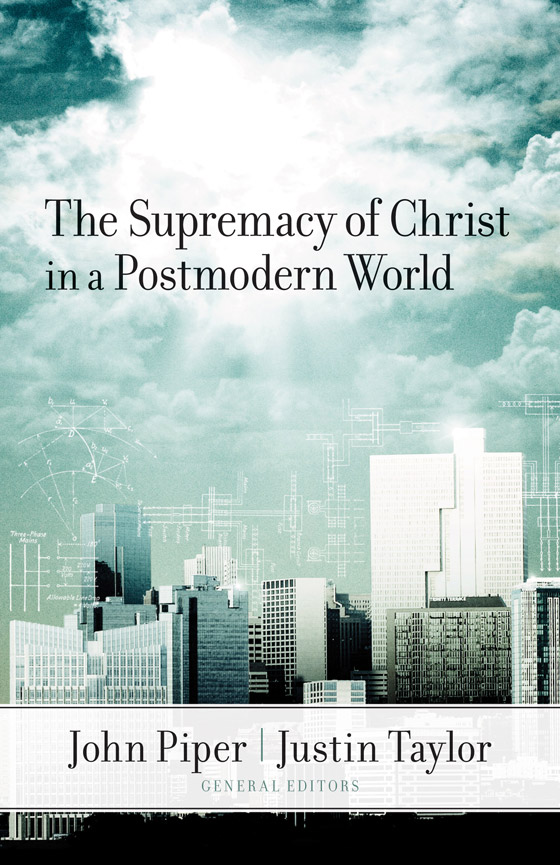
Crossway Books has just recently published The Supremacy of Christ in a Postmodern World edited by John Piper and Justin Taylor.

Abraham has just announced that, "We just received the new book The Supremacy of Christ in a Postmodern World. It will be on sale for $5 from now through Friday."

November 5, 2007 thru November 9, 2007 ONLY.

You may be interested in browsing this book and can do so online here.

Here is a list of the contents:

Part 1: Culture and Truth
1 The Supremacy of Christ in a Postmodern World by David Wells
2 Truth and the Supremacy of Christ in a Postmodern World by Voddie Baucham Jr.

Part 2: Joy and Love
3 Joy and the Supremacy of Christ in a Postmodern World by John Piper
4 Love and the Supremacy of Christ in a Postmodern World by D. A. Carson

Part 3: Gospel Theologizing and Contextualizing
5 The Gospel and the Supremacy of Christ in a Postmodern World by Tim Keller
6 The Church and the Supremacy of Christ in a Postmodern World by Mark Driscoll

After this sale you can purchase this book from Westminster Bookstore for $9.89 or from CBD for $11.99.
Share/Bookmark

Saturday, July 14, 2007

Common Pitfalls with Expository Preaching


I found this great list of "Common Pitfalls with Expository Preaching" by Paul Lamey over at Expository Thoughts.

Here are a few things we all struggle with at times. These are items to either avoid or amend in our expository preaching (in no particular order):

1. Not taking enough time to observe the text of Scripture.
2. Observing things that are not there or are not significant.
3. Not checking and double-checking your observations.
4. Rushing exegesis for the sake of exposition.
5. Being slavishly dependent on commentaries.
6. Preaching too long.
7. Preaching too short.
8. Missing the point(s) of a passage.
9. Abusing the aorist tense .
10. Losing site of the context.
11. Having all heat (passion) and no light (content).
12. Having all light and no heat.
13. Flattening out a text for the sake of a theological system.
14. Erecting a theological “mountain” in the place of a mere theological “hill.”
For our purposes, here, I'm particularly interested in the inclusion of #5 "Being slavishly dependent on commentaries."

This reminds me of a lecture I recently listened to by John Piper (John Owen: The Chief Design of My Life--Mortification and Universal Holiness) in which he answered a question during the Q&A time regarding commentaries. I found it interesting that three of the four he mentioned were older classics (Alford, Murray, and Broadus). Then he concluded by saying that he rarely uses commentaries. He said,
I don't use commentaries very often, frankly. If I think I'm unsure about what I've seen, I'll check it out. But, by and large, assiduous... See, a pastor only has so much time to get ready for Sunday morning. If you've got a block of ten to twenty hours; wherever you fit in there, and you can only do so much, assiduous meditation on the original languages and prayer are much more important than reading six commentaries. Both is better. Because you might guard yourself from a really stupid mistake if you check it out with another mind. But if you've gotta choose, I'd choose assiduous meditation.
Just prior to this Q&A session, he concluded his lecture on the life of John Owen with this imperative concerning preaching:

Do not preach anything that you have not spiritually tasted.

In this same vein, Proverbs 12:27 says "Whoever is slothful will not roast his game, but the diligent man will get precious wealth." We need to be sure to roast what we take in. To assiduously meditate upon the Word of God. Turn it over and over in your thoughts. Prayerfully.

Spurgeon, in his Lectures to My Students writes,
You will not be able to extemporise good thinking unless you have been in the habit of thinking and feeding your mind with abundant and nourishing food. Work hard at every available moment. Store your minds very richly, and then, like merchants with crowded warehouses, you will have goods ready for your customers, and having warehouses, you will have goods ready for your customers, and having arranged your good things upon the shelves of your mind, you will be able to hand them down at any time without the laborious process of going to market, sorting, folding, and preparing.
So, assiduous meditation and storing up your minds carefully are indispensable for the expository preacher.
Share/Bookmark

Wednesday, May 16, 2007

Piper's list of "Most Influential Books"

Books That Have Influenced Me Most by John Piper

This was written by Dr. John Piper, Pastor for Preaching at Bethlehem Baptist Church in Minneapolis, Minnesota, in 1993. Though many years have passed since Dr. Piper created this list, we believe it remains a useful example of the reading of a pastor deeply committed to preaching the glories of the incomparable Christ. Used by permission of Desiring God Ministries. [read more here]

By John Piper. © Desiring God. Website: www.desiringGod.org. Email: mail@desiringGod.org. Toll Free: 1.888.346.4700.


Share/Bookmark