Showing posts with label 223.2 Psalms. Show all posts

Friday, March 14, 2014

Review: Psalms for Young Children

Psalms for Young ChildrenPsalms for Young Children by Marie-Helene Delval
My rating: 5 of 5 stars

I purchased this book last week from Eerdmans going off of the Google Preview only. I am very impressed and have not been disappointed! Per the copyright page, this little book, published in 2008 by Wm. B. Eerdmans Publishing Company, was first published in 2003 in French by Bayard Editions Jeunesse.

The artwork, by Arno, is bright, creative, engaging and well-suited to the selected texts. I was struck by the way the artist did not gloss over the lament passages making everything to look bright and cheerful. Rather, when the text is solemn, the characters appear to be solemn, when sad, likewise, and when joyful, the same. This is an example of careful, artistic interpretation.

The texts are "summary-paraphrases" of selected psalms. One question I had concerning the text was, "Will a child be able to smoothly transition from each "summary-paraphrase" to the full translation?"
After comparing many of the texts with the full translation, I'm confident that this will be a smooth transition. In fact, the value of a "summary-paraphrase" is that it seeks to pinpoint the mood and major theme of a text. I believe that Marie-Hélène Delval did an excellent job here.

This book will be an excellent introduction to the Psalter for children.

Unfortunately, this book is not available for purchase at Westminster Bookstore, but it is available in Hardcover and Kindle format from Amazon.com.


Share/Bookmark

Friday, October 11, 2013

Arguing With God by Bernd Janowski

I just found out about this newly translated work via @wjkbooks on Twitter: https://twitter.com/wjkbooks/status/388649458201681920/photo/1.  I'm looking forward to working through this one.

Arguing with God

A Theological Anthropology of the Psalms

Author:Bernd Janowski
More by author(s)
Publisher:Westminster John Knox Press
Format:6 x 9
Product Type:Paper
Publication Date:10/24/2013
Retail Price:$70.00

Description from the publisher:


Available October 2013.
This is the first English translation of Bernd Janowski's incisive anthropological study of the Psalms, originally published in German in 2003 as Konfliktgespräche mit Gott. Eine Anthropologie der Psalmen(Neukirchener). Janowski begins with an introduction to Old Testament anthropology, concentrating on themes of being forsaken by God, enmity, legal difficulties, and sickness. Each chapter defines a problem and considers it in relation to anthropological insights from related fields of study and a thematically relevant example from the Psalms, including how a central aspect of this Psalm is explored in other Old Testament or Ancient Near Eastern texts. Each chapter concludes with an "Anthropological Keyword," which explores especially important words and phrases in the Psalms. The book also includes reflections on reading the Psalms from a New Testament perspective, focusing on themes of transience, praising God, salvation from death, and trust in God. Janowski's study demonstrates how the Psalms have important theological implications and ultimately help us to understand what it means to be human.

Praise for Arguing with God:
"Bernd Janowski (University of Heidelberg) is not yet much known to English-speaking readers. He will be now! He is a world class scholar who has written a world class book that will promptly become the bench-mark for theological interpretation of the Psalms. Janowski, in a dense, complex genuinely inviting book, combines acute theological sensibility, close exegetical alertness, and attention to the large human questions now before us concerning life and hope in a failed world. The result of his work is a study that will reward close, careful, sustained reading. We may be grateful to Westminster John Knox for bringing this fresh and judicious book into English translation."
—Walter Brueggemann, William Marcellus McPheeters Professor of Old Testament Emeritus, Columbia Theological Seminary

Share/Bookmark

Friday, August 3, 2012

Learning How to Cry Out to God


One of the most helpful tools for learning how to pray is the book of Psalms.  Not only praying through the Psalms but also taking the time to understand the form and function of the various types of psalms is an excellent practice.  (For an overview of studying the Psalms see my series of posts beginning here.)  The most numerous type of psalm is the prayer for help, or as it is more commonly called, the lament (Mays, 21; Miller, 55).  Both James Mays and Patrick Miller have been a tremendous help to me by way of explaining the common structure of the lament psalms. Honorable mention goes to Walter Brueggemann (see bibliography below).

These are the most common elements of prayers for help: 
  1. Direct Address
  2. Petition
  3. Motivation
  4. Lament or Description of Trouble
  5. Expressions of confidence or trust
  6. Offer or vow 
These elements will vary in the order of their appearance, and one or two (in particular the offer/vow) may not appear at all in some instances.  When working through a psalm I find that identifying these elements proves to be extremely helpful.  The various elements are pregnant with implied meaning and purpose.  For instance, the typical address in the prayers for help is brief and distinctly personal.  This implies an urgency and a familiarity with the one addressed.  The use of motivation, or reasons to hear and answer the petition(s), typically draws upon an intimate knowledge of the one addressed, and/or a distinct history between the pray-er and the addressee.  At times the motivation is cloaked in praise which may appear at times to border on coercion.

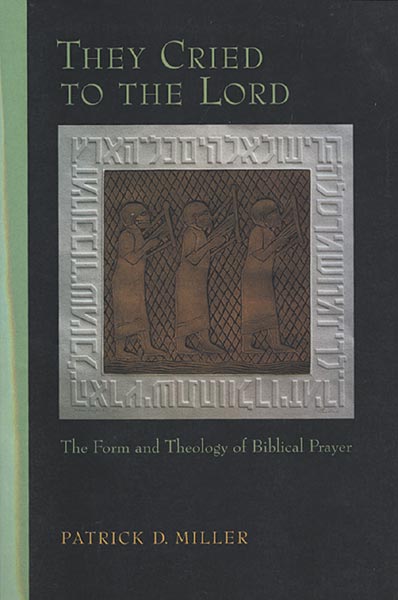
Something that Patrick Miller points out in They Cried to the Lord, is that even outside of the Psalms the Old Testament is filled with prayers for help.  I'm sure I knew this, but my focus on the Psalms has been so narrow that I overlooked the value of considering the prayers for help throughout the rest of Scripture. Miller identifies and outlines these laments in Appendix 1: A Structural Outline of Prayers for Help and Intercession in Prose Texts (pp. 337-357).

Well, the New Testament also includes prayers for help, especially in the passion narratives.  I am currently studying Mark 14:26-52 which includes Jesus' prayer in the garden of Gethsemane.  This is an astounding example of a prayer for help.  It is also significant in that it puts the Old Testament laments into perspective.  Jesus fulfills and answers the deepest cries of the soul.*  Here's how I would outline Jesus' prayer in the garden according to the elements listed above:

ADDRESS                                     Abba, Father
MOTIVATION                                All things are possible for you.
PETITION                                     Remove this cup from me.
DESCRIPTION OF TROUBLE        [My soul is very sorrowful, even to death.]
CONFIDENCE                               Yet not what I will, but what you will.

It is worth noting that this particular address is far more intimate than the typical, "O Lord," "O God," or even "My God."  There is an aspect of motivation coupled with the address that is absolutely stunning and beautiful.  Also, the description of trouble is pulled down from verse 34.  It seems appropriate to include it here, because it clearly identifies the circumstance from which this prayer arises.  (The English text is that of the ESV.)

BIBLIOGRAPHY
James L. Mays, Psalms. Interpretation. Louisville: John Knox Press, 1994.
Patrick D. Miller, They Cried to the Lord: The Form and Theology of Biblical Prayer. Minneapolis: Fortress Press, 1994.
Walter Brueggemann, Praying the Psalms: Engaging Scripture and the Life of the Spirit. Winona, MN: St. Mary's Press, 1982; 2nd Edition. Cascade Books, 2007.
_____, The Psalms and the Life of Faith. Minneapolis: Fortress Press, 1995.

Note* - Today I stumbled across the abstract for Rebekah Ann Eklund's dissertation, Lord, Teach Us How to Grieve: Jesus' Laments and Christian Hope. unpublished (Duke Divinity School), 2012.  Eklund notes that, "lament has a dual function in the New Testament: it points to Jesus as the beginning of the fulfillment of lament’s cries, and it points forward to the consummation of God’s kingdom as guaranteed in Jesus’ resurrection" (iv).  With this I am hooked.  I downloaded her complete dissertation here, and am looking forward to reading more.

Share/Bookmark

Friday, July 27, 2012

Prayer By Any Name

How do you pray?  What words would you use to describe your prayers?  Can prayer be silent?  When and where do you pray?  How would you describe your posture of prayer?

These questions are taken up in great detail in chapter two Patrick D. Miller's They Cried To the Lord: The Form and Theology of Biblical Prayer (Minneapolis: Fortress Press, 1994).   This is a stimulating study on the terminology, timing, locations, and actions associated with biblical prayers (focused particularly upon the OT). Miller reaffirms the case that the Scriptures do not limit pray-ers to one "correct" way of praying, but rather frees them by recognizing a variety of manners of communicating with God, a flexibility with regard to timing and location, and also appropriate, meaningful gestures.

This chapter is divided into three primary sections covering Terminology, Time and Place, and Gestures and Acts. 

The discussion of the terminology of prayer takes up the majority of space in which we are introduced to the variety of terms used in Scripture.  Identifying the terms used for communication between mankind and the divine is a task I've undertaken only on a limited scale and with reference to the NT.  This study is helpful and reads like an entry into NIDOTT.  Miller identifies general terms for communication, technical terms for prayer, and general terms of communication that have been adopted as technical terms for specific prayers (such as crying, complaining, and meditating).

What I learned from this is that prayer cannot be pigeon-holed into a single expression; for instance, "asking and receiving," or "obtaining answers."  Rather, prayer is a diverse act which is normally calm and controlled, often load and emotional, and sometimes quiet or silent altogether.

With regard to the time and place of prayer, Miller concludes:
Holy place and private room, sanctuary and sickbed are all places of prayer.  Set times and any time, morning and night are all times of prayer.  The Scriptures identify prayer as an act that could be set in particular moments and places and routinized in definite ways.  But it was not confined to such settings.  Formality and fixity interchange with openness and freedom in the time and place of prayer. (50, empahsis mine)
Questions about gestures and posture in prayer often meet inadequate answers and unbiblical reservedness.  At least that has been my experience up until lately.  The final section explores this issue with refreshing insight.  
"Praying is so much a verbal act, even if only in the mind, that one is inclined to neglect the nonverbal dimension that is frequently indicated in the texts.  But in ancient times as much or more than the present, dimensions of prayer were expressed with the body and in acts, movements, and gestures" (50).  
According to the OT data, sitting, laying prostrate, and kneeling convey a sense of humility before God, "that the conversation is not ordinary conversation" (50).  The upraised or outstretched hands in praise or petition "convey a sense of the transcendent, that prayer is directed beyond oneself and this world to the God who is in heaven" (51).  This posture is worth considering a bit further since it seems to provoke the most confusion, if not controversy.  Miller continues, 
All these gestures and actions serve to recognize that the act of praying to God, of setting one's case before God or presenting prayers in behalf of another in need, is not simply a routine action.  In some sense, one moves one's whole being into a stance of prayer.  There is a break from whatever is happening, an acknowledgement that now one is coming before God. ... Not all praying assumes a specifically holy ground, but this kind of action is not done matter-of-factly, and the reaching to heaven or to the holy place, the sanctuary, symbolizes that fact, that the very act of prayer takes one into another world, reaches out toward the transcendent. (51, emphasis mine)
What's interesting here is that we often accept "extreme gestures and acts" such as weeping and wailing, pulling the hair, tearing the cloths, fasting, etc.; yet we quibble about uplifted hands in public.  Hmmm!  Maybe we're missing something rich and vital to prayer, when we insist on strict restraint and propriety in all cases, especially when in public.

In summary, Miller writes, "However direct the encounter of prayer may be, however, open and assertive may be those who cry out and complain, there is no doubt that these are prayers of creature before creator, that anguish and anger do not belie the relationship" (54).
__________
Related:
Notes on the Introduction and Chapter 1

Share/Bookmark

Friday, July 20, 2012

Reading Note: Patrick Miller on Biblical Prayer (Intro, Ch. 1)

I am currently working through Patrick D. Miller's They Cried To the Lord: The Form and Theology of Biblical Prayer (Minneapolis: Fortress Press, 1994) and am finding it to be dense, yet profitable.  This is a scholarly work dedicated to James L. Mays, whom I have come to greatly appreciate for his work on the Psalms (see here and here).

AUDIENCE
The audience for which Miller wrote is suggested by Michael Welker in his endorsement on the back cover--"This volume will become a standard work not only for exegetes but also for both practical and systematic theologians, for pastors, and for anyone interested in understanding the foundations of piety."  Having found numerous references to this work in commentaries and studies on the Psalms, I believe that Welker's statement has been amply validated.

The opening paragraph of Miller's Preface not only identifies the source from which these studies originated, but also grounds this work in a very practical setting: the classroom.  Miller writes,
This study of biblical prayer arises form teaching seminary students, pastors, and lay people about the Psalms and, more broadly, about prayer in Scripture.  All of these groups have taught me as I have taught them and thus have helped to shape this book in large and small ways. (xv)
So, we have here a book on the theology of prayer which was developed and cultivated in the crucible of the classroom in conversation with a variety of practitioners.  This sounds promising!

THEME
This book is introduced with the thought-provoking declaration that "No single practice more clearly defines a religion than the act of praying" (1).  Furthermore, by arguing that belief is shaped by prayer, Miller contends for the necessary interdependence and essential unity of prayer and the theological task.  He continues,
"So prayer and theology exist in relation to each other in a correcting circle, the one learning from the other and correcting the other.  Religious faith seeks not to think one way and to pray another but to come before God in a manner that is consistent with what we believe and profess about God and God's way and to think about God in a way that is shaped by the experience of actual encounter in prayer. Learning to pray teaches about God" (1).
AIM
The stated aim of this book is "to look fairly comprehensively and broadly at biblical prayer," yet this volume is not to be taken as "a theology of prayer in general," but rather "a theology of biblical prayer" (2).

"WHAT OTHER GREAT NATION HAS A GOD SO NEAR TO US?"*
Chapter 1, "Israel's Neighbors at Prayer," was an introduction to new territory for me, yet I found it fascinating to see the many parallels and contrasts between the examples of Mesopotamian prayers provided.  One lesson that stood out to me (and which is promised to be dealt with more fully later on in the book) was the note that whereas the prayers of Israel's neighbors typically accompanied sacrificial offerings and the biblical Psalms lack such ritual directions, nevertheless, "it is clear from references in the Psalms and the historical books that the biblical laments and thanksgiving songs were also accompanied by sacrifice.  In fact, the same Hebrew term, todah, designates both the thanksgiving song and the thanksgiving sacrifice" (31). This is helpful to keep in mind while reading the books of the Law and the Psalms.  The connection between the speech and actions of worship is significant.

Miller concludes this chapter with the following observation:
The commonality that does exist between Israel's prayers and those of its neighbors suggests structures and modes of prayer that are not precisely identical but sufficiently related that we can assume there is something universal here, that it is in the shared and common history that we learn what God seeks in prayer, that the modes receive a confirmation in part because they seem to be common human ways belonging to the creatureliness of every human being and the imperfect and partial effort on the part of the creature to communicate with the divine. (31)
I didn't expect to find so much in common although it is clear that, beyond the polytheistic and monotheistic differences between Israel and her early neighbors, the openness and freedom which Israel and all of her children enjoy in prayer is unmistakable.

____________________
* NOTE - I love connecting the dots between books, authors and history.  Here is a hint to the significance of the title chosen for the Festschrift in honor of Patrick Miller: Brent A. Strawn and Nancy R. Bowen (eds.), A God So Near: Essays on Old Testament Theology in Honor of Patrick D. Miller (Eisenbrauns, 2003).
Share/Bookmark

Friday, April 6, 2012

James L. Mays on Psalms (Interpretation Commentary) 71% off at CBD

James L. Mays's commentary has become my primary "go-to" commentary on the Psalms when I'm looking for quick theological interpretation.  There are others I turn to when I have more time to work through the details of exegesis such as the three volumes in the WBC series (Marvin Tate and Leslie Allen) or Gerald Wilson's volume on Pss 1-72 in the NIVAC series (I still have Goldingay's 3-volumes on my "wish list").  However, I have found the introductory matter supplied by Mays along with his careful eye to highlight structural features consistent in each form along with theological continuity to especially helpful.  In particular, Mays's understanding of the various patterns of prayers in the Psalter and their basic features has been most helpful.

Along with this commentary, I would recommend a collection of essays and sermons by James L. Mays, Preaching and Teaching the Psalms, edited by Patrick D. Miller.  The essays included here very useful.
 
CBD currently has Mays's commentary on Psalms (hardcover) marked down to $9.99.  This is an excellent price!!!  It appears that this series has been re-published in paperback and also in digital format.  This more than likely accounts for the discounted prices on the older copies.  However, some of these older copies are still gems.  CBD currently has the following volumes in the Interpretation series marked down.  Take a look...


Share/Bookmark

Thursday, March 8, 2012

Psalms: Warts-and-all-Religion

"There is no literature in all the world that is more true to life and more honest than the Psalms, for here we have warts-and-all religion. Every skeptical thought, every disappointing venture, every pain, every despair that we can face is lived through and integrated into a personal, saving relationship with God--a relationship that also has in it acts of praise, blessing, peace, security, trust and love.

"Good poetry survives not when it is pretty or beautiful or nice but when it is true: accurate and honest. The psalms are great poetry and have lasted not because they appeal to our fantasies and our wishes but because they are confirmed in the intensities of honest and hazardous living."
-Eugene Peterson, A Long Obedience in the Same Direction, p. 75.

Share/Bookmark

Sunday, February 19, 2012

Jesus Acted Out the Trust to Remove Our Fear

"Trust," writes Erik Routley, "is a consequence of calling.  But when we find trusting too great a burden, we are the victims of fear.  This fear Jesus has come to remove."

My Sunday School class is studying the Psalms of Ascents and this morning we arrived at Psalm 123.

123 A Song of Ascents.
1     To you I lift up my eyes,
O you who are enthroned in the heavens!
2     Behold, as the eyes of servants
look to the hand of their master,
       as the eyes of a maidservant
to the hand of her mistress,
       so our eyes look to the Lord our God,
till he has mercy upon us.
3     Have mercy upon us, O Lord, have mercy upon us,
for we have had more than enough of contempt.
4     Our soul has had more than enough
of the scorn of those who are at ease,
of the contempt of the proud.

A book we are using to supplement our studies is Erik Routley's Ascent to the Cross. In this little book, Routley considers how Jesus may have appropriated these pilgrim psalms on his final journey up to Jerusalem. I neglected to re-read Routley's thoughts on Psalm 123 prior to teaching this morning but I did so this afternoon and found this gem of counsel on spiritual depression.

Routley writes:

It is relatively easy to turn trustfully to God in the heat of a straight fight; even more so, after a fight has been brought to a successful conclusion in the enemy's defeat.... But it is another thing when you are exhausted and frustrated; it is an even worse thing when you know that the people to whom you are trying to talk are being subtly brainwashed by the purveyors of secular and trivial values. Christians all over the world are indeed exceedingly filled with the contempt of the proud.

You can always say, in a vague romantic way, that the answer to depression and anxiety, the endemic diseases of a sophisticated civilization, is ‘trust in God’. The answer you will get from an honest man in distress is ‘Yes, but that is just what I can’t do: if I could, I wouldn’t be depressed and anxious’. I heard with some pleasure a sardonic remark from a distinguished minister who was speaking at a university mission. ‘When I meet some radiant Christians,’ he said, ‘I am convinced of the case for the morose Christian.’ There can be something dreadfully heartless about eupeptic Christianity.

Of course, it can do us good, in times of depression, to repeat the words of the saints, to take to ourselves the great affirmations of those who have found the way even when we cannot pretend to have found it ourselves. Do not allow an over-valuing of ‘sincerity’ to prevent you from doing this when it is the only thing to do. This is not hypocrisy. It is the admission that you can’t swim strongly enough to beat the current and that you need a lifebelt.

But our Lord goes further than this…. The way from men to God was barred, as it were, by the devil, by sin, by grievance, by a settled assumption that God disliked humanity and would disappoint its hopes of happiness. The way to heaven must be cleared, the rusty gate opened. He must open it, and this could not be done merely by telling us that it was open. What he preached and taught must be acted out in history.

Therefore he must draw off towards himself all this poison that is corrupting our conversation with God. He must so place himself that the despitefulness of the proud will have its way with him. He must throw himself, as a servant, into the hands of mankind, his master. He must utterly trust us with himself, commit his destiny to us, give himself away to us. He must ‘empty himself’ of his divinity, and become obedient, even if that meant death at our hands. All this—to show us that when we are told that God has made a covenant with us, expecting us to act as people whom he trusts and respects, that statement is literally true and not merely something in a hymn book.

Share/Bookmark

Friday, February 3, 2012

New Volume on the Psalms in the Studies in Theological Interpretation Series

Here's another interesting looking study in the Psalms: Gordon Wenham, The Psalms as Torah: Reading Biblical Song Ethically. Studies in Theological Interpretation. (Baker Academic, 2012).


Contents
Introduction
1. Jewish and Christian Approaches to the Psalms
2. Critical Approaches to the Psalms
3. The Psalter as an Anthology to Be Memorized
4. The Unique Claims of Prayed Ethics
5. The Concept of the Law in the Psalms
6. Laws in the Psalter
7. Narrative Law in the Psalter
8. Virtues and Vices in the Psalter
9. Appeals for Divine Intervention
10. The Ethic of the Psalms and the New Testament
Conclusion
Indexes

"An important contribution to both ethics and our insightful reading of the Psalms."--Patrick D. Miller, Princeton Theological Seminary


Have any of our you read any of the volumes in this series? What are your impressions?


I also found this related title by Wenham: Story as Torah: Reading Old Testament Narrative Ethically (Baker Academic, 2004).


Added to the wish list!


Studies in Theological Interpretation


Psalms as Torah, Gordon J. Wenham, 978-0-8010-3168-7
New!
Reading Biblical Song Ethically
ISBN: 978-0-8010-3168-7
Price: $22.99
Format: Paperback
Publication date: Feb. 12 | Division: Baker Academic
VIEW AT AMAZON

Character of Christian Scripture, The, Christopher R. Seitz, 978-0-8010-3948-5
The Significance of a Two-Testament Bible
ISBN: 978-0-8010-3948-5
Price: $22.99
Format: Paperback
Publication date: Oct. 11 | Division: Baker Academic
VIEW AT AMAZON

Virtuous Reader, The, Richard S. Briggs, 978-0-8010-3843-3
Old Testament Narrative and Interpretive Virtue
ISBN: 978-0-8010-3843-3
Price: $27.00
Format: Paperback
Publication date: Jan. 10 | Division: Baker Academic
VIEW AT AMAZON

Body, Soul, and Human Life, Joel B. Green, 978-0-8010-3595-1
The Nature of Humanity in the Bible
ISBN: 978-0-8010-3595-1
Price: $24.00
Format: Paperback
Publication date: Jun. 08 | Division: Baker Academic
VIEW AT AMAZON

Prophecy and Hermeneutics, Christopher R. Seitz, 978-0-8010-3258-5
Toward a New Introduction to the Prophets
ISBN: 978-0-8010-3258-5
Price: $23.00
Format: Paperback
Publication date: Jul. 07 | Division: Baker Academic
VIEW AT AMAZON

Seeing the Word, Markus Bockmuehl, 978-0-8010-2761-1
Refocusing New Testament Study
ISBN: 978-0-8010-2761-1
Price: $27.00
Format: Paperback
Publication date: Aug. 06 | Division: Baker Academic
VIEW AT AMAZON


Share/Bookmark

Friday, July 16, 2010

Christ the Omnipotent Healer - by St. Augustine (part 2)

Here is the conclusion to Augustine's comments on Christ the Omnipotent Healer in Psalm 103:3-4a.
c. 1480Image via Wikipedia
Why then hanker for temporal things when you are unwell? Concentrate first on getting better. Sometimes a person is ill in bed in his own house. His sickly state is quite obvious, though there is another sickness, just as unmistakable, which people are unwilling to recognize. However, in the case of the physical complaint, human doctors are called in. The patient is ill in his home, gasping with fever in his bed. Perhaps he tries to think about his financial affairs, or to give orders about his staff, or his farm, or to make some other arrangements. But he is immediately recalled from these anxieties by the solicitude of his relatives who fuss and murmur all round him. He is advised, "Forget about all that; just concentrate on getting better." The same advice is apposite for you. Whoever you are, think about other things if you are well; but if some malady proves to you how sick you really are, concentrate on your salvation. Christ is your salvation, so fix your mind on Christ. Accept his cup of salvation, for he heals all your diseases. If you truly want this salvation, you will get it. If you seek honors and riches you will not have them as soon as the desire arises, but what Christ gives you is more precious and is yours as soon as the desire it. He heals all your diseases; he will redeem your life from corruption. Every desire that plagues you will be healed when this corruptible nature is clothed in incorruptibility. Your life has been redeemed from corruption; there is no need to be afraid anymore. A contract has been signed in good faith; no one can deceive your redeemer, no one outwit him, no one bully him. He has struck this business deal, and he has paid the price already by shedding his blood. That is what I am saying, no less: that God's only Son has poured out his blood for us. Walk tall, human soul, for you are worth so high a price.

He will redeem your life from corruption. What he has promised us as a reward he has shown us in himself by way of example. He died for our offenses, and rose for our justification. Let the members hope for what has been demonstrated in their head. Will he not care for the members if he has raised their head to heaven? Surely; he will redeem your life from corruption.

Saint Augustine (Bishop of Hippo). Expositions of the Psalms, 99-120. III/19. The Works of Saint Augustine: A Translation for the 21st Century.  Translation and notes by Maria Boulding, O.S.B. Edited by Boniface Ramsey. Hyde Park, NY: New City Press, 2003, pp. 84-85.

Share/Bookmark

Tuesday, July 13, 2010

Christ the Omnipotent Healer - by St. Augustine

The following is a beautiful and convicting modern translation of Augustine's comments on Psalm 103:3.

c. 1480Image via Wikipedia
Now listen to all the ways in which he has repaid you. He is ready to forgive your iniquities, and he heals all your diseases. He will redeem your life from corruption, he crowns you in his pity and mercy. He satisfies your longing with good things, your youth will be renewed like an eagle's. These are the forms his repayment takes. What was due to a sinner except torment? What was owed to a blasphemer except the fires of hell? Yet these were not the repayment he made to you; do not be afraid, do not shrink back appalled, do not give way to loveless terror. Do not forget all those good ways in which he has repaid you; allow yourself to be changed now, and so avoid experiencing his—what shall I say? His bad ways of repaying you? But they cannot be bad if they are just. They seem bad to you, but to God not even the bad things you suffer are bad; for if they are just, they are good, and only to you who endure them do they seem bad. Would you prefer not to experience your fate as bad, just though it is in God's sight? Then make sure there is no sinful badness on your part in his presence. He has never ceased to call you, nor has he neglected to instruct the one he has called; he has never ceased to perfect the one he has instructed, nor will he neglect to crown you when he has made you perfect. What have you to say? That you are a sinner? Be converted, then, and be open to receive the repayments he offers, for he is ready to forgive all your iniquities.

Even after your sins are forgiven you still carry with you a weak body. Inevitably there will be carnal desires that titillate you and tempt you to forbidden pleasures; these result from your sickness, for you still carry weak flesh. Death has not yet been swallowed up in victory, nor has this corruptible nature yet been clothed in incorruptibility (See 1 Cor. 15:54, 53). The soul itself is still shaken by manifold disturbances, even after the forgiveness of its sins. It is still battered by dangerous temptations, and all sorts of suggestions assail it. Some of these it finds pleasurable, others it does not; but from time to time it consents to some of those in which it takes pleasure, and then it is trapped. This is a disease, but the Lord heals all your diseases. All your maladies will be healed, never fear. "They are great," you say; but the physician is greater. An omnipotent doctor is never confronted with an incurable disease. All you need to do is to allow yourself to be cured. Do not thrust his hands away, for he knows what he is doing. You must not simply enjoy it when he pampers you; you must also bear it when he plies the knife. Hold out under the painful treatment by fixing your mind on the health it will bring you.

Just think, my brothers and sisters, how much people put up with in their bodily illnesses, and only to gain a few extra days of life before they die and uncertain days at that. Plenty of people have endured excruciating pain under surgery, and then died in the hands of the doctors, or else recovered only to succumb to some other illness that carried them off. If they had looked for such a speedy death, would they have consented to undergo that agonizing pain? But you are not suffering for the sake of a doubtful outcome; he who has promised you health cannot make a mistake. A doctor is sometimes mistaken in promising health where a human body is concerned. Why can he be mistaken. Because what he is trying to heal is not something he made himself. But God made your body, and God made your soul. He knows how to re-create what he created; he knows how to form anew what he once formed. Your job is simply to stay under the doctor's hands; anyone who pushes his hands away offends him. People do not behave so to human doctors. On the contrary, they let themselves be tied down and cut. For the sake of uncertain recovery they are willing to pay the high price of certain pain. God who made you cures you with absolute certainty, and he charges no fee. Yield to his hands, then, O soul, you who bless him, mindful of all the ways in which he repays you, for he heals all your diseases.
Saint Augustine (Bishop of Hippo). Expositions of the Psalms, 99-120. III/19. The Works of Saint Augustine: A Translation for the 21st Century.  Translation and notes by Maria Boulding, O.S.B. Edited by Boniface Ramsey. Hyde Park, NY: New City Press, 2003, pp. 82-83 (emphasis mine).

Share/Bookmark

Monday, July 20, 2009

A Collection of Psalters On Display at the Getty Museum

On view through August 16, 2009.

In an era of e-books, it is impressive to see the enduring beauty of the 21 manuscripts and leaves, or individual pages, displayed in "Temptation and Salvation: The Psalms of King David." All of the examples -- some large, some tiny -- were drawn from the Getty's own collection of the illustrated texts, inaugurated in 1983 with the purchase of 144 manuscripts owned by German chocolate magnate Peter Ludwig and his wife, Irene. (Martha Groves, "Getty displays medieval manuscripts focusing on King David," LA Times, July 20, 2009)
(HT: Jim Davila @ PaleoJudaica.com)
Share/Bookmark

Wednesday, June 10, 2009

Must Hear: BBC's Poetry Please: Readings from Psalms

I just finished listening to the BBC's Poetry Please broadcast of readings from the book of Psalms (HT: Phil Sumpter and John Hobbins). Kenneth Cranham reads from the time-honored King James Version and Henry Goodman reads from a fresh translation of the The Book of Psalms by Robert Alter.

While listening to these moving readings, I was reminded of a question posed in one of my pulpit speech classes: When does interpretation begin? We all (or most of us) assumed that interpretation began with the preaching of the sermon. That was the first time I realized that interpretation begins during the reading of the Scriptures. Ever since I've paid close attention to how people read the Scriptures. This episode by the BBC is a treat, indeed. The readings are full of interpretive moves that are brilliant. One of the most difficult psalms is the 137th, which includes a very strong imprecation. Both readers captured the emotion of this text better than I have ever heard.

Psalm 65 was a favorite--reverent, prayerful, and full of confidence in "our rescuing God."
Roger McGough presents a programme dedicated to the poetry of the Old Testament Book of Psalms, in old translations and new, read by Kenneth Cranham and Henry Goodman.

Featured in this programme
Psalm 23
Taken from The King James Bible
Psalm 23
Taken from The Book of Psalms
Translated by Robert Alter
Published by WW Norton and Company
Psalm 1
Taken from The Book of Psalms
Translated by Robert Alter
Published by WW Norton and Company
Psalm 150
Taken from The King James Bible
Psalm 22
Taken from The Book of Psalms
Translated by Robert Alter
Published by WW Norton and Company
Psalm 19
Taken from The King James Bible
Psalm 104
Taken from The Book of Psalms
Translated by Robert Alter
Published by WW Norton and Company
Psalm 13
Taken from The King James Bible
Psalm 13
Taken from The Book of Psalms
Translated by Robert Alter
Published by WW Norton and Company
Psalm 65
Taken from The King James Bible
Psalm 137
Taken from The King James Bible
Psalm 137
Taken from The Book of Psalms
Translated by Robert Alter
Published by WW Norton and Company

Share/Bookmark

Sunday, December 28, 2008

A Schedule for Reading Through the Psalter in One Month

Richard at תהלים (A blog dedicated to the Psalms) has offered a challenge to join him in reading through the Psalter. He has provided a link to the Psalter of the Book of Common Prayer which follows the following reading schedule:

Week 1: Days 1 through 7, Psalms 1 through 37.
Day 1

Morning Prayer: Pss 1-5
Evening Prayer: Pss 6-8

Day 2

Morning Prayer: Pss 9-11
Evening Prayer: Pss 12-14

Day 3

Morning Prayer: Pss 15-17
Evening Prayer: Ps 18

Day 4

Morning Prayer: Pss 19-21
Evening Prayer: Pss 22-23

Day 5

Morning Prayer: Pss 24-26
Evening Prayer: Pss 27-29

Day 6

Morning Prayer: Pss 30-31
Evening Prayer: Pss 32-34

Day 7

Morning Prayer: Pss 35-36
Evening Prayer: Ps 37

Week 2: Days 8 through 14, Psalms 38 through 74.
Day 8

Morning Prayer: Pss 38-40
Evening Prayer: Pss 41-43

Day 9

Morning Prayer: Pss 44-46
Evening Prayer: Pss 47-49

Day 10

Morning Prayer: Pss 50-52
Evening Prayer: Pss 53-55

Day 11

Morning Prayer: Pss 56-58
Evening Prayer: Pss 59-61

Day 12

Morning Prayer: Pss 62-64
Evening Prayer: Pss 65-67

Day 13

Morning Prayer: Ps 68
Evening Prayer: Pss 69-70

Day 14

Morning Prayer: Pss 71-72
Evening Prayer: Pss 73-74

Week 3: Days 15 through 21, Psalms 75 through 106.
Day 15

Morning Prayer: Pss 75-77
Evening Prayer: Ps 78

Day 16

Morning Prayer: Pss 79-81
Evening Prayer: Pss 82-85

Day 17

Morning Prayer: Pss 86-88
Evening Prayer: Ps 89

Day 18

Morning Prayer: Pss 90-92
Evening Prayer: Pss 93-94

Day 19

Morning Prayer: Pss 95-97
Evening Prayer: Pss 98-101

Day 20

Morning Prayer: Pss 102-103
Evening Prayer: Ps 104

Day 21

Morning Prayer: Ps 105
Evening Prayer: Ps 106

Week 4: Days 22 through 28, Psalms 107 through 138.
Day 22

Morning Prayer: Ps 107
Evening Prayer: Pss 108-109

Day 23

Morning Prayer: Pss 110-113
Evening Prayer: Pss 114-115

Day 24

Morning Prayer: Pss 116-118
Evening Prayer: Ps 119:1-32

Day 25

Morning Prayer: Ps 119:33-72
Evening Prayer: Ps 119:73-104

Day 26

Morning Prayer: Ps 119:105-144
Evening Prayer: Ps 119:145-176

Day 27

Morning Prayer: Pss 120-125
Evening Prayer: Pss 126-131

Day 28

Morning Prayer: Pss 132-135
Evening Prayer: Pss 136-138

Week 5: Days 29 through 31, Psalms 139 through 150.
Day 29

Morning Prayer: Pss 139-141
Evening Prayer: Pss 142-143

Day 30 (and 31)

Morning Prayer: Pss 144-146
Evening Prayer: Pss 147-150

This is a great plan!
Share/Bookmark

Sunday, December 7, 2008

Obeying God in a [insert modifier] Culture

How would you describe the culture in which you are planted? Rob Howell, a missionary friend, describes his Tanzanian culture as that of "a witchcraft culture."

Obeying God in a Witchcraft Culture

A blessing of our new life in Christ is that we don't need any kind of secret knowledge accessed only by a privileged few. We don't need a diviner to tell us what is causing our lives to unravel, or how to get them back on track. We have God's Spirit, the Holy Scriptures, and the community of believers to help us navigate life in a witchcraft culture. That was the basic message in Shadi today. And so I encouraged the believers to turn their focus on obeying what they know the Scriptures teach and leave the rest to God. That's what faithfulness is . . . living what you believe to be true even though culture flows in the opposite direction and pressures you to follow. (emphasis added)

We might use the following modifiers for the US culture: market analyst, psychotherapist, pharmacist, prosperity-gospel, etc. In light of the current intellectual, political, economic, and moral crisis we are facing, men and women are searching high and low for advice and certainty. Idols are being exposed to which we had been previously blind. Crisis and crunch are causing us to come face to face with our "lords" and "saviors": our gods.

God is still there! He is faithful and true. Here is a fitting Psalm.

Psalm 18 (NLT)
For the choir director: A psalm of David, the servant of the Lord. He sang this song to the Lord on the day the Lord rescued him from all his enemies and from Saul. He sang:

1 I love you, Lord;
you are my strength.
2 The Lord is my rock, my fortress, and my savior;
my God is my rock, in whom I find protection.
He is my shield, the power that saves me,
and my place of safety.
3 I called on the Lord, who is worthy of praise,
and he saved me from my enemies.

4 The ropes of death entangled me;
floods of destruction swept over me.
5 The grave wrapped its ropes around me;
death laid a trap in my path.
6 But in my distress I cried out to the Lord;
yes, I prayed to my God for help.
He heard me from his sanctuary;
my cry to him reached his ears.

7 Then the earth quaked and trembled.
The foundations of the mountains shook;
they quaked because of his anger.
8 Smoke poured from his nostrils;
fierce flames leaped from his mouth.
Glowing coals blazed forth from him.
9 He opened the heavens and came down;
dark storm clouds were beneath his feet.
10 Mounted on a mighty angelic being, he flew,
soaring on the wings of the wind.
11 He shrouded himself in darkness,
veiling his approach with dark rain clouds.
12 Thick clouds shielded the brightness around him
and rained down hail and burning coals.
13 The Lord thundered from heaven;
the voice of the Most High resounded
amid the hail and burning coals.
14 He shot his arrows and scattered his enemies;
his lightning flashed, and they were greatly confused.
15 Then at your command, O Lord,
at the blast of your breath,
the bottom of the sea could be seen,
and the foundations of the earth were laid bare.

16 He reached down from heaven and rescued me;
he drew me out of deep waters.
17 He rescued me from my powerful enemies,
from those who hated me and were too strong for me.
18 They attacked me at a moment when I was in distress,
but the Lord supported me.
19 He led me to a place of safety;
he rescued me because he delights in me.
20 The Lord rewarded me for doing right;
he restored me because of my innocence.
21 For I have kept the ways of the Lord;
I have not turned from my God to follow evil.
22 I have followed all his regulations;
I have never abandoned his decrees.
23 I am blameless before God;
I have kept myself from sin.
24 The Lord rewarded me for doing right.
He has seen my innocence.

25 To the faithful you show yourself faithful;
to those with integrity you show integrity.
26 To the pure you show yourself pure,
but to the wicked you show yourself hostile.
27 You rescue the humble,
but you humiliate the proud.
28 You light a lamp for me.
The Lord, my God, lights up my darkness.
29 In your strength I can crush an army;
with my God I can scale any wall.

30 God’s way is perfect.
All the Lord’s promises prove true.
He is a shield for all who look to him for protection.
31 For who is God except the Lord?
Who but our God is a solid rock?
32 God arms me with strength,
and he makes my way perfect.
33 He makes me as surefooted as a deer,
enabling me to stand on mountain heights.
34 He trains my hands for battle;
he strengthens my arm to draw a bronze bow.
35 You have given me your shield of victory.
Your right hand supports me;
your help has made me great.
36 You have made a wide path for my feet
to keep them from slipping.

37 I chased my enemies and caught them;
I did not stop until they were conquered.
38 I struck them down so they could not get up;
they fell beneath my feet.
39 You have armed me with strength for the battle;
you have subdued my enemies under my feet.
40 You placed my foot on their necks.
I have destroyed all who hated me.
41 They called for help, but no one came to their rescue.
They even cried to the Lord, but he refused to answer.
42 I ground them as fine as dust in the wind.
I swept them into the gutter like dirt.
43 You gave me victory over my accusers.
You appointed me ruler over nations;
people I don’t even know now serve me.
44 As soon as they hear of me, they submit;
foreign nations cringe before me.
45 They all lose their courage
and come trembling from their strongholds.

46 The Lord lives! Praise to my Rock!
May the God of my salvation be exalted!
47 He is the God who pays back those who harm me;
he subdues the nations under me
48 and rescues me from my enemies.
You hold me safe beyond the reach of my enemies;
you save me from violent opponents.
49 For this, O Lord, I will praise you among the nations;
I will sing praises to your name.
50 You give great victories to your king;
you show unfailing love to your anointed,
to David and all his descendants forever.

Share/Bookmark