Showing posts with label Thomas Chalmers. Show all posts

Saturday, January 19, 2008

Fullness of Joy

Instead of posting in the comments to Tim's previous post, The Emptiness of Mere Success, I would like to share this quote here.

The Gospel teaches us that what truly satisfies is not what we can accomplish by our own strength but what Someone else has accomplished for us. This is contrary to the wisdom of men. Men (yes, and women), generally, want to accomplish and achieve things. Tom Brady says that he feels that "there's something out there greater for me". Whether or not the wording of this statement was intentional I can't say, but he got the last part correct. There is something out there greater for him. I appreciate those who have caught on to this and have been encouraging us to pray for the salvation of Tom Brady. This is a worthy cause.
This morning I picked up my review copy of the Letters of Thomas Chalmers (BOT: 2007) and read a few more selections. The letters I read were an exchange between Dr Chalmers and a close friend named Thomas Smith. Smith had been seeking Chalmers' help with questions about his faith and, in one letter, had hinted toward his need form further spiritual reform. Chalmers responded with the following statement that I found to be very helpful, even to me. Maybe it will be a timely word of exhortation to you too.

...will you permit me further to say, that the effect of all your doings would be hurtful did the consciousness of them go to wean you from dependence on Christ, or turn your eye from Him as all your desire and all your salvation? Go joyfully to God in His name; follow closely in the path of His example; feel your need of His Spirit in every enterprise; have no doubt of your forgiveness through the merits of His blood, coupling with faith in this one testimony, the acceptance of every one saying about the necessity of holiness and self-denial, and the mortification of all that is sinful, and the adornment of the whole man with the graces of the Spirit, and the dedication of the whole life to the will of Him who poured out His soul unto death for you. (p.19)
Even Christians, as this young man confessed, can easily find themselves in a state of emptiness if they look to the works of their hands alone. Let us not forget the source of our fullness, the gospel of Jesus Christ. Yes, we are weak, but He is strong. Abraham learned this ever so slowly as he followed God away from home and throughout his days of sojourning. David learned this as he sought to execute his royal responsibilities. Jesus' disciples learned this as they followed and learned from Him. One of the psalms from my reading this week captures this, too.

Psalm 16:8-11
שויתי יהוה לנגדי תמיד
כי מימיני בל אמוט׃

I have set the Lord always before me;
because he is at my right hand, I shall not be shaken.
לכן שמח לבי ויגל כבודי
אף בשרי ישכן לבטח׃

Therefore my heart is glad, and my whole being* rejoices;
my flesh also dwells secure.
כי לא תעזב נפשי לשאול
לא תתן חסידך לראות שחת׃

For you will not abandon my soul to Sheol**,
or let your holy one see corruption.
תודיעני ארח חיים
שבע שמחות את פניך
נעמות בימינך נצח׃

You make known to me the path of life;
in your presence there is fullness of joy***;
at your right hand are pleasures forevermore. (ESV)

____________________
Notes:
*
כבוי alt. mss. glory; LXX tongue
**
שאול grave or the abode of the dead.
*** A literal translation would be Satisfying rejoicings are in your presence.

Share/Bookmark

Thursday, June 7, 2007

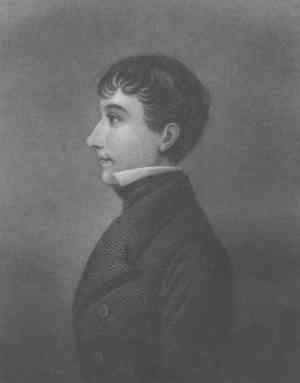
John Urquhart (June 7, 1808-January 19, 1827)

John Urquhart was born in Perth, Scotland on June 7, 1808. From his childhood he was noted to have been extremely intelligent. “William Orme, his minister in Perth, claimed that he had never met anybody of so fine a mind or who arrived so quickly at maturity” (Piggin , Stuart & John Roxborough. The St. Andrews Seven. Edinburgh: Banner of Truth, 1985, page 13).

It was at the Grammar School in Perth that young Urquhart struck up a lasting friendship with Alexander Duff. Of his early habits and manner of life, Duff wrote,

For the most part, he rose every morning between three and four o’clock, and directly issued forth to enjoy its sweets. And should you, at any time, during the course of the morning, cast your eyes along that beautiful extensive green, the North Inch of Perth, you could not fail to observe, in the distance, this interesting youth moving along the surface like a shadow wholly unbound to it; sometimes in the attitude of deepest meditation, and sometimes perusing the strains of the Mantuan bard, which afforded him peculiar pleasure. Some of the fruits of these early perambulations, when most of his school-mates were enjoying the slumbers of repose, appeared in his having committed entirely to memory, four of the largest books of the AEneid. He was highly esteemed by all who attended the school. For, while his superior intellectual attainments commanded their admiration, that amiable simplicity and guileless innocence, which formed such predominating features in his character, necessarily commanded their love. You never heard him utter a harsh or unbecoming expression; you never saw him break forth into violent passion; you never had to reprove him for associating with bad companions, nor for engaging in improper amusements.

Duff continues to explain, in the rest of this note, that although Urquhart was very amiable, simple and talented there did not seem to be any evidence of “vital Christianity in the heart." Urquhart loved his studies, and avoided carousing, but he did not think much of the Gospel or of the Christian ministry. Because of this, Orme did not want him to be pushed into the ministry but rather urged him to pursue his studies at the University of St. Andrews where he would receive an education proper to any profession including that of the ministry.

It was shortly after arriving at the University of St. Andrews that Urquhart wrote Orme to share with him that he had committed his life to Jesus Christ.

My first impressions of danger, as a sinner, were caused by a sermon you preached on a Lord’s day evening.... At that time, I was very much affected; it was then, I think, that I first really prayed. I retired to my apartment, and with many tears confessed my guilt before God. (ibid, page 14)

While at the University of St. Andrews Urquhart came under the Christian influence of Dr Thomas Chalmers. Along with Urquhart were three other young men (Alexander Duff, John Adam, and Robert Nesbit) who banded together, under the leadership of Chalmers, to form the University of St. Andrews Missionary Society (1824). The purpose of this society was to foster missionary zeal among themselves and their fellow students.

In their meetings they reviewed the state of missions, read one or two essays written by members and extracts from missionary journals, and raised money to support missions. They also maintained a library of missionary journals and biographies.

In these Society meetings strong friendships were forged and deep commitments to the Gospel were made. To read of the leadership, vision and passion of Urquhart, Duff, and Adam is inspiring. I wish that I had read of these men prior to my college days. I’ve had an entirely different view of education and the work of the ministry ever since.

In the midst of his schooling Urquhart was called home to care for his dying, younger brother. The agony of his brother’s sufferings seemed to cast a cloud over Urquhart. It certainly caused him to consider the reality of death and increased his burden for the lost.

Soon after this, Urquhart and Adam committed themselves to the missionary cause. They were ready and willing to do the Lord’s bidding. In the meantime, they set forth a plan to do evangelistic work at home, in the surrounding highlands. However, Urquhart fell ill. His sickness lingered to a point where he became very lonely and depressed without his usual fellowship. It lingered on still to the point where he questioned his faith and began to fear that he was in the grip of Satan.

The Lord brought him safely through these battles and the restored correspondence with his friend, John Adam, proved to be a great encouragement. Still his body was weak and was hindered from pursuing the missionary course as he so desired.

By the end of the year, 1826, Urquhart suffered a relapse of illness. By early January his condition worsened. He decided to return home to his parents in Perth, but made it no farther than Glasgow. His conditioned worsened and his parents were called for. The little that John said was full of confidence in Jesus His Savior. To his father he said, “My mind is quite calm now … my hope is fixed on the Rock of Ages. I know that nothing shall separate me from the love of God, which is in Christ Jesus my Lord” (ibid, page 91).

On Wednesday, January 19, 1827, John Urquhart was received into the joy of our Lord. William Sinclair Mackay, one of the St. Andrews Six, wrote of the impact of Urquhart and Wm. Orme’s Memoir of John Urquhart saying,

One name...rises before me, fresh and fragrant with the dew of holiness. John Urquhart was a Missionary in purpose, first and before us all. The Lord showed him to us, and then took him p to his own paradise. To the eyes of many the half-opened rose-bud is lovelier than the full-blown flower; and his early death gave his word a charm and a power, which a longer life might have failed to impart. Something drew me towards him from the moment when I first looked upon his keen, delicate, intellectual features. Little did I see what influence he was to have on my future life. The reading of his memoirs…first brought the claims of the Heathen before me with painful clearness. That very night I resolved to be a Missionary: and, thanks be to God, from that resolution I never swerved. It was the happy turning-point of my life. (ibid, page 94)

I pray that the consideration of this life will stir some up to the great cause of Gospel missions at home and abroad. Also, if you have not read it yet, I would highly recommend the following:

St. Andrews Seven. By Stuart Piggin & John Roxborogh. Banner Of Truth, 1991.

Purchase: CBD ($8.99) | Westminster Bookstore ($6.99)


Also, you can read the Memoirs of John Urquhart by William Orme online.


Share/Bookmark