Showing posts with label Classical Music. Show all posts

Friday, November 23, 2012

Harmony & Trinitarian Christianity

The Roman Catholic church remembers November 22 (yesterday) as St. Cecilia's day.  I had no idea about this and had never heard of St. Cecilia until a few weeks ago.  Apparently, St. Cecilia is the patroness of musicians and church music.

In his excellent, little book, Delighting in the Trinity: An Introduction to the Christian Faith (IVP Academic, 2012), Michael Reeves illustrates the harmonious relationship between Christianity and music using John Dryden's poem, A Song for St. Cecelia's Day, 1687, which was later set to music by George Fredric Handel (1739).  I didn't catch the full power of this illustration until I heard Reeves introduce it and explain it in greater detail in the second of three audio lectures which are available online.  This is magnificent, and the point is clearly established.

Take some time and listen to the audio (at least the excerpt outlined below).  If you have about an hour to spare, I encourage you to watch the YouTube video listed below and follow along with a copy of Dryden's poem.  It is truly beautiful and a great example of theology leading into doxology.

Follow these links to the TheologyNetwork.org website in order to either listen online or download the audio files.
Enjoying the Trinity 1: A Delightfully Different God
Enjoying the Trinity 2: The Spreading Love
Enjoying the Trinity 3: This Changes Everything!
It is in the second lecture, "Enjoying the Trinity 2", that Michael Reeves speaks about "the sweet relationship between Christianity and music." He argues that this relationship is based upon the Trinity. The entire lecture is excellent, but here is an outline to his comments on music, harmony and Christianity:
At 21:34 he begins to address Christianity's relationship with music.
At 23:20 he contrasts the music of trinitarian Christianity with "less-trinitarian Christianity".
At 25:16 he introduces John Dryden and his A Song for St. Cecilia's Day.
At 27:01 he begins to play G. F. Handel's musical composition, Ode for St. Cecilia's Day. [The music ends at 29:35.]
At 28:25, while the music is playing, Reeves speaks of the NT description of the church as being made up of different members with different gifts yet constituting a harmony. This was also awesome.
A beautiful performance of this cantata can be viewed on YouTube here: http://youtu.be/UlVUVOCyyQs ~ Händel Ode for St Cecilia's Day Arts Florissants, P Agnew.

A Song for St. Cecilia's Day, 1687 
BY JOHN DRYDEN 

Stanza 1
From harmony, from Heav'nly harmony
               This universal frame began.
       When Nature underneath a heap
               Of jarring atoms lay,
       And could not heave her head,
The tuneful voice was heard from high,
               Arise ye more than dead.
Then cold, and hot, and moist, and dry,
       In order to their stations leap,
               And music's pow'r obey.
From harmony, from Heav'nly harmony
               This universal frame began:
               From harmony to harmony
Through all the compass of the notes it ran,
       The diapason closing full in man.


Stanza 2
What passion cannot music raise and quell!
                When Jubal struck the corded shell,
         His list'ning brethren stood around
         And wond'ring, on their faces fell
         To worship that celestial sound:
Less than a god they thought there could not dwell
                Within the hollow of that shell
                That spoke so sweetly and so well.
What passion cannot music raise and quell!


Stanza 3         
The trumpet's loud clangor
                Excites us to arms
         With shrill notes of anger
                        And mortal alarms.
         The double double double beat
                Of the thund'ring drum
         Cries, hark the foes come;
Charge, charge, 'tis too late to retreat.


Stanza 4         
The soft complaining flute
         In dying notes discovers
         The woes of hopeless lovers,
Whose dirge is whisper'd by the warbling lute.


Stanza 5         
Sharp violins proclaim
Their jealous pangs, and desperation,
Fury, frantic indignation,
Depth of pains and height of passion,
         For the fair, disdainful dame.


Stanza 6
But oh! what art can teach
         What human voice can reach
The sacred organ's praise?
Notes inspiring holy love,
Notes that wing their Heav'nly ways
         To mend the choirs above.


Stanza 7
Orpheus could lead the savage race;
And trees unrooted left their place;
                Sequacious of the lyre:
But bright Cecilia rais'd the wonder high'r;
         When to her organ, vocal breath was giv'n,
An angel heard, and straight appear'd
                Mistaking earth for Heav'n.


GRAND CHORUS
As from the pow'r of sacred lays
         The spheres began to move,
And sung the great Creator's praise
         To all the bless'd above;
So when the last and dreadful hour
   This crumbling pageant shall devour,
The trumpet shall be heard on high,

         The dead shall live, the living die,
         And music shall untune the sky.

Share/Bookmark

Saturday, June 26, 2010

DEAL: The 99 Most Essential Handel Masterpieces

Here's a wonderful deal on some excellent music (especially for studying)!  I'm listening to it now. It's a beautiful collection of recordings.

The 99 Most Essential Handel Masterpieces (Amazon Exclusive)
by Various Artists

Price: $1.99

Album Savings: $96.02 compared to buying all songs

* Original Release Date: May 1, 2010
* Format - Music: MP3
* Compatible with MP3 Players (including with iPod®), iTunes, Windows Media Player
For more on Handel, please read our article, "George Frideric Handel (Feb 23, 1685 - Apr 14, 1759)," by Andy Efting.

(HT: Phil Gons)
Share/Bookmark

Tuesday, March 9, 2010

Free Classical Downloads from Alexander Street Press

Some time ago we discussed the benefits of listening to music in preparation for study and also during study here.  (We also highlighted the music of Handel here.)  Well, about that time I signed up for email and RSS notifications from Alexander Street Press regarding free classical music downloads.  I keep neglecting to mention this here on the blog, so I'll do so while I'm thinking about it.  For more information visit Alexander Street Press or go directly to Music Online (an ASP blog) where you will find notices of free music downloads.

Franz Schubert LithographImage via Wikipedia

Schubert composed this Fantasie for piano four hands in 1828; it was first published in 1829. This version of the work is for symphony orchestra and is performed by the Rhine Palatinate Orchestra; Kurt Redel, conductor.
Download this work now at http://musicdownloads.alexanderstreet.com/promo/
All tracks downloaded through this promotion are owned by Alexander Street Press and are available to legally download, free of cost to the user.

Share/Bookmark

Saturday, December 13, 2008

Lloyd-Jones on Barth's Morning Pick-Me-Up

Something Jason said about Mozart in his post on The Digital Karl Barth Library reminded me of a comment Martyn Lloyd-Jones made on the benefit of music to ministers starting their day of studying. Lloyd-Jones is dealing with the preparation of the preacher before the preparation of the sermon. In this discussion he uses Barth's delight in Mozart as an illustration.
Someone recently said to me that he was astonished when reading the obituary notices at the time of the death of Karl Barth to find that Barth used to start the morning by listening to a record of music by Mozart. He said that he could not understand this. I said, 'What is your difficulty?' 'Well,' he replied, 'I am surprised that a thinker like Karl Barth went to Mozart; I would have expected him to go to Beethoven or Wagner or perhaps Bach.' He was astonished. My feeling about this man was that he evidently did not know the real value of music, or how to use it. 'I can tell you why Karl Barth went to Mozart' I said, 'He did not go to him for thoughts or ideas, he went to Mozart because Mozart did something to him in a general sense. Mozart put him into a good mood, and made him feel happy in his spirit. He released him, and set him free to do his own thinking.' A general stimulus in that way is often more helpful than a more particular intellectual one. The man himself is bigger than his intellect. Is not that the reason why the prophets of old had music played to them on the harp or some other instrument? . . . Anything that does you good, puts you into a good mood or condition, anything that pleases you or releases tensions and relaxes you is of inestimable value. Music does this to some in a wonderful way. . . . So put on your gramophone record, or whatever it is -- anything you know that will help you.
(Preaching and Preachers, Grand Rapids: Zondervan Publishing House, 1972. p. 183)

Maybe it really is true that Mozart Makes You Smarter. I love Mozart, so I'm holding out hope.
Share/Bookmark

Saturday, February 23, 2008

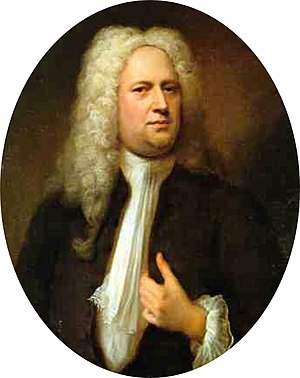
George Frideric Handel (Feb 23, 1685 - Apr 14, 1759)

This article was written and submitted as a guest-post by Andy Efting (Unsearchable Riches).

George Frideric Handel was born February 23, 1685 and lived for 74 years, dying in 1759. His contemporaries included such notables at George Whitefield (1714-1770), Jonathan Edwards (1703-1758); John Wesley (1702-1791); Ben Franklin (1706-1790), and J.S. Bach (1685-1750). These are just a few of the names that could be mentioned from this time period. It is amazing to think of the notable figures in theology, politics, and music that all lived in that same era and still influence us today.

Handel, of course, was a musician and of his music, Beethoven once declared, “Handel is the greatest composer who ever lived. I would bare my head and kneel at his grave.” While probably referring to his entire body of work, for most of us, George Frideric Handel is synonymous with one major work and that is his great sacred oratorio, Messiah.

Handel composed Messiah in 1741 and performed it for the first time in Dublin, Ireland in 1742 as a charity benefit. As was his standard practice, Handel worked very quickly, finishing the entire score in less than a month. This haste did not sit well with Charles Jennens, who supplied Handel with the libretto (or text). He wrote, "His Messiah has disappointed me, being set in great hast, tho' he said he would be a year about it, & make it the best of all his Compositions. I shall put no more Sacred Works into his hands, to be thus abus'd."[1]

I don’t know what this comment says about the standards of musical composition back in Handel’s day, but Jennens eventually warmed to the final product, as least somewhat, as evidenced by a note he wrote a few years after its premiere,

"I shall show you a collection I gave Handel, call'd Messiah, which I value highly, & he has made a fine Entertainment of it, tho' not near so good as he might & ought to have done. I have with great difficulty made him correct some of the grossest faults in the composition, but he retain'd his Overture obstinately, in which there are some passages far unworthy of Handel, but much more unworthy of the Messiah."

This quote reveals one of the problems Handel faced with his most famous piece. There was wide-spread resistance to using a sacred subject as the source for entertainment. As Handel biographer Hamish Swanton wrote, “Everyone was nervous of New Testament words being further reduced in authority by being sung in a theatre by singers of doubtful reputations among decent folk.”[2]

This reservation may have been one reason for performing the premiere in Dublin rather than London. Evidently, that same reticence did not exist in Ireland. In fact, over 700 were expected for its first performance. Due to the expected crowd, and quite humorously to us today, ladies were advised not to wear hoop dresses and the gentlemen were asked to leave their swords at home. The London premiere occurred a year later in 1743, its legitimacy still not accepted by all parties.

Today, of course, all such reservations have been largely, if not completely, overcome. For those of us who love God’s Word, its prophetic emphasis in the Old Testament of God’s plan of redemption through the Messiah, and Christ’s triumph over sin by the resurrection, there could hardly be a more thrilling piece of music. In fact, I dare say that those familiar with Handel’s Messiah cannot read Isaiah 40 without hearing the soothing tenor accompagnato and aria that begins his oratorio, or Isaiah 9 without hearing Handel’s rousing chorus, or many other passages without hearing them come alive in one’s mind through Handel’s music. The crime today is that most performances only include the so-called Christmas portion.

While Handel’s Messiah is most well-known, it is not his only oratorio dealing with sacred subject matter. While none measure up to Messiah, several are quite excellent, including his Solomon, Belshazzar, Israel in Egypt, and the historical Judas Maccabaeus (from which we get the tune for the hymn, Thine Be the Glory). Others worth mentioning are Jephtha, Esther, Joshua, Saul, Deborah, Joseph and his Brethren, and Samson. Most online CD stores allow you to listen to samples before you buy. For those not familiar with these works, it may be a profitable exercise to sample some of these less-known pieces.

Recommend CD’s:

On the Web:


[1] http://gfhandel.org/chron3.htm, accessed 18 Feb 2008.

[2] Hamish Swanston as cited by David Daniell in his The Bible English, pp. 569-70.


Share/Bookmark