Showing posts with label Puritans. Show all posts

Monday, December 21, 2009

Good Deals on Used Puritan and Reformed Books


Reformation Heritage Books is advertising a huge sale on used and out-of-print Puritan and Reformed books. These books are available on a first come, first served basis. The list of books is extensive and includes such rarities as Joseph Caryl's 12-volume exposition of Job and Daniel Neal's 3-volume History of the Puritans. Order by email or phone. See their blog for details.


UPDATE: Reformation Heritage Books says, "We are SOLD OUT of the Books listed on used Puritan and Reformed (many out of print) books."
Share/Bookmark

Friday, November 28, 2008

Thankful for God’s Providence


As we reflect on God’s goodness to us over the past year, let’s take a longer look back to the Mayflower Pilgrims that we may be able to look ahead. The Pilgrims left England, spent time in Holland, and then came to the New World in pursuit of freedom to worship God according to Scripture and conscience. Arriving late in the year put them at a disadvantage; winter was upon them. The winter of 1620-21 saw the deaths of half their number from starvation and disease. The survivors buried their dead in unmarked graves to conceal their losses from the Indians.

At winter’s end sprung signs of hope. David Beale gives an interesting account in his book, The Mayflower Pilgrims (Greenville, SC: Ambassador-Emerald International, 2000).

Those who were fortunate enough to have garden seed proceeded to plant it on March 17. There was a desperate need for green vegetables, the lack of which probably caused most of the sickness, which was a type of scurvy. Captain [Miles] Standish called another meting on March 26 to discuss military strategy. Suddenly, Chief Samoset walked right into Plymouth, speaking English. He was an Algonquin and had learned English from various fishing captains. The story he told gave the Pilgrims cause to thank God once again for His Providence. According to Samoset, this area had been the territory of the Patuxets, a large hostile tribe that killed every white man who landed on these shores. Less than four years prior to the Pilgrims’ landing, a mysterious plague had devastated the tribe. Convinced that some great spirit had destroyed the Patuxets, neighboring tribes had shunned the entire area. So the cleared land on which the Pilgrims had settled apparently belonged to no one. Their nearest neighbors, explained Samoset, were the Wampanoags, some fifty miles to the southwest. These Indians numbered about sixty warriors and Massasoit, their chief, also ruled over several other tribes. (p. 139)

God provided the Pilgrims another blessing through neighboring Indians. On his next visit Samoset brought a Patuxet named Squanto, an English-speaking Indian who was to become “a special instrument sent of God for their good, beyond their expectation” (Beale, p. 140). Having escaped the plague that destroyed his tribe, Squanto had lived with the Wampanoags until coming to Plymouth Colony, where he spent the rest of his days teaching the colonists how to hunt, fish, and plant. “Without Squanto’s help, the Pilgrims would have suffered even more severely over the next year” (Beale, p. 140). Through the mediation of Squanto and Samoset a peace treaty was struck between the Pilgrims and chief Massasoit. In October or November of 1621 the Pilgrims hosted the Indians in the first ever American Thanksgiving, three days of feasting, playing games, and thanking God.

In spite of heavy losses the first year the colony survived and grew to about three hundred after a decade in the New World. Looking back, Governor William Bradford observed, “Thus out of small beginnings greater things have been produced by His hand that made all things of nothing, and gives being to all things that are; and as one small candle may light a thousand, so the light here kindled hath shone to many, yea in some sort to our whole nation; let the glorious name of Jehovah have all the praise” (quoted in Eerdmans’ Handbook to Christianity in America, p. 29).

These people suffered severely because they had a conscience for God and acted on their convictions. Out of 103 persons that survived the voyage, half died the first winter. How could they be thankful instead of bitter or at least disappointed? Answer: They saw God’s hand in all that happened to them. They were students of two books, the Word of God (Scripture) and the work of God (providence). They looked back and took note of mercies along the way. They looked around and saw evidence of their growing influence on others. They believed God would not abandon His work in the future. What kept the Pilgrims grounded during difficult times? Their perspective and priorities were right. Their aim—the glory of God. Their outlook—“here by thy great help I’ve come.”

God’s pilgrims progress the same way in the 21st Century. Instead of looking for their best life now they expect hardships. “Through many tribulations we must enter the kingdom of God” (Acts 14:22). They know that suffering isn’t inconsistent with the teaching of the Bible.

God’s pilgrims also know that suffering isn’t permanent. The hard times are only temporary, like school days, and “we know that we at the end, shall life inherit.”

In the meantime we can count on God to honor His Word and prosper His work, supplying our needs and gladdening our hearts as we humbly trust in Him and submit ourselves to Him.

We still hear and tell the story of that first Thanksgiving. Who knows? Maybe someday people will talk about the faith we once displayed against all odds. Maybe they will glorify God through us.

God moves in a mysterious way,

His wonders to perform;

He plants his footsteps in the sea,

And rides upon the storm.

Deep in unfathomable mines

Of never failing skill

He treasures up his bright designs,

And works his sovereign will.

Ye fearful saints fresh courage take,

The clouds ye so much dread

Are big with mercy, and shall break

In blessings on your head.

Judge not the LORD by feeble sense,

But trust him for his grace;

Behind a frowning providence,

He hides a smiling face.

His purposes will ripen fast,

Unfolding every hour;

The bud may have a bitter taste,

But sweet will be the flow'r.

Blind unbelief is sure to err,

And scan his work in vain;

GOD is his own interpreter,

And he will make it plain.

~William Cowper

from Olney Hymns


Share/Bookmark

Friday, June 6, 2008

The Nature of Public Worship: Priestly or Prophetic?

I’ve been Baptist all my life and have observed that the preaching of the Word is the focus of our public worship services, as in most other Protestant churches. The pulpit takes center stage. In sacramental assemblies, like Catholicism and much of Anglicanism, the focus of public worship is the Eucharist. The altar takes center stage.

Though this difference may sometimes be taken for granted by Protestants today, the prophetic position on worship wasn’t a given in the 17th Century, the age of the Puritans. The Puritans were the evangelical wing of the Church of England. They came into being because of a desire to rid the Church of the unscriptural vestiges of Catholicism, to complete the English Reformation.

Through their voluminous writings the Puritans developed a doctrine of preaching the Word of God. They also developed a doctrine of hearing the Word of God. Together these aspects of a church service form the Puritan conception of public worship. In his book The Genius of Puritanism Peter Lewis states that

the tension between the Anglican and Puritan modes and ideals of worship arose largely from the difference between the Anglican conception of public worship as fundamentally a priestly act, and the Puritan idea of it as fundamentally a prophetic one. To the Puritan mind the priestly element in worship rested on the two great truths of Christ’s perpetual High Priesthood and the consequent priesthood of all believers. Thus, any mediation of grace through the minister was not through any supposed priestly act of his, but through the Word of Christ spoken by him in the Spirit of Christ to the people of Christ. In public worship, therefore, the Puritan conceived of the prophetic element as the grand climactic and dominating factor.

Peter Lewis, The Genius of Puritanism (Carey Publications Limited, 1979), p. 53.

I found it interesting that the Puritans had to hammer out this conception of worship that I frequently take for granted, as though this position had always been the norm in churches. It had to be fought for. Today it seems that some professing evangelicals are flirting with sacramentalism and focusing less on the preached Word. Could it be partly because some preachers have seemingly lost the conception of the momentous event that is taking place when a man of God stands before a congregation and opens the Word of God?

Just like it was in the Puritans’ day, our society will be most impacted by ministers and listeners who view the sermon as “the climax of public worship…the principal mediating instrument of the power of God unto salvation and sanctification” (Lewis, p. 53).

______________________

Recommended reading:

Peter Lewis, The Genius of Puritanism (paperback, 144 pages - reprinted by Soli Deo Gloria)

Using abundant quotes from the Puritans, Lewis provides a valuable introduction, emphasizing “the preaching and pastoral activities of those remarkable men of the 17th Century” (from the Foreword by Martyn Lloyd-Jones, p. 5). Available from Reformation Heritage Books ($11.00) and Amazon ($11.00).

D. Martyn Lloyd-Jones, Preaching and Preachers (Zondervan, hardback, 325 pages)

This is not a book on homiletics; it is essentially a theology of preaching and should be required reading for every ministerial student. Very helpful.


Share/Bookmark

Saturday, April 19, 2008

Richard Baxter’s Call to the Unconverted

Our use of gospel tracts and pamphlets can possibly be traced to the Puritans, some of whom produced small, easy-to-carry books urging sinners to turn to Christ. In his book A Quest for Godliness J.I. Packer says that “it was the Puritans who invented evangelistic literature. One has only to think here of Richard Baxter’s Call to the Unconverted, and Joseph Alleine’s Alarm to the Unconverted, both of them outstanding pioneer works in this class of writing” (pp. 291-292).

Gary Brady at Heavenly Worldliness is doing a series of posts on Baxter’s Call. This is worth checking out to learn something about the man and the influential little book credited with usefulness in the conversion of thousands.

On Baxter’s Call Part 01

On Baxter’s Call Part 02

On Baxter’s Call Part 03

On Baxter’s Call Part 04

—————————————————————

Baxter’s Call to the Unconverted available from:

Amazon (If you have a Kindle, they have a Kindle edition for download)

Cumberland Valley (Invitation to Live by John Blanchard, a modern presentation of Baxter’s book)


Share/Bookmark

Saturday, March 29, 2008

Samuel Rutherford Answers the Divine Summons (March 29, 1661)

When the English monarchy was restored in 1660, King Charles II betrayed the Scottish Presbyterians who had supported him and had crowned him as their king in 1651. All those years Charles had hated Reformation principles, and at the Restoration he began his efforts to turn England and Scotland back to pre-Reformation times. A tidal wave of suffering was about to break over the land for those who didn’t conform to the king’s religious and governmental principles. One of the first nonconformists to receive the king’s attention was Samuel Rutherford, who in early 1661 lay dying at the college at St. Andrews, where he was professor of divinity.

Rutherford (1600–1661) had worked for decades to ensure the continuance of the Reformation in England and Scotland. He was well-known in his own time as a faithful pastor, author, professor, and member of the Westminster Assembly of Divines. The letters he wrote to friends throughout his public ministry and, especially, during his exile in Aberdeen form the legacy by which he is mainly known today. Such a leader Charles II summoned to appear before him for high treason.

Rutherford’s response and Parliament’s reaction are reported by John Howie in his book The Scots Worthies:

It is commonly said that, when the summons came, he spoke out of his bed and said, “Tell them I have got a summons already before a superior Judge and judicatory, and I behove to answer my first summons, and ere your day come I will be where few kings and great folks come.” When they returned and told he was a-dying, the parliament was put to a vote, whether or not to let him die in the college. It was carried, “put him out,” only a few dissenting. My Lord Burleigh said, “Ye have voted that honest man out of the college, but ye cannot vote him out of heaven.” Some said, He would never win there, hell was too good for him. Burleigh said, “I wish I were as sure of heaven as he is, I would think myself happy to get a grip of his sleeve to haul me in.”

(John Howie, The Scots Worthies. Edinburgh: Banner of Truth, 2001. p. 236)

The Lord spared Rutherford from seeing all the horror that was about to descend upon England and Scotland. But he “lived to see all he had striven for over thirty years crumbling before his eyes…. [T]he Drunken Parliament of 1661, as it was called, gleefully rescinded each act on the statute book that safeguarded Reformation principles” (Faith Cook, Samuel Rutherford and His Friends. Banner of Truth, 1992. p. 28).

With so much seemingly going against him, Rutherford was not gloomy, but rather joyful, in answering his “first summons.” Those gathered around his deathbed heard him say many things about Christ, as though he were already in Heaven with his Lord. He was not glorying in work accomplished or grieving over work undone by the government; He was glorying in Jesus Christ and in Him alone. His friends and daughter Agnes heard him utter memorable statements of a long-held faith. When asked by one, “What think ye now of Christ?” he replied,

“I shall live and adore Him. Glory! Glory to my Creator and my Redeemer for ever!” …. Oh! That all my brethren in the land may know what a Master I have served, and what peace I have this day. I shall sleep in Christ, and when I awake I shall be satisfied with His likeness. This night shall close the door, and put my anchor within the vail; and I shall go away in a sleep by five of the clock in the morning…. Oh! For arms to embrace Him! Oh! For a well-tuned harp!” (Howie, The Scots Worthies, p. 239)

By 5:00 on the morning of March 29, 1661 Samuel Rutherford had answered the divine summons, “Come up hither.” His last words were, “Glory, glory dwelleth in Immanuel’s land.”

About 200 years later many of Rutherford’s sayings were memorialized in a lengthy poem by Anne Ross Cousin, “The Sands of Time Are Sinking.” Mrs. Cousin was the wife of a Scottish Presbyterian minister. She was inspired by Rutherford’s biography and wrote 19 stanzas, only a few of which appear in most hymnals. Reading the entire poem is like glimpsing into the heart of Samuel Rutherford and seeing his devotion to the Lord and his outlook on life. The last stanza relates Rutherford’s reply to those sent to summon him.

They’ve summoned me before them, but there I may not come,

My Lord says “Come up hither,” My Lord says “Welcome home!”

My King, at His white throne, my presence doth command

Where glory—glory dwelleth in Immanuel’s land.

———————————————

For further reading:

Letters of Samuel Rutherford (Bonar edition. Banner of Truth, 2006). 365 letters prefaced by Andrew Bonar's biographical sketch of Rutherford.

Alexander Smellie, Men of the Covenant (Banner of Truth, 1962 reprint). An account of the Scottish Covenanters of the 17th Century.

Faith Cook, Samuel Rutherford and His Friends (Banner of Truth, 1992). Biographical vignettes that show the man and his ministry to people through his letters.

Faith Cook, Grace in Winter: Rutherford in Verse (Banner of Truth, 1989). Poetic forms of some of Rutherford’s best letters.

John Howie, The Scots Worthies (Banner of Truth, 2001). Biographical vignettes of the Scottish Covenanters.


Share/Bookmark

Friday, August 31, 2007

Pilgrim Enters the Celestial City

On August 31, 1688 John Bunyan (b. 1628) went to be with the Lord. He died peacefully and triumphantly in bed, surrounded by close friends. Much can be said about Bunyan, but I plan to explore other aspects of his life in future posts. On this anniversary of his passing into the presence of God, I want to emphasize what is probably his greatest legacy. He was a great preacher and author, a godly husband and father, and a humble servant of Christ. He left many good books of sermons and poetry. But John Bunyan is best remembered today for being the author of The Pilgrim’s Progress.

This beloved book, which Bunyan completed while imprisoned for preaching, has been translated into over 100 languages and has been constantly in print since it was published in 1678. It is an allegory of the Christian life from start to finish. It is theology in story form. In many ways it is also autobiographical of Bunyan.

The Pilgrim’s Progress contains such vivid imagery that Bunyan still influences our thinking about many things in life. For instance, sinners under conviction of sin are still sometimes said to be in “the slough of despond.” The phrase “Vanity Fair” is still in common use and still means pretty much what it meant in Bunyan’s day. But perhaps the most common picture from Pilgrim’s Progress is that of Christian and Hopeful “crossing the river” into the Celestial City.

For Bunyan, death was like crossing a bridgeless river, which was deeper or shallower, raging or placid according to the measure of one’s faith. With Christian and Hopeful crossing together, Bunyan gives us a picture of two possible experiences of believers facing death. Christian, the older man in the story, experiences trouble and torment at first. He immediately begins to sink in deep water and fears he is forsaken and will never see the desired City. He remembers sins he committed before and after his conversion to Christ. In addition, he is hounded by apparitions of demons coming to claim his soul.

Hopeful has less trouble than Christian and quickly finds firm ground under the water to hold him up. He keeps his companion afloat and encourages him with Scripture until the light of God’s Word breaks upon Christian’s troubled soul. Then Christian feels the bottom and they both pass over safely and are received by the Shining Ones awaiting them.

So, what was Bunyan’s experience when he received his summons to cross the river? He was stricken with a severe fever while traveling to London and was taken in by a friend for rest. Here are a few quotes from John Bunyan: A Story of His Life by Frank Mott Harrison (p. 196).

The weather has cleared. It is now fine again, and brilliant sunshine floods the dying man’s room, bathing his pale, drooping face with its warmth. He signs to those near not to exclude the light: it is to him the reflection of the Celestial City towards which he is swiftly journeying; and he sees the shining ones waiting to meet him; he sees too the ‘trumpeters clothed in white raiment, who with melodious noises and loud’ make ‘even the Heavens echo with their sound.’ He sees the gates opening to let him in; he hears the celestial choir sing ‘Holy, holy, holy is the Lord’; and ‘he wishes himself among them’.

Presently, John Bunyan awakes from a short, sweet slumber. He looks at each of his friends. They draw near and kneel around his bed. They ask what can be done for him? ‘Brothers,’ he says, in a soft, mellow tone, “I desire nothing more than to be with Christ, which is far better.’

He releases his hands from those who lovingly hold them—as though loosing the last moorings which bind him to earth—and his fair locks, tinged with grey, fall around his head as he raises it from the pillow; his bright, blue eyes sparkle in the sunlight, his cheeks recover their wonted ruddy hue, and with outstretched arms he cries with the shout of the Victor:

TAKE ME, FOR I COME TO THEE!

Thus passes in triumph the soul of JOHN BUNYAN.

May my end be like his, full of triumphant faith; even more, may my life here be like his, characterized by diligent study of God’s Word and faithfulness to it.

Frank Mott Harrison’s biography is a very good, relatively brief account of Bunyan’s life. It is a 213-page paperback from Banner of Truth. It is written on a level that any Christian, minister or layman, can enjoy.

By all means, read up on Bunyan, and read Pilgrim’s Progress. If you’re a true believer in Christ, don’t be afraid to contemplate death. You’re not being gloomy; you’re anticipating the bright, eternal day when we will join Bunyan and countless others at the side of our blessed Lord. We get only one shot at crossing the river. Let’s do it well.


Share/Bookmark

Friday, August 24, 2007

The Great Ejection (August 24, 1662)

On this day in 1662 England’s Act of Uniformity was enforced, resulting in the ejection of 2000 nonconformist ministers from their livelihoods. With the restoration of the monarchy in 1660, King Charles II began working to restore Anglican supremacy in English and Scottish churches. He betrayed the Presbyterians who had helped him return from exile in France, refusing to grant religious toleration and trying to force all ministers to worship in the Anglican way. Those who refused were forced out of their ministries and were eventually forbidden to come within five miles of an incorporated town. They were not allowed to hold public services, hold public office, or obtain degrees from Cambridge or Oxford. These ministers and their families suffered hardship as good soldiers of Jesus Christ for their good conscience toward God. They could not be bribed or threatened into conformity with practices they considered unscriptural.

In 1962 Martyn Lloyd-Jones gave an address at Westminster Chapel’s Puritan Conference to commemorate the tercentennial of this event. You can read that address in his book, The Puritans: Their Origins and Successors. It is the chapter titled, “Puritan Perplexities—Some Lessons from 1640-1662.” Lloyd-Jones considered the Great Ejection a watershed event on an almost equal footing with the Reformation itself. I would like to give a summary of his points as to the causes of this tragedy and its lessons.

CAUSES

The mixing of politics and religion. From the time of the English Reformation many prominent Anglicans also held public office and had influence with the King, like the hated Archbishop Laud. The Puritans had grievances with Laud and his party, and so did others whose motives were not motivated by religion as were the Puritans’. These disenfranchised parties banded together in an unscriptural alliance to fight a common enemy. “To mix politics with religion in the church is always a danger” (Lloyd-Jones, p. 61).

Divisions among the Puritans. “This is what makes the story a real tragedy. Fundamentally these men were all agreed about doctrine” (Lloyd-Jones, p. 61). But they had endless disagreements over other matters, especially church government. Among the various groups of Puritans, Lloyd-Jones faulted the Presbyterians the most for this divisive spirit because “they were the most intransigent” (p. 62). Ironically, the Presbyterians “were always ready to make agreements with the king,” but they tended to fight those with whom they were in agreement on the essential matters of the Christian faith.

The idea of a State-Church. “The Presbyterians believed in a State Church quite as much as the Anglicans” (p. 63). They inherited this position and continued to fight for their version of it rather than inquiring what the New Testament said about the nature of the church as it relates to the government. “The Presbyterians believed, quite as much as the Anglicans, that people should be compelled by Act of Parliament and the power of the State to submit to their particular view of the Church” (p. 65). While other groups simply wanted toleration to worship freely, the Anglicans and Presbyterians were fighting for supremacy, and the Anglicans won in 1662.

LESSONS

The thing of supreme importance is “the gospel of salvation which is also ‘the gospel of the glory of God’” (p. 67). That is what all believers are agreed upon—a right view of the gospel.

“Coupled with that, there was their emphasis upon the necessity of having able and good ministers, and the primacy and the centrality of preaching” (pp. 67-68).

Our view of the church should be in line with the New Testament. How should doctrine and practice be determined? Our faith should stand squarely on the Scriptures.

Our divisions should be over the fundamental things of the faith, not things of lesser importance. That’s been a hot one for the last sixty years. Lloyd-Jones is arguing against a divisive spirit that won’t budge on non-essential matters. But to the intransigent there are no “non-essential” matters. Everything is seen in black and white; anything else is compromise.

We must fight this battle “in a spiritual manner, and not with carnal weapons” (p. 70). Many Presbyterians actually allied themselves with those who hated everything they stood for to gain political advantage. Some Puritans, like John Owen, stood against such carnality, and so should we. If we view party success as more important than the glory of God and the purity of the Church, “our cause is already lost” (p. 71).

“The ultimate lesson to be learned from this period is this: ‘The arm of flesh will fail you, ye dare not trust your own’” (p. 72). “If we see what the Truth is, well then, I say, we must hold to it and fight for it, and to refuse to compromise about it, whatever it may cost us” (p. 72).

I highly recommend The Puritans: Their Origins and Successors by Martyn Lloyd-Jones. [CBD $25.99| WTS $18.20 | Amazon $21.27]

I’ll close the way Lloyd-Jones closed his address: “We thank God for the memory of these men, who, having seen the position clearly, acted upon it at all costs. May God give us grace to follow in their train!”


Share/Bookmark

Thursday, July 26, 2007

Super Bargains at P&R Publishers

Each week P&R Publishers sends out a list of a handful of titles that they have discounted. Today's list includes a book that I would like to recommend to you.

Anne Bradstreet

A Guided Tour of the Life and Thought of a Puritan Poet
by Heidi L. Nichols
Copies Available: 11
Super Discount Price: $2.80
Compare with prices here: CBD, Amazon, RHP

This is a delightful and informative guide not only to the file and writings of Anne Bradstreet, but also to the Puritans, especially the New England Puritans. I've written a review of this book here.

Here is the link to P&R's list of discounted titles.


Share/Bookmark

Sunday, July 1, 2007

Westminster Assembly Convenes

On July 1, 1643 the Westminster Assembly convened for the first time in the Henry VII Chapel of Westminster Abbey in London. According to Wikipedia the Assembly “was appointed by the Long Parliament to restructure the Church of England.” It consisted of 10 Lords, 20 Commoners, and 121 “Divines” of the Anglican Church. Some of these men were from the Puritan wing of the Church, who wanted to carry on the work of the Reformation in the Church and purify it from the remnants of Catholicism. The Assembly also called on the Scottish Presbyterians, who sent 6 representatives including George Gillespie, Robert Baillie, and Samuel Rutherford.

Though never able to agree on a form of church government, the Assembly produced some important and influential documents: the Longer and Shorter catechisms and the Westminster Confession of Faith. These documents have been accepted by many and adapted by others as standards for faith and practice. The Anglicans adopted these documents only after revisions, but “they formed the cornerstone of the Presbyterian Church and other reformed churches as they established themselves throughout Europe and America” (Wikipedia).

The work of the Westminster Divines represents men of different persuasions trying to hammer out a scriptural position during times of trouble. England was locked in civil war during the 1640s between Parliament and those loyal to King Charles I. War ended with the king being executed, his son Charles II exiled, and the monarchy abolished. The few years of relative peace and religious tolerance following saw many Puritan books produced, many of which are reprinted today. When Charles II and his supporters restored the monarchy in 1660, religious persecution was the order of the day; and men like Rutherford, Thomas Watson, and others were marked men. Their ministries were limited and difficult. Yet the work they did in the 1640s remained, and still does.

The catechisms and the Confession are in print today, along with expositions based on them. A good exposition of the Westminster Shorter Catechism is Thomas Watson’s A Body of Divinity published by Banner of Truth. Whether or not you read these documents, it’s likely that your statement of faith was at least influenced by them. Today is a good opportunity to be thankful to the Lord for using men in all ages to meticulously study and clearly express the great doctrines of the faith.


Share/Bookmark

Friday, June 29, 2007

Building a Puritan Library

Monergism has an interesting strategy for building a Puritan library in three years. They also provide information on obtaining some of these books at a discount through July 31. If you're looking for guidance on solid expositional works by the Puritans, check it out.
Share/Bookmark

Friday, June 8, 2007

Reading to Counter Your Moods

Martyn Lloyd-Jones’ doctor’s degree wasn’t a ministerial one. Before he entered the ministry he was a medical doctor, assistant to Lord Horder, physician to the Queen. That is why throughout his ministry he was known affectionately as “the Doctor.” Lloyd-Jones always held doctors in high esteem and kept abreast of the latest developments in medicine. He was knowledgeable of mental and emotional ailments as well as physical ones, so he recognized the complexity of the human psyche and learned how to handle it. His medical skills were called upon frequently during his first pastorate in a depressed area of South Wales. For an interesting and humorous story of his diagnosing and “treating” a former nursing student, see Vol. 1 of the biography by Iain Murray, pp. 260-261.

This is the third in a series of posts on Lloyd-Jones on Ministerial Reading. From the chapter, “The Preparation of the Preacher,” in his book, Preaching and Preachers, he counsels ministers concerning general reading practices in preparation for the pulpit. Having advised on Scripture reading habits, he turns to the reading of books. In the first place, a minister should read books that will “help you in general to understand and enjoy the Scriptures” (p. 174). Lloyd-Jones’ first pick in this category is Puritan literature. Why? In addition to the Bible knowledge they give you, the Puritans do something for you internally.

It is most important that the preacher should know not only himself in general but also his particular moods and states and conditions. The preacher should never be moody; but he will have varying moods. No man can tell what he will feel like tomorrow morning; you do not control that. Our business is to do something about these changing moods and not to allow ourselves to become victims of them. You are not exactly the same two days running, and you have to treat yourself according to your varying conditions. So you will have to discover what is the most appropriate reading for yourself in these varying states (p. 175).

He testifies that the Puritans are “almost invariably helpful” and specifically commends Richard Sibbes for helping him when he was overworked and “subject in an unusual manner to the onslaughts of the devil.” Through reading the Puritans, especially Sibbes, the Doctor received tender treatment for his soul. Just what the Doctor needed! Sibbes’ books The Bruised Reed and The Soul’s Conflict “quietened, soothed, comforted, encouraged and healed me” (p. 175).

Lloyd-Jones also counsels the reading of sermons to counter your changing moods. Here Jonathan Edwards was a great help to him, “not only his sermons, but also his account of that Great Awakening, that great religious Revival that took place in America in the eighteenth century, and his great The Religious Affections” (p. 176). The Doctor prescribes older sermons for real help and seems to avoid most Twentieth Century ones. While I see his point I would like to recommend some more recent sermons too; namely, Lloyd-Jones’. I could do a whole post on how his sermons have helped me at some crucial times. Check out his Romans and Ephesians series; his Studies in the Sermon on the Mount and Spiritual Depression. And these are his older printed series. New ones continue to be published.

I’m sure we all at some time have turned to trusted books to help us through a dark valley. We probably did so out of instinct or some experience. We just believed a certain book or author would help. What if we learned to do this by habit? Instead of sitting around discouraged or agitated we would routinely point our troubled minds in the direction of help, trusting the Lord to bless godly counsel to our souls. Changing moods and conditions are a part of life, especially for believers. And leaders of Christians are special targets of the devil. “There are these states and conditions of the soul, and the sooner you learn how to deal with them, and how to handle them, the better it will be for you and for the people to whom you preach” (p. 176).


Share/Bookmark

Friday, May 11, 2007

"Holy Violence"

According to Thomas Watson, “holy violence” is what a believer needs to offer to himself in his pursuit after glory. In his book, Heaven Taken by Storm, the puritan preacher expounds Matthew 11:12, “And from the days of John the Baptist until now the kingdom of heaven suffereth violence, and the violent take it by force.” He pictures the Christian life as a conquest of Heaven, which must be pressed into because of enemies that stand in our way. On his first missionary journey the apostle Paul told believers, “We must through much tribulation enter into the kingdom of God” (Acts 14:22). This was after Paul had been stoned and left for dead. Difficulties should not deter the true believer from his pursuit. Watson knew this concept in his own personal experience. He was one of the 2000 ministers ejected from his pulpit for nonconformity in 1662. Heaven Taken by Storm was published in 1669 after years of deprivation and persecution.

But external enemies are not the believer’s only hindrance. We have an enemy within called “the flesh” that seeks to turn us toward sin and away from glory. Concerning this traitor within Watson says, “There needs no wind to blow to sin when this tide within is so strong to carry us thither.” Going against this current within is like the salmon swimming upstream. Only we put forth this effort, not to die like the salmon, but to live eternally. As the writer to the Hebrews indicates, “striving against sin” is called for in the life of faith (Heb. 12:4). This line of biblical truth is notoriously “missing in action” in many of today’s books and sermons. Watson’s wise counsel is still timely after more than three hundred years: “The exercises of the worship of God are contrary to nature; therefore there must be a provoking of ourselves to them. The movement of the soul towards sin is natural, but its movement towards heaven is violent.”

I heartily recommend this worthy volume by Thomas Watson. It was reprinted in 1992 by Soli Deo Gloria Publications, but it seems to be out of print now. However, used copies are available through online resources like Amazon and AbeBooks. A digital copy of the book is available here.
Share/Bookmark

Friday, February 16, 2007

Anne Bradstreet, by Heidi L. Nichols

Anne Bradstreet: A Guided Tour of the Life and Thought of a Puritan Poet. By Heidi L. Nichols (Phillipsburg, PA: P & R Publishing, 2006), 210pp. $14.00


Heidi L. Nichos (M.A. Villanova Universitty, Ph.D. Indiana
University of Pennsylvania) is assistant professor of English at Lancaster Bible
College. She is the author of The Fashioning of Middle-Class America:
Sartain's Union Magazine of Literature and Art and Antebellum
America.
A few months ago I was preparing a series of lesson to be taught to our youth group which included introductory matter about the Puritans, as well as some biographical information of a few notable persons, when the thought crossed my mind that I didn’t know of any female, Puritan personalities to introduce to our teen girl (we have an extremely small youth group at this point). After some diligent research I discovered that there is, in fact, at least one female Puritan with whom we can become acquainted. If you think about it, the reason we know about most of the Puritans is because we have their writings. Anne Bradstreet, a female Puritan, was also a writer. Because she wrote so much, and because her brother-in-law secreted some of her writings to London and had them published, we now have a marvelous glimpse into the life of a female Puritan.

There are a number of scholars who have studied the intricacies of Bradstreet’s works, devising all sorts of conclusions about her view of femininity. Bradstreet, for sure, has been a favorite of man feminists who laud her as a cover girl for their ideas.

Heidi L. Nichols, being well versed in all of this scholarship, has provided for conservative Christianity a delightful “guided tour of the life and thought” of Anne Bradstreet. And as an able tour guide, Nichols carefully fills out the storyline with pertinent background information on the times in both Old England and New England. She even includes many portraits of key persons and images of the title pages of the key editions of Bradstreet’s works.

Part 2 of this book is a collection of Selected Works with explanatory introductions. Included in this section is a chronology of Anne Bradstreet and Her Times.

A thorough bibliography, notes About the Illustrations, and Index of Persons, and an Index of Bradstreet’s Works are all provided at the end of the book.

“Why should you read Anne Bradstreet?” is the question with which Heidi Nichols begins this book. This is the question I had when I found her name and realized that she was a Puritan writer. Nichols answers this question by noting that “Bradstreet’s life and work, revealing her vibrant intellectualism and her outspoken love for her husband, challenge stereotypes many still have of the Puritans. And, as an orthodox Puritan, Bradstreet adds another dimension to the study of women in church history” (13).

“Why wouldn’t we want to read Anne Bradstreet,” asks Nichols, “or anyone else for that matter, who reminds us that in spite of our twenty-first-century context, we face the same realities of life—of mortality, of redemption, and of the role of grace? Perhaps Bradstreet’s probing and self-reflection in light of these, a characteristically Puritan discipline, will inspire us toward the same, whether through literature or otherwise” (15). I must say that I have been inspired toward the same after taking this guided tour through the life and writings of Anne Bradstreet. If you are unfamiliar with the life of Bradstreet or are looking for a place to begin your study of her life, this is the book to choose.

Share/Bookmark

Monday, November 6, 2006

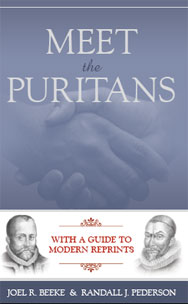
New Book - Meet the Puritans

I just saw this new title at Reformation Heritage Books. Looks fantastic. (Christmas is coming soon! - Hint, Hint).

Meet the Purtians, by Joel R. Beeke & Randall J. Pederson.
Retail Price: $35.00 RHB Price: $25.00
In Stock: Ships within 4-5 business days.
Format: Hardcover 935pp.
Publisher: Reformation Heritage Books
Pub Date: 2006
ISBN: 9781601780003

PURCHASE AT:
  1. Westmister Bookstore $24.50 (as of 3/22/07)
  2. Amazon $25.00 (as of 3/22/07)
UPDATE: Tony Rienke, over at The Shepherd's Scrapbook, has bestowed his own Shepherd's Scrapbook Book of the Year 2006 award on this book.
He is also facilitating a special discount on purchasing this book from RHP. Check it out

REVIEWS:
  1. Tim Challies at www.challies.com (reviewed on 3/22/07)
  2. Gary McCullough at www.puritanismtoday.wordpress.com (reviewed on 3/8/07)

Share/Bookmark

Jeremiah Burroughs - New Reprints from SDG

Here's an excellent book review on a recent reprint of some of Jeremiah Burrough's works >> The Shepherd's Scrapbook.

(Reviewed above)
The Gospel Life Series Six Volume Set
Published by Soli Deo Gloria Publications

Gospel Worship
Gospel Fear
Gospel Conversation
Gospel Revelation
Gospel Remission
Gospel Reconciliation

Other works:

Online resources:


Share/Bookmark

Thursday, November 2, 2006

Puritan Studies

I have been revisiting the Puritans this past month. I can't say that I'm an expert on the Puritans but I'm learning and studying up on them.
Here are a couple of sites that are helpful:
First,They also have a blog (The Puritan Board) that has a lively forum on books called the "Library".

I would recommend that you stop in and look around.

Also,

Also,


Share/Bookmark